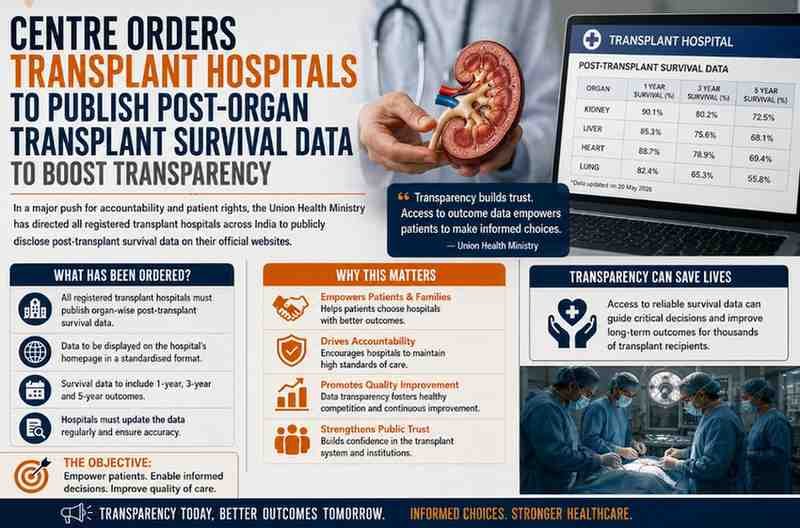
In a significant move to enhance accountability in India’s Healthcare system, the Centre has directed all registered organ transplant hospitals to publicly disclose their post-organ transplant survival data on the homepage of their official websites. The decision is expected to make critical performance information more accessible to patients and families considering life-saving transplant procedures.
Organ transplantation is among the most complex forms of medical treatment, involving extensive evaluation, highly specialized surgery, long-term follow-up care, and lifelong medication. By making survival outcomes publicly available, the government aims to promote greater transparency while empowering patients to make better-informed choices about where they receive treatment.
The directive also reflects a broader shift toward outcome-based healthcare, where hospitals are increasingly evaluated not only by the number of procedures they perform but also by the quality and long-term success of patient care.
What Has the Centre Directed?
Under the latest directive, registered transplant hospitals across the country have been instructed to prominently display post-organ transplant survival data on the home page of their respective websites.
The objective is to ensure that prospective patients, caregivers, and referring physicians can easily access key information regarding transplant outcomes without navigating through multiple sections of a hospital’s website.
Making such data publicly available is intended to improve transparency while encouraging hospitals to maintain consistently high standards of care.
Why Post-Transplant Survival Data Matters
Successful transplantation extends far beyond the operating room. A patient’s long-term survival depends on several factors, including surgical expertise, donor-recipient compatibility, infection control, intensive post-operative care, medication adherence, and regular follow-up.
Publishing survival outcomes provides valuable insight into how effectively hospitals manage the entire transplant journey rather than focusing solely on surgical procedures.
For patients facing complex treatment decisions, this information can become an important part of evaluating available healthcare options.
Understanding Organ Transplant Survival Rates
Post-transplant survival data generally refers to the proportion of patients who remain alive after receiving an organ transplant over defined periods such as one year, three years, or five years.
These statistics help assess overall treatment outcomes but should always be interpreted alongside other important factors, including:
- Patient age and overall health.
- Severity of underlying disease.
- Type of transplanted organ.
- Availability of suitable donors.
- Complexity of individual medical conditions.
- Quality of long-term follow-up care.
Outcome data therefore serves as one indicator of hospital performance rather than a complete measure of quality.
How Greater Transparency Benefits Patients
Public access to transplant outcome data allows patients and families to participate more actively in healthcare decisions.
Instead of relying solely on reputation or personal recommendations, individuals can review objective performance information when discussing treatment options with their healthcare providers.
This approach encourages informed decision-making while strengthening trust between hospitals and patients.
| Benefit | Impact on Patients |
|---|---|
| Greater transparency | Improves access to hospital performance information |
| Outcome-based evaluation | Supports informed treatment choices |
| Public accountability | Encourages continuous quality improvement |
| Standardized reporting | Enables easier comparison across institutions |
| Patient confidence | Strengthens trust in transplant services |
Why Outcomes Matter More Than Procedure Volumes
Hospitals are often recognized for performing a large number of transplant procedures. While experience is valuable, experts increasingly emphasize that long-term patient outcomes provide a more meaningful measure of healthcare quality.
High survival rates may reflect strong surgical expertise, effective infection prevention, coordinated multidisciplinary care, and comprehensive post-transplant monitoring.
Evaluating both procedural experience and patient outcomes offers a more complete picture of institutional performance.
The Complexity of Organ Transplant Care
Organ transplantation requires collaboration among numerous specialists.
Successful treatment typically involves:
- Transplant surgeons.
- Physicians and organ specialists.
- Anaesthesiologists.
- Critical care teams.
- Transplant coordinators.
- Nurses.
- Laboratory specialists.
- Rehabilitation professionals.
Long-term success depends on the effectiveness of this multidisciplinary approach before, during, and after surgery.
What Patients Should Consider Beyond Survival Statistics
Although survival data provides valuable insight, patients should avoid making decisions based solely on numerical outcomes.
Other important considerations include:
- Experience with specific organ transplants.
- Availability of specialized intensive care facilities.
- Access to long-term follow-up programs.
- Patient education and counselling services.
- Availability of emergency support.
- Coordination with referring physicians.
Comprehensive evaluation remains essential when selecting a transplant centre.
How Public Reporting Encourages Quality Improvement
Internationally, public reporting of healthcare outcomes has often encouraged hospitals to strengthen quality assurance systems, improve clinical protocols, and invest in patient safety initiatives.
When performance data becomes publicly visible, healthcare institutions may place greater emphasis on continuous monitoring, infection prevention, staff training, and long-term patient follow-up.
Ultimately, transparency can drive improvements that benefit future patients.
| Traditional Approach | Outcome-Based Healthcare |
|---|---|
| Focus on procedure numbers | Focus on patient outcomes |
| Limited public information | Greater transparency |
| Hospital reputation | Evidence-based performance |
| Internal quality assessment | Public accountability |
| Patient trust through experience | Patient trust through measurable results |
The Bigger Picture: A Shift Towards Transparent Healthcare
The Centre’s directive reflects a broader movement toward transparency and accountability within India’s healthcare system. As patients become increasingly informed and digitally connected, access to reliable performance information is becoming an important component of quality healthcare.
Public disclosure of transplant outcomes also aligns with the growing emphasis on patient-centred care, where individuals actively participate in medical decision-making using accurate and accessible information.
Over time, similar outcome-based reporting could become more common across other specialized medical services, further strengthening quality improvement throughout the healthcare sector.
Conclusion
By directing registered transplant hospitals to publish post-organ transplant survival data prominently on their websites, the Centre has taken an important step toward improving transparency, accountability, and patient empowerment. The initiative enables patients and families to access meaningful information about long-term transplant outcomes while encouraging hospitals to continuously enhance the quality of care they provide.
Although survival statistics should always be interpreted within the broader clinical context, making such data publicly available represents progress toward a healthcare system where informed decision-making, measurable performance, and patient trust work together to improve outcomes.
As organ transplantation continues to evolve, greater transparency may not only strengthen confidence in transplant programmes but also contribute to higher standards of care for patients across India.
For breaking news and live news updates, like us on Facebook or follow us on Twitter and Instagram. Read more on Latest Health on thefoxdaily.com.






COMMENTS 0