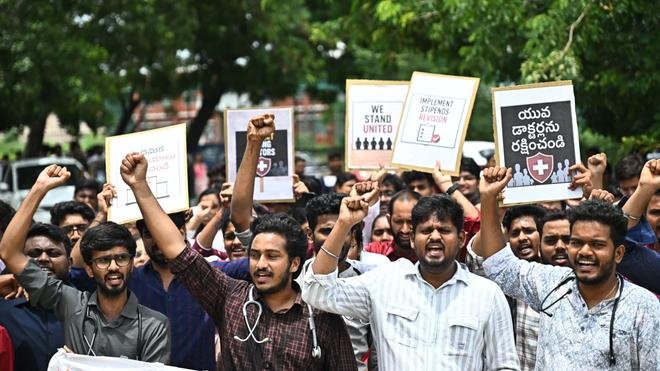
A long-pending stipend revision has escalated into a statewide agitation involving nearly 9,000 junior doctors, with emergency services being boycotted from August 17. Here is what is behind the protest, what the government is offering and why the dispute matters for patients.
Introduction
Government hospitals across Andhra Pradesh are facing disruption as junior doctors intensify their protest over a long-pending revision of their stipends. The dispute, which began as a demand for implementation of a scheduled increase, has now escalated into a phased statewide strike.
The immediate issue is money: the Andhra Pradesh Junior Doctors Association (APJUDA) is demanding a 15% increase in stipend, saying the revision has been due since January 1, 2026. The government, however, has proposed a much smaller increase—3% for postgraduate junior doctors and 5% for house surgeons and interns—while citing the state’s financial position.
The disagreement has become more serious because junior doctors are not peripheral to government hospitals. They are deeply involved in day-to-day clinical care, including ward work, emergency departments, intensive care, operating theatres and labour rooms.
According to reports on August 17, the protest had escalated to a total boycott of emergency services across 19 government medical colleges. The wider group involved is reported to include around 9,000 resident doctors, interns and other doctors working within government medical institutions.
What Are Andhra Pradesh Junior Doctors Protesting About?
At the centre of the dispute is a periodic stipend revision.
APJUDA says the increase should have taken effect from January 1, 2026. The association is seeking implementation of a 15% revision, referring to an existing policy framework under which stipends are periodically revised.
The doctors say the issue has been pursued through representations to the government, but the absence of a firm written assurance led them to escalate their agitation.
The government’s position is different. It has cited financial constraints and proposed a lower increase rather than accepting the 15% demand.
This means the dispute is not simply about whether junior doctors should receive a stipend increase. Both sides broadly acknowledge that the stipend can be revised; the disagreement is primarily over how much the increase should be and when it should take effect.
What Is the Government Offering?
The government has proposed a 3% increase for postgraduate junior doctors and a 5% increase for house surgeons and interns, according to reports on the current negotiations.
APJUDA, however, wants the 15% revision it says is due under the existing framework.
| Issue | Junior doctors’ position | Government position |
|---|---|---|
| Stipend revision | 15% increase | 3% for PG junior doctors; 5% for interns and house surgeons |
| Effective date | Revision due from January 1, 2026 | Government has not accepted the 15% demand |
| Reason for demand | Periodic revision and recognition of doctors’ work | Financial constraints limit the proposed increase |
| Current dispute | Written assurance and implementation | Negotiations and alternative proposal |
The financial scale of the disagreement helps explain why the government has resisted the full demand. The state says it currently spends about ₹586.08 crore annually on stipends for approximately 9,501 junior doctors. It estimates that accepting a 15% hike would add roughly ₹87.91 crore a year to expenditure.
Why Did the Protest Escalate?
The current agitation was not an overnight decision.
APJUDA had been pursuing the stipend issue before the latest escalation. A July report said the association had made several formal representations since December 2025 and sought intervention from senior political and government leaders.
The association’s argument is essentially that repeated representations have not produced the written commitment it wants.
That distinction matters. In industrial or professional disputes, verbal assurances can reduce immediate tension but may not settle the underlying question if the affected group wants a formal government order specifying the revised amount and effective date.
With negotiations failing to produce an acceptable agreement, the protest moved from symbolic action towards withdrawal of services.
How Has the Strike Been Phased?
The doctors did not begin with a complete withdrawal from hospital duties.
The protest reportedly began with the withdrawal of non-emergency services on August 11. When the deadlock continued, APJUDA escalated the action on August 17 by boycotting emergency services.
This progression is significant because emergency services are among the most sensitive areas of any hospital.
It also explains why the dispute has moved from an employment and remuneration issue into a wider public-health concern.
What Hospital Services Are Being Affected?
Reports indicate that the strike has affected government teaching hospitals and medical colleges across the state. Areas of concern include casualty departments, intensive care units and labour rooms, alongside other clinical services.
The government has said it is making alternative arrangements to minimise disruption. According to its response, authorities are coordinating with district collectors, medical college principals and hospital superintendents and keeping additional doctors on standby where required.
The government has also said arrangements are being made to maintain critical services such as emergency departments, ICUs, maternity care, operation theatres, neonatal and paediatric intensive care, dialysis and trauma services.
This creates a difficult balancing act. The doctors are using service withdrawal to create pressure for a policy decision, while the government has a responsibility to ensure that patients do not become collateral damage in the dispute.
Why Does the Stipend Matter So Much to Junior Doctors?
Calling the payment a “stipend” can make it sound like a minor educational allowance. For residents and interns working within public hospitals, however, the reality is considerably more complicated.
Junior doctors in teaching hospitals combine medical training with substantial clinical responsibilities. Postgraduate residents work long hours while managing patients, participating in procedures, attending emergencies and fulfilling academic requirements.
The financial value of a stipend therefore has to be considered alongside the intensity of residency.
For younger doctors who have relocated for training, the stipend may also cover living expenses such as accommodation, food, transport, study materials and other day-to-day costs.
The debate consequently has two dimensions: remuneration and recognition.
The doctors’ argument is not simply that they want more money. They are also asking the government to implement a periodic revision mechanism that they say is already part of the policy framework.
Is This Only About Money?
No.
APJUDA has raised additional issues alongside the stipend dispute.
One demand concerns implementation of National Medical Commission norms relating to recruitment of MSc and PhD holders to clinical faculty positions.
The association is also opposing a proposal concerning an increase in the retirement age of doctors from 62 to 65 years.
These additional demands are important because they show that the agitation is broader than a salary negotiation. The doctors are also engaging with questions about medical education, faculty structures and the organisation of the public health workforce.
The Government’s Financial Argument
The government’s position is built largely around affordability.
It has said the Finance Department was not favourably inclined towards the requested 15% increase because of the state’s current financial position. Instead, it has proposed smaller annual increases while indicating that the increment process would continue.
From a public-finance perspective, the argument is straightforward: a percentage increase applied across thousands of doctors creates a recurring expenditure commitment, not a one-time payment.
That is particularly important when government spending has to cover salaries, infrastructure, medicines, medical equipment, welfare programmes and other competing priorities.
But the doctors’ counterargument is equally significant: if a periodic revision mechanism exists, delaying or reducing an agreed revision can undermine the predictability of the compensation system.
The Numbers Explain Why the Deadlock Is Difficult to Resolve
The government’s own figures illustrate the scale of the disagreement.
With annual stipend expenditure reported at ₹586.08 crore for around 9,501 junior doctors, a 15% increase represents a substantial recurring financial commitment. The government’s estimate of an additional ₹87.91 crore gives policymakers a concrete figure to weigh against other health-sector spending priorities.
But there is another way to view the same calculation.
Junior doctors are not simply students receiving financial support. They form a significant part of the workforce delivering care in government teaching hospitals.
That makes stipend policy part of a broader question about how the state recruits, trains, retains and motivates doctors within its public healthcare system.
Why the Protest Matters Beyond Junior Doctors
The immediate concern for patients is service availability.
Government medical colleges often serve as referral centres for complicated cases. They receive patients from district hospitals and smaller healthcare facilities, including people who may have limited access to expensive private care.
When staffing is disrupted at these institutions, the consequences can extend beyond the protest sites.
Emergency departments can face increased pressure. Patients may be redirected. Waiting times can change. Senior doctors may have to absorb additional clinical responsibilities. Elective procedures and outpatient services can be particularly vulnerable.
The government says it has made contingency arrangements to maintain essential care, but the longer a service disruption continues, the more difficult it can become to maintain normal hospital operations.
A Key Distinction: Emergency Care Versus Routine Care
One of the most important aspects of the current escalation is the move from non-emergency service withdrawal to emergency-service boycott.
Emergency medicine operates under a different ethical and practical framework from routine outpatient care.
A patient arriving with a heart attack, severe trauma, stroke symptoms, major bleeding or another life-threatening condition cannot simply wait for a labour dispute to be resolved.
This is why the government’s contingency measures are particularly important.
The state has said it is prioritising emergency departments, ICUs, maternity services, trauma care, dialysis and other critical units.
The deeper lesson is that healthcare strikes create a unique tension: doctors have legitimate employment and professional grievances, but hospitals must also protect patients who have no control over the dispute.
What Could End the Standoff?
The most obvious solution is a negotiated agreement on the stipend revision.
However, simply announcing a percentage increase may not be enough if the underlying disagreement concerns implementation, timing and future revisions.
A durable settlement could address several points simultaneously:
- The revised stipend percentage
- The effective date of the revision
- Whether arrears are payable
- A predictable mechanism for future revisions
- Clear timelines for resolving pending policy demands
- Written communication from the government
- Safeguards to minimise disruption of critical patient care during future disputes
A transparent formula could also reduce the possibility of similar confrontations recurring every few years.
The Missing Conversation: What Is a Fair Stipend Policy?
The dispute highlights a larger policy question that is often overlooked: how should governments determine medical resident stipends?
A fair system could consider factors such as inflation, workload, training responsibilities, regional living costs and comparisons with other states.
However, inter-state comparisons need to be made carefully. A higher stipend in one state does not automatically mean another state has the fiscal capacity or identical employment structure to match it.
The better approach is to establish a transparent formula rather than negotiate from scratch whenever doctors protest.
Such a system would provide predictability to both sides. Doctors would know how compensation is expected to change, while the government could forecast its future financial commitments.
The Broader Healthcare Workforce Problem
Stipend disputes can be viewed as symptoms of a much larger healthcare workforce challenge.
Medical education produces doctors over many years, but training them is only one part of building a functional public health system. Governments must also create working environments that retain professionals after training.
That means considering compensation, staffing levels, accommodation, safety, workload, academic support, infrastructure and career progression.
If one part of the system is neglected, pressure can eventually surface elsewhere.
For Andhra Pradesh, the current confrontation provides an opportunity to examine whether its public medical colleges are being planned only around the number of seats and buildings—or around the workforce required to keep those institutions functioning effectively.
What Happens Next?
As of August 17, the immediate situation remains a negotiation rather than a settled policy dispute. Junior doctors have escalated their agitation, while the government says it is attempting to maintain essential services and has urged acceptance of its proposed increase.
The central question remains whether both sides can move from competing positions—15% versus the government’s lower proposal—to a written settlement that addresses the effective date and future revision mechanism.
The longer the dispute continues, the greater the pressure on both sides.
For the doctors, prolonged strike action can affect training and patient-care relationships. For the government, prolonged disruption at teaching hospitals can affect thousands of patients and place additional pressure on the wider public health system.
Conclusion
Andhra Pradesh’s junior doctors are protesting primarily because they want a 15% stipend revision that they say has been due since January 1, 2026. The government has instead proposed a 3% increase for postgraduate junior doctors and 5% for interns and house surgeons, citing financial constraints.
The dispute escalated from withdrawal of non-emergency services on August 11 to a wider boycott of emergency services on August 17, involving government medical colleges across the state.
But the controversy is bigger than a percentage on a payslip. It raises questions about how resident doctors are compensated, how periodic revisions should work, how governments budget for medical education and how public hospitals can remain functional during professional disputes.
The most sustainable outcome would not simply be a number agreed upon under pressure. It would be a transparent, predictable stipend-revision system that gives junior doctors clarity while allowing the government to plan its health expenditure responsibly.
For patients, meanwhile, the immediate priority is continuity of essential medical care. Any resolution will ultimately be judged not only by what doctors and the government agree to, but also by whether Andhra Pradesh’s public hospitals emerge from the dispute stronger, more predictable and better equipped to serve the people who depend on them.
Primary search intent: Informational — readers want to understand why junior doctors in Andhra Pradesh are protesting, what they are demanding, what the government has offered, how the strike affects hospitals and what could resolve the dispute.
Primary keyword: Andhra Pradesh junior doctors protest
Related semantic keywords: Andhra Pradesh junior doctors strike, APJUDA protest, junior doctors stipend hike, Andhra Pradesh medical colleges strike, 15% stipend hike, PG doctors stipend Andhra Pradesh, emergency services strike, government medical colleges Andhra Pradesh, junior doctors demands, Andhra Pradesh healthcare protest
SEO title: Andhra Pradesh Junior Doctors Protest: Why Are They on Strike Over Stipends?
SEO URL: andhra-pradesh-junior-doctors-protest-stipend-strike
Important keywords: Andhra Pradesh junior doctors protest, APJUDA strike, stipend hike, junior doctors strike, Andhra Pradesh medical colleges
Tags: Andhra Pradesh, healthcare
4 important points:
- Junior doctors are demanding a 15% stipend revision that they say has been due since January 1, 2026.
- The government has proposed a 3% increase for postgraduate junior doctors and 5% for interns and house surgeons, citing financial constraints.
- The phased protest escalated on August 17, with emergency services being boycotted across 19 government medical colleges.
- The dispute also includes demands related to medical faculty recruitment and opposition to a proposed increase in doctors’ retirement age.
For breaking news and live news updates, like us on Facebook or follow us on Twitter and Instagram. Read more on Latest Health on thefoxdaily.com.






COMMENTS 0