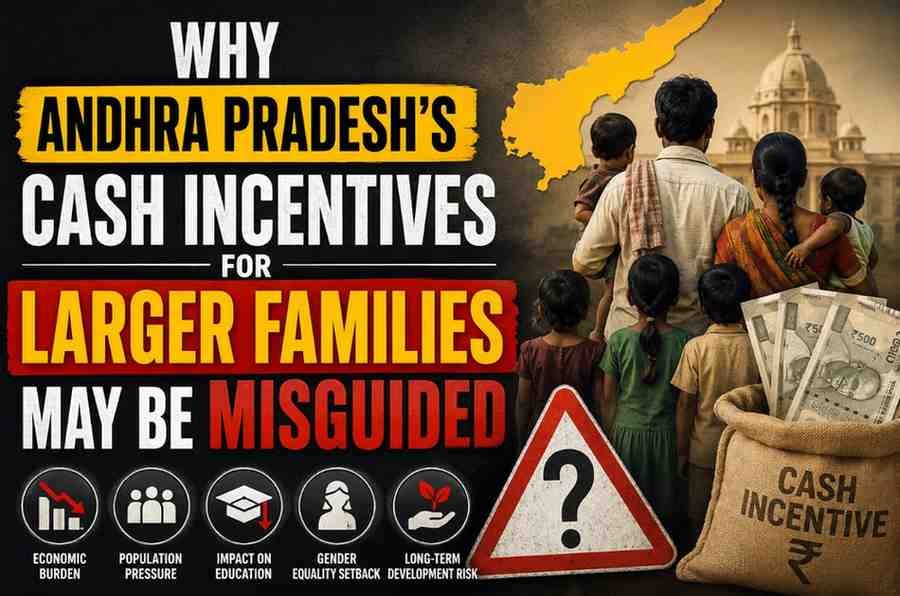
As concerns over declining fertility rates gain traction across several parts of India, the Andhra Pradesh government’s recent proposal to encourage larger families through cash incentives has sparked debate among economists, demographers, and public policy experts. While the move aims to address fears of an aging population and a shrinking workforce, many specialists argue that monetary incentives alone are unlikely to convince couples to have more children.
The reason is simple: fertility decisions are influenced by far more than one-time financial benefits. Housing costs, education expenses, healthcare, women’s employment, childcare support, and changing social aspirations all shape how many children families choose to have.
In that context, critics say Andhra Pradesh’s approach addresses symptoms rather than the deeper causes behind declining birth rates.
Why Fertility Rates Are Falling
Declining fertility is not unique to Andhra Pradesh or India. Countries across Asia, Europe, and North America have experienced similar trends over the past few decades.
Several factors contribute to smaller family sizes:
- Rising education levels.
- Urbanization and higher living costs.
- Greater participation of women in the workforce.
- Delayed marriage and parenthood.
- Changing lifestyle aspirations.
- Improved access to family planning.
These changes reflect broader economic and social transformations rather than a sudden reluctance to have children.
Why Cash Incentives Often Have Limited Impact
Governments worldwide have experimented with financial incentives to encourage childbirth. These include cash payments, tax benefits, and maternity support programs.
While such measures can provide temporary relief, studies from countries facing low fertility suggest they rarely produce sustained increases in birth rates.
Experts explain that raising children involves long-term commitments, whereas cash incentives are often short-term benefits.
For many families, the decision revolves around decades of expenses rather than immediate rewards.
The Real Costs of Raising Children
Modern parenting comes with significant financial and emotional responsibilities.
Families must consider:
- Education costs.
- Healthcare expenses.
- Housing affordability.
- Childcare arrangements.
- Career sacrifices and work-life balance.
- Future economic uncertainty.
Even generous cash payments may not offset these concerns.
In urban areas especially, the cost of raising children has increased substantially, influencing family size decisions.
| Short-Term Incentives | Long-Term Factors Affecting Family Size |
|---|---|
| Cash rewards | Education expenses |
| One-time payments | Housing affordability |
| Tax benefits | Healthcare costs |
| Financial bonuses | Childcare support |
| Temporary assistance | Career and lifestyle considerations |
An Overlooked Reality: Fertility Decline Is Often a Sign of Development
One aspect frequently overlooked in fertility debates is that declining birth rates are closely linked to improvements in education, healthcare, and economic development.
As societies become wealthier and women gain greater educational and professional opportunities, family sizes naturally tend to decrease.
This demographic transition has been observed in countries across the world and is generally considered a marker of social progress rather than a crisis in itself.
The challenge lies not in reversing development but in adapting policies to changing demographic realities.
Lessons from Other Countries
Countries such as Japan, South Korea, Italy, and China have spent billions trying to boost fertility through financial incentives and subsidies.
Despite these efforts, birth rates have remained stubbornly low.
Experts suggest that successful approaches require broader reforms, including:
- Affordable childcare services.
- Flexible work arrangements.
- Paid parental leave.
- Gender equality in caregiving responsibilities.
- Accessible healthcare and education.
Without these structural changes, cash incentives alone tend to have limited influence.
The Role of Women’s Employment and Aspirations
Modern family planning decisions are increasingly shaped by women’s educational and career aspirations.
Many women today balance professional ambitions with caregiving responsibilities, making access to childcare and workplace flexibility essential.
Experts emphasize that policies encouraging larger families must avoid placing the burden solely on women.
Instead, creating environments that support both careers and parenthood may prove more effective.
Should Falling Fertility Always Be Seen as a Problem?
Demographers argue that moderate declines in fertility are not necessarily alarming.
Lower birth rates can lead to:
- Reduced pressure on resources.
- Improved investment in children’s education and health.
- Greater opportunities for women.
- Enhanced quality of life.
However, sustained low fertility over decades can contribute to population aging and labor shortages, requiring thoughtful policy responses.
The solution, experts say, lies in adapting to demographic change rather than simply encouraging more births.
What Could Work Better?
Rather than focusing primarily on cash incentives, experts recommend policies that reduce the everyday burdens of raising children.
Potential measures include:
- Affordable childcare facilities.
- Expanded parental leave policies.
- Better healthcare access.
- Flexible work arrangements.
- Support for working mothers and fathers.
- Quality education systems.
These interventions address the underlying reasons families choose to have fewer children.
Conclusion
Andhra Pradesh’s cash incentives reflect growing concerns about demographic shifts, but experts caution that fertility decisions are shaped by far more than financial rewards. Rising costs, changing aspirations, and evolving social norms have transformed the meaning of parenthood in modern societies.
Ultimately, if governments want families to feel confident about having more children, the answer may lie not in one-time incentives, but in creating conditions that make raising children economically sustainable and emotionally manageable.
For breaking news and live news updates, like us on Facebook or follow us on Twitter and Instagram. Read more on Latest Health on thefoxdaily.com.




COMMENTS 0