- Life After War: Survival in Extreme Conditions
- Hunger Crisis: Aid Exists, But It’s Not Enough
- Healthcare System on the Brink
- Infrastructure Collapse: The Root of Multiple Crises
- Diplomatic Deadlock: Why Progress Is Slow
- Comparison: Ceasefire Expectations vs Ground Reality
- A Critical Insight: The Shift from War to “Silent Crisis”
- The Human Factor: Living Without Certainty
- What Needs to Change?
- Conclusion: A Ceasefire Without Recovery
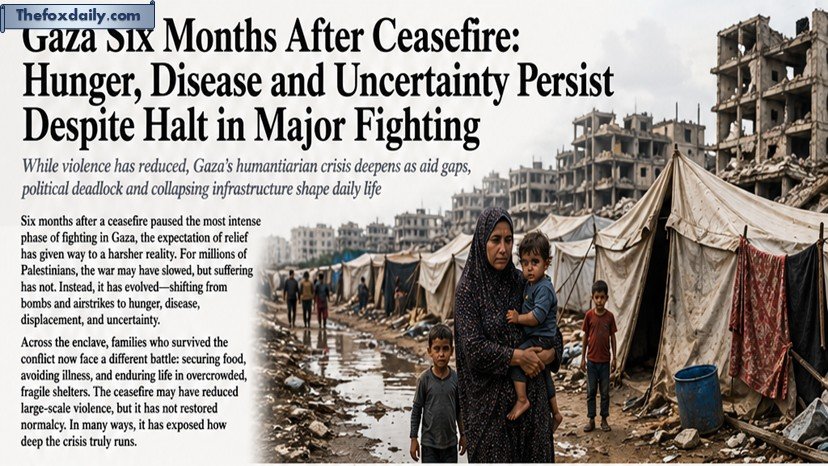
Six months after a Ceasefire paused the most intense phase of fighting in Gaza, the expectation of relief has given way to a harsher reality. For millions of Palestinians, the war may have slowed, but suffering has not. Instead, it has evolved shifting from bombs and Airstrikes to hunger, disease, displacement, and uncertainty.
Across the enclave, families who survived the Conflict now face a different battle: securing food, avoiding illness, and enduring life in overcrowded, fragile shelters. The ceasefire may have reduced large-scale violence, but it has not restored normalcy. In many ways, it has exposed how deep the crisis truly runs.
Life After War: Survival in Extreme Conditions
For displaced families, daily life is defined by scarcity and vulnerability. Makeshift shelters often tents or partially destroyed buildings offer little protection from changing seasons.
During winter, flooding and cold posed serious threats. Now, with rising temperatures, new dangers have emerged. Poor sanitation, open sewage, and infestations are becoming widespread, creating an environment ripe for disease.
Basic necessities remain limited:
- Food: Inconsistent supply, rising dependence on aid
- Water: Often unsafe or insufficient
- Shelter: Overcrowded and structurally weak
- Sanitation: Severely compromised, increasing health risks
This shift from immediate violence to prolonged hardship is a common but often overlooked phase in post-conflict zones.
Hunger Crisis: Aid Exists, But It’s Not Enough
Although humanitarian access has improved compared to wartime conditions, it remains far below what is needed. Aid deliveries have increased, but logistical challenges and restrictions continue to limit their effectiveness.
Large portions of the population face acute food insecurity, meaning they do not have reliable access to sufficient nutrition. Even when food arrives, distribution challenges and overcrowding reduce its impact.
The situation reveals a critical gap: availability does not equal accessibility. Food may be entering Gaza, but reaching those who need it most remains a challenge.
Key Constraints on Aid Delivery
- Security checks and movement restrictions
- Limited number of aid trucks entering daily
- Damaged infrastructure slowing distribution
- Coordination challenges among aid agencies
The result is a fragile system that struggles to meet even basic needs.
Healthcare System on the Brink
Perhaps the most alarming aspect of Gaza’s current crisis is the state of its Healthcare system. Years of strain, compounded by recent conflict damage, have left hospitals operating at reduced capacity.
Many facilities are either partially functional or completely out of service. Medical supplies are limited, and staff are overwhelmed.
This becomes especially dangerous as new health threats emerge.
Rising Health Risks
- Spread of skin diseases due to poor hygiene
- Risk of waterborne illnesses from contaminated sources
- Potential outbreaks in overcrowded shelters
- Limited ability to respond due to weak healthcare infrastructure
With summer approaching, these risks are expected to intensify, turning a humanitarian crisis into a potential Public health emergency.
Infrastructure Collapse: The Root of Multiple Crises
Behind the visible suffering lies a deeper structural issue widespread destruction of infrastructure.
A significant portion of buildings in Gaza has been damaged, including homes, schools, and hospitals. This destruction creates a chain reaction:
- Displacement increases overcrowding
- Lack of housing worsens sanitation conditions
- Damaged roads and systems hinder aid delivery
Reconstruction, however, remains stalled. Restrictions on building materials often classified as potential dual-use items have slowed efforts to rebuild even basic shelters.
This leaves families trapped in temporary living conditions that are neither safe nor sustainable.
Diplomatic Deadlock: Why Progress Is Slow
While humanitarian needs grow, political negotiations have struggled to keep pace. Talks involving multiple stakeholders have made limited progress, with key disagreements preventing a breakthrough.
The central issue remains disarmament. One side views it as essential for long-term stability, while the other sees it as a security risk in the absence of guarantees.
This deadlock has broader consequences:
- Delays in reconstruction planning
- Uncertainty over governance structures
- Limited long-term investment in recovery
Without political resolution, humanitarian efforts alone cannot stabilize the situation.
Comparison: Ceasefire Expectations vs Ground Reality
| Expectation | Reality After 6 Months |
|---|---|
| Improved living conditions | Widespread displacement and poor shelter |
| Stable food supply | Ongoing food insecurity |
| Healthcare recovery | Strained and partially functioning system |
| Rapid reconstruction | Minimal progress due to restrictions |
| Political stability | Negotiation deadlock |
This gap highlights why ceasefires alone do not resolve crises they merely create space for solutions that must still be implemented.
A Critical Insight: The Shift from War to “Silent Crisis”
One of the most important and often missed insights is that Gaza is no longer in a phase of visible war, but it is far from peace.
Instead, it has entered what can be described as a “silent crisis”:
- Fewer headlines, but persistent suffering
- Lower intensity conflict, but higher long-term risks
- Reduced violence, but increased systemic breakdown
This phase is particularly dangerous because it attracts less global attention, even as conditions worsen.
The Human Factor: Living Without Certainty
Beyond statistics and policy debates lies a deeper issue uncertainty. For residents, the absence of a clear future is as distressing as current hardships.
Questions remain unanswered:
- Will the ceasefire hold?
- Will reconstruction begin?
- Will governance stabilize?
This uncertainty affects mental health, decision-making, and long-term resilience of communities.
What Needs to Change?
Addressing Gaza’s crisis requires more than temporary measures. Several critical steps are necessary:
- Improved aid access: Streamlining delivery and distribution systems
- Healthcare support: Rebuilding and resourcing medical facilities
- Infrastructure reconstruction: Allowing materials and technical support
- Political agreement: Breaking the deadlock on key issues
Without coordinated progress across these areas, conditions are unlikely to improve significantly.
Conclusion: A Ceasefire Without Recovery
Six months after the ceasefire, Gaza stands at a crossroads. The guns may be quieter, but the crisis is far from over. Hunger, disease, and displacement have replaced active combat as the defining challenges of daily life.
The situation underscores a critical lesson: ending violence is only the first step. Recovery requires sustained effort, political will, and international coordination.
Future Outlook: If negotiations remain stalled and aid constraints persist, Gaza risks slipping deeper into a prolonged humanitarian emergency. However, with targeted action and renewed focus, the ceasefire could still become a foundation for recovery rather than a pause before further crisis.
For now, the reality is clear peace on paper has not yet translated into stability on the ground.
For breaking news and live news updates, like us on Facebook or follow us on Twitter and Instagram. Read more on Latest World on thefoxdaily.com.




COMMENTS 0