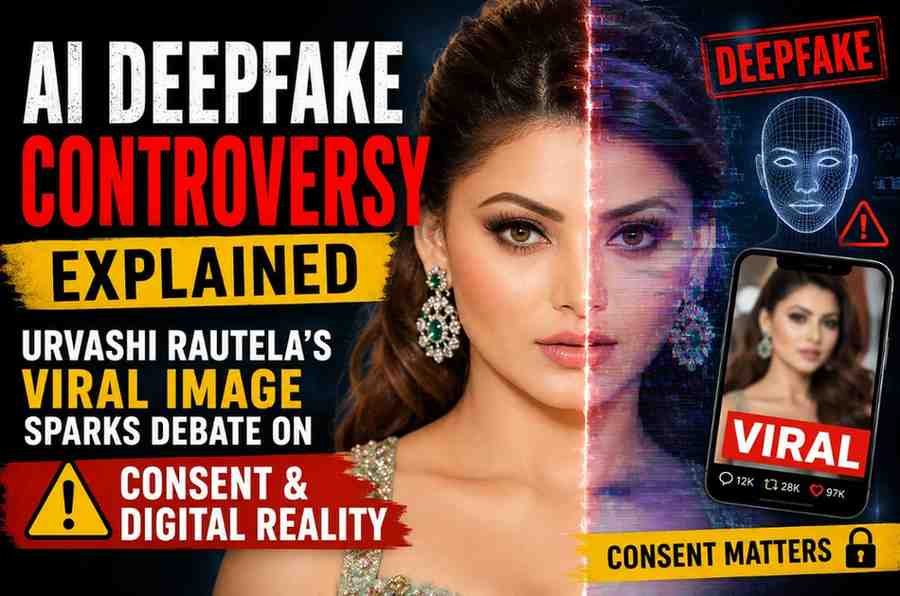
The internet thrives on speed, virality, and often, controversy. But when Technology crosses ethical boundaries, the consequences go far beyond a trending topic. The recent incident involving Urvashi Rautela criticizing an AI generated image depicting her kneeling before Aishwarya Rai and Priyanka Chopra has sparked a larger conversation about digital manipulation, consent, and the rising threat of AI-generated misinformation.
Who: Urvashi Rautela, Bollywood actor
What: Reaction to a viral AI generated image
When: Recently surfaced on social media platforms
Where: Circulated widely across digital platforms
Why: Raises concerns about misuse of AI in celebrity imagery
How: Created using generative AI tools capable of hyper realistic manipulation
What may seem like a simple online controversy actually exposes a deeper issue—how artificial intelligence is reshaping reality, often without accountability.
The Context: How AI Generated Images Are Changing Digital Reality
Artificial Intelligence has rapidly evolved from a niche innovation to a mainstream creative tool. Platforms now allow users to generate hyper-realistic images within seconds. While this technology has opened doors for artists and designers, it has also blurred the line between reality and fabrication.
AI-generated visuals, commonly referred to as “deepfakes,” can convincingly depict individuals in situations that never occurred. In this case, the viral image placed Urvashi Rautela in a submissive posture before two globally respected actresses an implication that triggered strong reactions.
Unlike traditional photo editing, modern AI doesn’t just alter images it creates entirely new ones based on learned patterns. This makes detection harder and impact more severe.
Key Developments: What Happened and Why It Escalated
The image quickly gained traction due to its controversial nature. Social media algorithms, designed to amplify engaging content, pushed it further into public visibility.
Urvashi Rautela responded strongly, calling out the toxicity and demanding accountability. Her reaction reflects a growing frustration among public figures who are increasingly targeted by manipulated content.
- Rapid virality fueled by social media algorithms
- Emotional and reputational impact on the individual
- Lack of clear accountability for creators of such content
- Public debate on ethical use of AI
This isn’t an isolated case. Similar incidents have been reported globally, affecting not just celebrities but also private individuals.
Deep Analysis: Why This Matters More Than You Think
1. Consent in the Age of AI
One of the most critical issues highlighted by this controversy is consent. Traditional media required physical participation. AI removes that barrier entirely.
Now, anyone’s likeness can be used without permission raising serious legal and ethical questions. The absence of consent turns creativity into exploitation.
2. Reputation Damage Is Instant and Lasting
Even if proven fake, such images can leave a lasting impression. Human psychology often remembers visuals more strongly than corrections.
This creates a dangerous situation where misinformation spreads faster than truth, damaging reputations in minutes.
3. The Algorithm Problem
Social media platforms reward engagement, not accuracy. Controversial or shocking content is more likely to go viral, regardless of authenticity.
This creates a feedback loop:
- Fake content gets attention
- Attention drives algorithmic promotion
- Promotion increases reach
- Reach normalizes misinformation
4. Technology vs Regulation Gap
AI technology is evolving faster than legal frameworks. While some countries are introducing laws against deepfakes, enforcement remains inconsistent.
This gap allows misuse to continue with minimal consequences.
Comparison: AI Manipulation vs Traditional Media Editing
| Aspect | Traditional Editing | AI Generated Content |
|---|---|---|
| Creation Method | Manual editing | Automated generation |
| Realism | Limited | Highly realistic |
| Time Required | Hours to days | Seconds to minutes |
| Detection | Relatively easier | Increasingly difficult |
| Ethical Risk | Moderate | High |
This comparison clearly shows why AI-generated manipulation is far more dangerous it combines speed, realism, and accessibility.
Real-World Impact: Beyond Celebrity Controversies
While celebrities like Urvashi Rautela have a platform to respond, ordinary individuals often don’t. AI generated content has been used in:
- Cyberbullying and harassment
- Fake news and political propaganda
- Financial scams using deepfake identities
- Non-consensual explicit content
This makes the issue not just a celebrity concern, but a societal one.
The Psychology Behind Viral Manipulated Content
Why do such images spread so quickly?
Because they tap into three powerful psychological triggers:
- Shock value Unexpected or controversial visuals grab attention
- Curiosity People want to verify or discuss what they see
- Emotional reaction Outrage or amusement fuels sharing
Ironically, even people criticizing the content contribute to its spread.
Unique Insight: The Rise of “Synthetic Reality”
We are entering an era where reality itself is becoming negotiable. Experts are calling this shift “synthetic reality” a digital environment where real and fake coexist seamlessly.
This raises a critical question: If everything can be fabricated, how do we trust anything?
The Urvashi Rautela incident is a small but significant example of this emerging challenge.
Future Predictions: What Comes Next?
Looking ahead, three major developments are likely:
1. Stronger Regulations
Governments may introduce stricter laws around AI generated content, especially involving identity misuse.
2. AI Detection Tools
Technology companies are already working on systems to detect deepfakes. However, this will be an ongoing race between creation and detection.
3. Digital Literacy Will Become Essential
Users will need to develop critical thinking skills to differentiate between real and manipulated content.
What Can Be Done: Practical Steps for Protection
- Verify content before sharing
- Use trusted sources for information
- Report misleading or harmful content
- Support ethical AI practices
For public figures, legal action and public clarification remain key tools—but prevention is always better than reaction.
Conclusion: A Wake-Up Call for the Digital Age
The controversy involving Urvashi Rautela is not just about one viral image it’s a reflection of a rapidly changing digital world where technology can both empower and exploit.
Summary: AI-generated content is transforming how visuals are created and consumed, but it also introduces serious risks related to consent, reputation, and misinformation.
Future Outlook: As AI continues to evolve, society must adapt through regulation, awareness, and responsible usage. The goal isn’t to stop innovation, but to ensure it doesn’t come at the cost of truth and dignity.
Because in a world where anything can look real, trust becomes the most valuable currency.
For breaking news and live news updates, like us on Facebook or follow us on Twitter and Instagram. Read more on Latest Entertainment on thefoxdaily.com.






COMMENTS 0