Google has introduced Gemini 4 Carbon, a new Artificial Intelligence model designed to advance Cybersecurity, long-horizon reasoning and complex engineering workflows, just two weeks after making Gemini 4 Argon widely available to consumers and enterprises. The rapid succession highlights the accelerating pace of AI development, with companies seeking to improve model capabilities while strengthening safeguards against potential misuse.
Google DeepMind describes Gemini 4 Carbon as its strongest model yet, highlighting improvements in cybersecurity benchmarks, long-context performance and sustained agentic workflows. However, broad availability remains uncertain, with the company saying the model will soon become available to developers, businesses and consumers.
Initially, access will be restricted to a select group of cybersecurity experts before expanding to additional trusted partners through Google’s Fairwind Program. This phased rollout reflects the need to evaluate powerful AI systems carefully, particularly when their capabilities could be used for both defensive cybersecurity and potentially harmful activities.
Google Gemini 4 Carbon Introduces a Faster AI Development Cycle
The introduction of Gemini 4 Carbon only two weeks after Gemini 4 Argon’s wider release illustrates how quickly leading AI developers are advancing their models. Rather than waiting for lengthy intervals between major releases, Google is presenting a new model with additional capabilities while continuing to emphasize safety and controlled deployment.
Koray Kavukcuoglu, senior vice president at Google DeepMind and chief AI architect at Google, said Carbon builds on Argon and demonstrates the company’s efforts to advance AI capabilities more rapidly while strengthening safeguards alongside those improvements.
The short interval between the two releases raises important questions about how AI companies will manage increasingly frequent upgrades. Faster development can help businesses gain access to improved tools sooner, but it also places greater demands on testing, security evaluations, developer documentation and deployment processes.
For enterprises, the practical value of a new AI model depends on more than its benchmark scores. Organizations must also assess reliability, integration costs, data protection, operational stability and whether the model performs consistently on real-world tasks.
Gemini 4 Carbon’s phased availability suggests that Google is prioritizing controlled access before a broader rollout. This approach could help the company evaluate how the model behaves in demanding cybersecurity environments before expanding access to a larger user base.
Gemini 4 Carbon Targets Cybersecurity and Vulnerability Detection
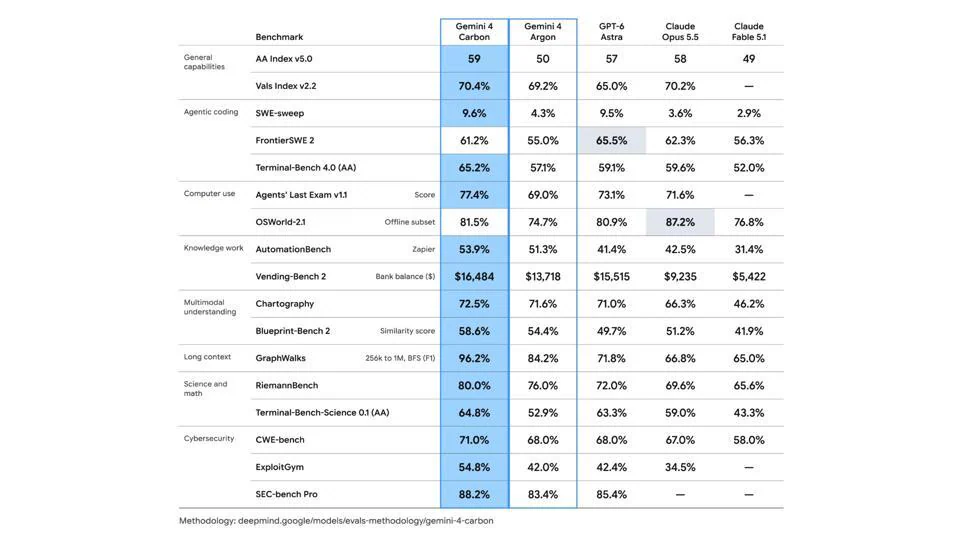
Cybersecurity is one of the main areas in which Google claims Gemini 4 Carbon has advanced beyond its predecessor. The company has highlighted results across several security-focused benchmarks, including SEC-bench Pro, ExploitGYM and CWE-bench.
According to the supplied benchmark figures, Gemini 4 Carbon achieved an 88.2% score on SEC-bench Pro, compared with 85.4% for the cited GPT-6 Astra model. On ExploitGYM, Carbon recorded 54.8%, ahead of the reported 42.4% score for GPT-6 Astra.
On CWE-bench, Gemini 4 Carbon scored 71%, compared with 68% for both Gemini 4 Argon and the cited GPT-6 Astra model.
These evaluations are intended to assess capabilities relevant to software security and vulnerability-related tasks. Strong performance could make an AI model useful for helping security professionals identify weaknesses, investigate suspicious code and develop potential fixes.
However, benchmark results should be interpreted carefully. Scores from different evaluations may reflect different testing conditions, task definitions and scoring methods. They do not automatically establish that a model will outperform competitors in every cybersecurity environment.
Real-world performance will also depend on how effectively a model distinguishes legitimate security testing from potentially harmful requests, handles incomplete information and produces recommendations that human experts can verify.
Fairwind Program Will Expand Access to Trusted Cybersecurity Partners
Google plans to make Gemini 4 Carbon available initially to a select group of cybersecurity experts. The company will then gradually expand access through its Fairwind Program, which works with 650 partners on cybersecurity defence, model deployment and safety measures.
Named partners include Accenture, CrowdStrike, Snowflake and Wiz. Their participation provides Google with an established network of organizations working across enterprise Technology, security and cloud-related services.
A controlled rollout can help AI developers understand how advanced models perform outside internal testing. Cybersecurity professionals may be able to evaluate whether the model can support vulnerability discovery, investigate complex software issues and improve defensive workflows.
The approach also reflects a broader challenge facing AI companies: capabilities that improve defensive security can sometimes be misused. Models that can identify vulnerabilities or reason through complex software systems may be valuable to security researchers, but the same abilities require safeguards against unauthorized exploitation.
Google says Gemini 4 Carbon retains the multi-layered security framework used by Argon. The company identifies model training, real-time misuse defences, prompt-injection resilience and chain-of-thought monitoring among the components of that framework.
The effectiveness of these protections will depend on their performance under real-world conditions. Independent evaluations and practical deployment experience will be important for determining how reliably the safeguards prevent misuse without unnecessarily restricting legitimate security work.
Long-Context Reasoning and Agentic Workflows Set Carbon Apart
Beyond cybersecurity, Google is emphasizing Gemini 4 Carbon’s ability to handle long-running, multi-step engineering tasks. The model is designed for sustained agentic workflows, in which an AI system can work through a sequence of related actions toward a defined objective rather than responding to a single prompt.
Kavukcuoglu said internal teams had observed Carbon working for days on complex engineering problems, including identifying the underlying causes of subtle bugs and developing patches across large codebases and low-level systems.
Such tasks can be difficult because software problems often require examining large volumes of code, tracing dependencies, testing possible explanations and revising an approach when an initial solution fails.
A model capable of maintaining context across these steps could help developers investigate problems that would otherwise require substantial manual effort. It could also support software maintenance, debugging and other engineering activities that involve multiple interconnected decisions.
However, the ability to work for extended periods does not eliminate the need for human oversight. AI-generated code can introduce new vulnerabilities, overlook important dependencies or produce fixes that work in one situation but fail in another. Testing, code review and validation remain essential before changes are deployed in production environments.
GraphWalks Benchmark Highlights Long-Context Performance
Google has also highlighted Gemini 4 Carbon’s performance on the GraphWalks long-context benchmark. According to the supplied figures, Carbon achieved a score of 96.2%, compared with 84.2% for the cited Gemini 4 Astra model and 71.8% for GPT-6 Astra.
Long-context capabilities are important when AI systems must process and connect information spread across extensive documents, large software repositories or lengthy sequences of interactions.
For engineering teams, improved context handling could help a model track relationships between different parts of a codebase, remember earlier troubleshooting steps and use information gathered during previous stages of a task.
Nevertheless, a high benchmark score does not guarantee that an AI model will consistently retain every relevant detail in a complex real-world project. Performance can vary according to the structure of the information, the difficulty of the task and the amount of reasoning required.
Businesses evaluating Gemini 4 Carbon will therefore need to consider both benchmark performance and practical results from their own workloads.
Gemini 4 Carbon Leads the Reported AI Index 50 Rankings
Gemini 4 Carbon also leads the reported Artificial Intelligence Index 50, a composite evaluation combining nine AI benchmarks across different tasks and categories. These include agentic coding, frontier agentic capabilities, factual recall and hallucination measurement across economically relevant domains.
The supplied results place Gemini 4 Carbon at 59, ahead of Claude Opus 5.5 at 58 and GPT-6 Astra at 57.
Other models listed in the comparison scored lower, including Meta’s Muse Wonder Full at 50, Kimi K3.1 Pro at 46 and Grok 4.7 at 34.
A composite benchmark can provide a broader view of model performance than an individual evaluation because it considers multiple capabilities. However, its results depend on the benchmarks selected, their relative weighting and the methods used to combine their scores.
A narrow lead in an aggregate ranking should not automatically be interpreted as proof that a model is superior for every application. A business choosing an AI system for software development, research or customer support should evaluate the tasks most relevant to its needs.
For Google, the reported ranking supports its positioning of Carbon as a model designed to handle demanding professional workloads. For customers, the more important question will be whether those capabilities translate into measurable improvements in accuracy, productivity and reliability.
Google Claims Gemini 4 Carbon Reduces Unsupported Answers
Google says internal testing found that Gemini 4 Carbon reduced unsupported claims by approximately twofold compared with Gemini 4 Argon. The company also reported improved collaboration, with the model retrieving relevant sources and highlighting discrepancies to users before taking action.
Unsupported claims, commonly associated with AI hallucinations, can create problems when users rely on models for technical research, software development or other tasks requiring factual accuracy.
Reducing these errors could make an AI system more useful in professional environments, particularly when users need to understand the basis for a recommendation or identify conflicting information.
Source retrieval and the ability to flag discrepancies may also help users review an AI-generated response rather than accepting it without question. These features are particularly relevant to long-running workflows, where an early mistake can influence subsequent decisions.
However, Google’s reported improvement comes from internal testing. The precise testing conditions and the extent to which the results generalize to different applications are not established by the supplied information. Independent assessments will be necessary to determine how the model performs across varied real-world tasks.
Gemini 4 Carbon Pricing Matches Argon’s Introductory Rates
Google plans to introduce Gemini 4 Carbon at the same initial token usage prices as Gemini 4 Argon. The stated introductory rates are $2 per million input tokens and $10 per million output tokens.
After the introductory pricing period ends, the supplied pricing information indicates that input tokens will cost $4 per million and output tokens will cost $20 per million. Google has not specified how long the introductory rates will remain available.
Input tokens generally represent the information supplied to a model, while output tokens represent the content it generates. These charges are important for businesses because the total cost of using an AI system depends on the volume of information processed and the amount of output generated.
For applications involving long documents, extensive codebases or multi-step agentic workflows, token consumption can accumulate quickly. Businesses may therefore need to evaluate the total cost of completing a task rather than comparing models solely on their per-token rates.
The introductory pricing could make initial experimentation more accessible to developers and enterprise customers. However, organizations planning long-term deployments will need to account for the higher stated rates after the promotional period, as well as the costs of integration, monitoring and human review.
What Gemini 4 Carbon Means for Businesses and Developers
Gemini 4 Carbon’s proposed capabilities could have implications for organizations using AI in software development, cybersecurity and technical research. Its emphasis on long-horizon workflows suggests that Google is targeting tasks requiring sustained reasoning and coordinated actions rather than simple question-and-answer interactions.
For software developers, the potential benefits include assistance with debugging, code analysis and investigating problems across large projects. Security teams could explore applications involving vulnerability assessment and defensive analysis, subject to appropriate safeguards and verification procedures.
Enterprises will also need to consider the operational implications of faster model upgrades. Frequent releases can provide access to improved capabilities, but they may require teams to repeat evaluations, update integrations and confirm that existing workflows continue to operate as expected.
Model selection will increasingly depend on a combination of performance, reliability, security, availability and cost. Even when a model performs well on benchmarks, businesses must establish whether it meets their requirements for accuracy, privacy and predictable operation.
Conclusion: Faster AI Upgrades Bring New Opportunities and Challenges
Google Gemini 4 Carbon represents the company’s latest effort to advance AI capabilities in cybersecurity, long-context reasoning and sustained engineering workflows. Its reported benchmark results, claims of fewer unsupported answers and focus on complex multi-step tasks position it as a model aimed at demanding professional applications.
The release also highlights the increasingly short intervals between AI model upgrades. For developers and businesses, this pace could bring new capabilities more quickly, but it also increases the importance of testing, security evaluations and careful deployment planning.
Carbon’s initial availability will remain limited to selected cybersecurity experts before Google expands access through its trusted-partner program. Broader availability, real-world performance and the long-term implications of its pricing will be important factors in determining its adoption.
Ultimately, Gemini 4 Carbon’s significance will depend not only on benchmark rankings but also on whether its capabilities deliver reliable, measurable benefits in real-world environments while maintaining effective safeguards against misuse.
For breaking news and live news updates, like us on Facebook or follow us on Twitter and Instagram. Read more on Latest Business on thefoxdaily.com.






COMMENTS 0