China is showcasing a future in which robots serve customers, automated factories manufacture electric cars at scale and pilotless aircraft could eventually transport passengers between major cities. Demonstrations in Shenzhen and Guangzhou highlight how the country is combining Artificial Intelligence (AI), Robotics and electric mobility to reshape everyday services, manufacturing and urban transportation.
From a robot-operated ice cream outlet to electric vertical take-off and landing (eVTOL) aircraft, these technologies illustrate China’s growing ambition to move automation beyond industrial facilities and into public spaces. The developments also reflect a broader effort to establish the country as a global centre for emerging technologies, startups and advanced manufacturing.
Shenzhen, a major technology and manufacturing hub, is central to this ambition. The city is home to companies such as Tencent and DJI and has become an important centre for businesses developing robotics, artificial intelligence, consumer electronics and other emerging technologies.
However, China’s demonstrations also highlight an important distinction between technology that is already operating and products that remain experimental. While automated retail services and electric vehicle production are becoming increasingly visible, pilotless passenger aircraft still face regulatory and operational challenges before they can become a routine part of urban transportation.
Robot Waiters Demonstrate How China Is Automating Everyday Services
One of the most visible demonstrations of China’s automation push is an automated ice cream outlet showcased during the 33rd APEC Economic Leaders’ Meeting in Shenzhen. The outlet uses multiple robotic systems to manage different stages of the customer experience, from placing an order to preparing and delivering the finished product.
During a visit to the event, India Today’s Gaurav Sawant demonstrated how customers could interact with a robot named Starboy to place their orders. The robot communicates with customers and processes their requests, reducing the need for a human employee to handle the ordering process.
Once an order is placed, another automated system prepares the ice cream. A robotic arm then collects the product, while a delivery robot transports it directly to the customer’s table.
The arrangement brings several separate technologies together in a single service operation. Instead of relying on one machine to perform every task, the outlet uses different automated systems for customer interaction, food preparation, handling and delivery.
The demonstration is significant because it shows how robotics can be applied to relatively ordinary commercial activities. Restaurants, cafes, hotels and retail outlets involve repetitive tasks that can potentially be handled by automated systems. These include taking orders, moving products, preparing standardised items and delivering purchases to customers.
For businesses, automation could help improve consistency and reduce the time employees spend on repetitive work. It could also allow some services to operate with fewer staff members, although the actual benefits will depend on equipment costs, maintenance requirements, reliability and customer acceptance.
Such demonstrations are also designed to attract attention. Visitors from across China and overseas are arriving to experience the technology, giving companies an opportunity to showcase their products to potential customers, business partners and investors.
China’s Pilotless Electric Helicopters Could Transform Urban Transport
China’s automation ambitions extend beyond restaurants and factories. The country is also exploring electric aircraft that could eventually provide a new transportation option for passengers travelling within and between cities.
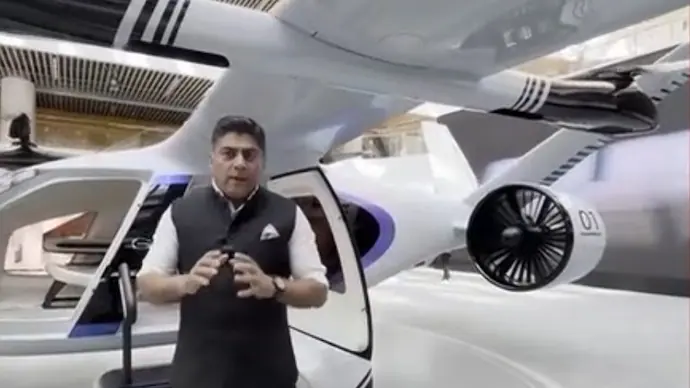
At GAC Motors in Guangzhou, electric vertical take-off and landing aircraft are being presented as a possible part of the future urban transport network. Unlike conventional aeroplanes, eVTOL aircraft are designed to take off and land vertically, potentially allowing them to operate from locations where traditional runways are unavailable.
One of the aircraft on display is a four-seater electric helicopter designed to operate without an onboard pilot. The prototype features multiple rotors and is intended to carry four passengers.
The company claims that the aircraft has a range of approximately 200 kilometres and can fly at an altitude of up to 500 metres on a single charge. If developed into a commercially viable passenger service, the aircraft could potentially connect cities such as Guangzhou, Shenzhen and Hong Kong.
Such connections could offer an alternative for some journeys that currently depend on road or conventional air transportation. Travelling between major urban centres can involve congestion, long transfers and significant time spent navigating crowded transport networks. A future air taxi service could potentially reduce journey times on selected routes.
However, the four-seater aircraft remains a prototype. It has not yet received clearance to carry passengers, meaning the proposed service should not be confused with an operational commercial air taxi network.
Two-Seater Pilotless Air Taxi Attracts More Than 200 Orders
Another aircraft displayed in Guangzhou is a two-seater pilotless electric air taxi. The model represents a smaller passenger aircraft designed around the concept of short-distance aerial transportation.
Unlike the four-seater prototype, this aircraft has reportedly attracted commercial interest. The company claims to have received more than 200 orders, suggesting that potential customers are already showing interest in the emerging air mobility market.
The aircraft is designed to allow passengers to board directly before its canopy closes ahead of flight. Its pilotless configuration points towards a future in which flight operations could increasingly depend on automated navigation and control systems rather than a human pilot sitting inside the aircraft.
However, orders do not necessarily mean that the aircraft is ready for widespread commercial operation. The development of passenger-carrying autonomous aircraft requires extensive testing, safety validation and regulatory approval. Companies must demonstrate that their systems can respond reliably to changing weather, technical failures, unexpected obstacles and other situations that could arise during flight.
There are also wider questions involving air traffic management, emergency procedures, landing infrastructure and public confidence. Passengers may be willing to use autonomous transportation only after they have confidence in the technology and the safety systems supporting it.
These challenges mean that the commercial future of pilotless air taxis will depend not only on aircraft design but also on the development of an entire supporting ecosystem.
Why eVTOL Aircraft Are Attracting China’s Technology Industry
Electric vertical take-off and landing aircraft are attracting attention because they combine several areas of technological development. Their design involves electric propulsion, battery systems, lightweight materials, flight-control software, sensors and autonomous navigation.
Unlike conventional helicopters, many eVTOL designs use multiple electrically powered rotors. This configuration can support vertical take-off and landing while reducing dependence on traditional aviation infrastructure. It also creates opportunities for manufacturers to experiment with different aircraft shapes and propulsion arrangements.
For densely populated cities, the long-term attraction is the possibility of adding another layer to urban transportation. Roads and rail networks operate at ground level, while air mobility concepts aim to use low-altitude airspace for selected passenger and cargo journeys.
However, the technology still faces important limitations. Battery capacity, charging requirements, aircraft range, payload, operating costs and safety certification will determine whether these vehicles can become practical transport options.
The proposed 200-kilometre range of the four-seater prototype is therefore a company claim about the aircraft’s intended capabilities, not evidence that a commercial service is already available over that distance.
Automated Electric Vehicle Factories Show China’s Manufacturing Scale
China’s automation push is also visible in its electric vehicle manufacturing industry. At an AION manufacturing facility in Guangzhou, the production process demonstrates how automation is being integrated into large-scale vehicle assembly.
The company claims that the facility can manufacture approximately 800 cars a day. Around 25% of the production process is automated, according to the information presented during the demonstration.
One notable feature of the production line is its ability to manufacture four different vehicle models. This allows the factory to switch between models without requiring an entirely separate assembly line for each vehicle.
Flexible manufacturing is important in an automobile market where companies need to respond to changing consumer demand. Different models can have different specifications, body designs and equipment, making production management more complicated when several vehicles share the same facility.
A production line capable of handling multiple models can help manufacturers use factory space and equipment more efficiently. It may also allow companies to adjust production schedules as demand changes.
The AION facility’s electric vehicles feature fully electric powertrains and digital interfaces, including large touchscreen displays. These features reflect the wider transformation of the automobile industry, where software and digital systems are becoming increasingly important alongside traditional mechanical engineering.
How Robotics and AI Are Connecting China’s Technology Industries
China’s approach is notable because it brings together several industries that are often discussed separately. Robotics, artificial intelligence, electric vehicles and autonomous aircraft are increasingly being developed as connected parts of a broader technology ecosystem.
Robots used in restaurants depend on sensors, software and automated movement systems. Electric vehicle factories use robotics to perform selected manufacturing tasks, while autonomous aircraft require sophisticated control systems to manage flight operations.
Artificial intelligence can support some of these applications by helping machines interpret information, respond to their surroundings and perform tasks with less direct human input. However, not every automated system necessarily relies on advanced generative AI. Many industrial robots and service machines operate through a combination of programmed instructions, sensors, control software and specialised automation technologies.
The connection between these sectors can create opportunities for technology companies to develop components and expertise that serve multiple markets. Advances in sensors, batteries, computing hardware, software and precision engineering can have applications across manufacturing, transportation and consumer services.
Shenzhen has an important role in this ecosystem. Its established technology industry, manufacturing capabilities and concentration of startups provide an environment in which companies can develop, test and demonstrate new products.
Companies such as Tencent and DJI have helped establish the city’s reputation in technology and innovation. Its growing focus on artificial intelligence and robotics adds another dimension to that identity.
Can Robots and Automation Replace Human Workers?
The increasing presence of robots in restaurants, factories and transportation raises questions about the future of employment. If machines can take orders, prepare products, deliver food and perform manufacturing tasks, some traditional roles could change or become less necessary.
In restaurants, automated systems could reduce the need for employees to perform repetitive activities such as carrying orders or handling standardised preparation tasks. In factories, robots can take on selected assembly operations that are physically demanding or require consistent repetition.
However, automation does not automatically eliminate the need for human workers. Businesses still require people to supervise operations, maintain equipment, manage customers, handle unexpected problems and ensure quality standards.
As automation becomes more widespread, demand could increase for workers with skills in robotics maintenance, software development, engineering, system integration and technical support. The nature of employment may therefore shift from manual and repetitive tasks towards specialised roles involving technology management.
The transition will not necessarily be smooth. Workers whose existing responsibilities can be automated may need retraining, while smaller businesses could struggle to afford expensive equipment. The benefits of automation may also differ significantly between industries and regions.
For China, the challenge will be to ensure that technological progress translates into sustainable economic benefits while managing the impact on workers and businesses.
The Challenges Before China’s Automated Urban Future Becomes Reality
Although China’s demonstrations offer a glimpse of what future cities could look like, widespread adoption will depend on practical considerations beyond technological capability.
Cost and commercial viability
Robotic systems, autonomous vehicles and advanced manufacturing equipment require substantial investment. Businesses must determine whether the savings from automation justify the purchase, maintenance and operating costs. A robot that attracts visitors during a technology demonstration may not necessarily be economical for a restaurant operating on tight margins.
Safety and reliability
Autonomous systems must operate reliably in unpredictable environments. A delivery robot navigating a restaurant faces different risks from an autonomous aircraft carrying passengers. The consequences of system failures are also much greater in aviation, where safety standards must be particularly demanding.
Regulation and infrastructure
Pilotless passenger aircraft will require regulatory frameworks covering aircraft certification, flight permissions, airspace management, passenger safety and emergency response. Cities will also need suitable take-off and landing facilities if air taxi services are to become commercially practical.
Public acceptance
Consumers may readily accept a robot delivering an ice cream order, but trusting a pilotless aircraft to carry them between cities is a different decision. Companies will need to demonstrate reliability and transparency before autonomous transportation becomes widely accepted.
China’s Technology Strategy Goes Beyond Individual Robots
The demonstrations in Shenzhen and Guangzhou show that China’s technological ambitions are not limited to building individual robots or electric vehicles. The broader objective is to integrate automation into multiple parts of economic and urban life.
Robot-operated retail services illustrate how automation could change everyday consumer experiences. Electric vehicle factories demonstrate how robotics can support large-scale manufacturing, while eVTOL prototypes point towards possible new forms of transportation.
These technologies are at different stages of development. The automated ice cream outlet and vehicle production facility demonstrate applications already being showcased in real-world settings, while the pilotless passenger aircraft remain subject to development and regulatory requirements.
The distinction matters because a prototype, a company order and an operational service represent very different levels of technological maturity. The existence of an aircraft capable of demonstrating a flight concept does not mean it is ready to carry passengers commercially.
Nevertheless, the direction of development is clear: China is seeking to connect artificial intelligence, robotics, electric mobility and advanced manufacturing into a wider innovation ecosystem.
What China’s Automation Push Could Mean for the Future of Cities
If these technologies become commercially viable, they could change how people interact with businesses, travel across cities and access everyday services. Restaurants could use robots for selected customer-facing tasks, factories could manufacture several vehicle models through flexible production systems, and electric air taxis could eventually serve routes where ground transportation is slow or congested.
But the transition will depend on more than impressive demonstrations. Costs, safety, regulations, infrastructure, employment and public trust will determine how quickly these technologies move from showcases into everyday use.
China’s developments in Shenzhen and Guangzhou provide a glimpse of that possible future. The robot that takes an ice cream order, the factory producing hundreds of electric cars a day and the pilotless aircraft prototypes represent different stages of the same technological ambition: bringing intelligent automation into the places where people work, travel and live.
The next test will be whether these innovations can move beyond demonstrations and become reliable, affordable and widely accessible services.
For breaking news and live news updates, like us on Facebook or follow us on Twitter and Instagram. Read more on Latest World on thefoxdaily.com.






COMMENTS 0