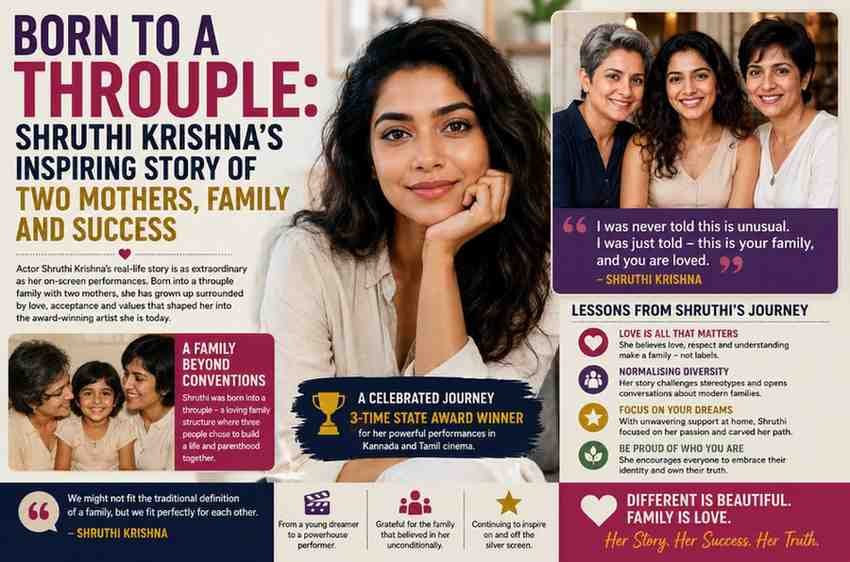
Few personal stories in Indian cinema are as remarkable as that of Shruthi Krishna. While audiences recognize her for her acclaimed performances and multiple State Awards, her life away from the camera has generated equal curiosity. Born into a family where one father and two women jointly raised her, Shruthi has often shared that she does not know which of her two mothers is her biological mother and, importantly, she has never considered that knowledge necessary.
Her story extends beyond celebrity headlines. It opens conversations about family, identity, emotional security, parenting, and the changing definitions of relationships in modern society. At a time when discussions around adoption, blended families, surrogacy and alternative parenting models are becoming more visible, Shruthi Krishna’s upbringing offers an unusual but deeply human perspective on what truly makes a family.
This article explores the actor’s unique upbringing, her successful career, the social context surrounding unconventional families, and why her experience continues to resonate with audiences far beyond the Entertainment industry.
Who Is Shruthi Krishna?
Shruthi Krishna is an Indian actor who earned recognition through powerful performances in regional cinema and television. Her acting journey has been marked by critical acclaim rather than merely commercial success, earning her multiple State Awards over the years.
Unlike many performers whose personal lives remain carefully guarded, Shruthi has occasionally spoken candidly about her childhood. Those conversations have revealed a family arrangement that remains exceptionally rare in India.
Instead of growing up with one mother and one father, she was raised by one father and two women who together functioned as equal parents. According to Shruthi, she has never been told which of the two women gave birth to her, and she has expressed that it has never affected her emotionally because both loved and cared for her equally.
A Family Built on Shared Parenthood Rather Than Biology
The aspect of Shruthi Krishna’s story that fascinates many people is not simply the presence of two mothers but the philosophy behind the family.
Rather than emphasizing biological relationships, the family reportedly focused on shared parenting responsibilities and emotional equality. From Shruthi’s perspective, both women fulfilled every role traditionally associated with motherhood.
This raises an important distinction often overlooked in discussions about families:
- Biological parenthood establishes genetic connection.
- Emotional parenthood develops through everyday care, sacrifice and nurturing.
- Social parenthood is created through responsibility, presence and lifelong commitment.
In Shruthi’s experience, these dimensions of motherhood appear to have mattered far more than genetics.
Why She Says She Doesn’t Know Her Biological Mother
Perhaps the most surprising revelation from Shruthi’s interviews is that she genuinely does not know which of her two mothers gave birth to her.
Rather than treating the information as a secret or mystery, the family appears to have intentionally avoided creating distinctions between the two women. As a result, Shruthi grew up identifying both equally as her mothers.
This approach challenges one of society’s strongest assumptions that biological identity must always define emotional identity.
For many psychologists, secure attachment depends far more on consistent caregiving than on biological connection. Children primarily develop emotional security through love, stability, responsiveness and trust.
Shruthi’s upbringing offers a real-life example of this principle in action.
Understanding the Meaning of a “Throuple”
The term throuple generally refers to a committed relationship involving three consenting adults.
While the concept has become more widely discussed globally over the past decade, it remains uncommon and often misunderstood in India.
It is important to separate sensationalism from reality. Every family structure is unique, and labels alone rarely capture the emotional dynamics within a household.
In Shruthi’s case, public interest has largely focused on the parenting arrangement rather than relationship terminology.
Her own reflections consistently emphasize love, care and equality rather than unconventional labels.
How Children Define Family Differently From Adults
Adults often categorize relationships according to legal, biological or cultural definitions.
Children, however, tend to define family much more simply.
To a child, family usually means the people who:
- Provide comfort during difficult moments.
- Celebrate achievements.
- Offer daily support.
- Create a sense of safety.
- Remain consistently present.
Shruthi’s experience illustrates this difference remarkably well. Instead of asking who was biologically related to her, she appears to have accepted both women naturally as her mothers because they fulfilled that role throughout her childhood.
Career Success Beyond Personal Curiosity
Although her family story often attracts headlines, Shruthi Krishna’s professional accomplishments deserve equal attention.
Winning three State Awards reflects sustained excellence rather than a single breakthrough performance. Such recognition typically acknowledges versatility, emotional depth and consistent artistic contribution.
For actors, maintaining critical acclaim across multiple projects requires far more than popularity. It demands discipline, adaptability and continuous growth.
Shruthi’s career demonstrates that audiences ultimately recognize talent independent of an artist’s personal background.
Timeline of Shruthi Krishna’s Journey
| Stage | Significance |
|---|---|
| Birth | Raised in a family with one father and two mothers. |
| Childhood | Grew up without knowing which mother was biologically related to her. |
| Education and Early Years | Developed normally within a household centered on shared parenting. |
| Acting Career | Entered the entertainment industry and earned critical recognition. |
| State Awards | Won multiple State Awards for acting excellence. |
| Public Interviews | Shared her unique upbringing, prompting broader conversations about family and identity. |
Why Her Story Resonates in Today’s India
India’s understanding of family has evolved significantly over the past few decades.
While the traditional joint family remains important, society has also witnessed increasing visibility of:
- Single-parent households.
- Blended families.
- Adoptive families.
- Guardians raising children.
- Grandparents serving as primary caregivers.
- Children conceived through assisted reproductive technologies.
Against this backdrop, Shruthi Krishna’s experience adds another dimension to the broader conversation.
Her story encourages people to reconsider whether family should be defined solely by biology or by the quality of relationships that develop over time.
What Child Development Experts Often Emphasize
Research in developmental psychology consistently highlights several factors associated with healthy childhood development.
- Stable emotional support.
- Reliable caregivers.
- Safe home environments.
- Open communication.
- Consistent affection.
- Positive role models.
These factors matter across different family structures.
While every household is unique and outcomes vary widely, experts generally agree that nurturing relationships contribute significantly to emotional well-being regardless of whether caregivers are biological parents, adoptive parents or other family members.
Breaking the Myth That Biology Alone Determines Parenthood
One of the strongest messages emerging from Shruthi Krishna’s life story is that parenting extends far beyond genetics.
Countless families around the world already demonstrate this reality every day.
- Adoptive parents raise children with extraordinary devotion.
- Step-parents become lifelong caregivers.
- Grandparents assume parental responsibilities.
- Guardians provide stable homes after family crises.
- Foster parents transform children’s futures.
Shruthi’s childhood fits within this larger conversation about emotional rather than purely biological parenting.
The Media’s Fascination With Unconventional Families
Stories involving unconventional families often attract significant media attention because they challenge familiar social expectations.
However, there is an important distinction between curiosity and understanding.
Many headlines focus on unusual relationship structures while overlooking the everyday realities of parenting, education, emotional development and personal achievement.
Shruthi Krishna’s career demonstrates that her identity cannot be reduced to a single aspect of her upbringing.
Her professional accomplishments, artistic recognition and resilience deserve equal focus alongside public curiosity about her family.
Comparison: Traditional vs Shared Parenting Perspectives
| Traditional Assumption | Perspective Highlighted by Shruthi’s Story |
|---|---|
| One biological mother defines motherhood. | Two caregivers can equally fulfill maternal roles. |
| Genetics determine identity. | Relationships shape emotional identity. |
| Family follows one standard model. | Families can function successfully in different ways. |
| Parenting roles are fixed. | Caregiving responsibilities can be shared. |
| Children need biological certainty. | Children primarily need love, stability and security. |
The Larger Cultural Conversation
Stories like Shruthi Krishna’s contribute to broader discussions about changing family dynamics across the world.
As societies evolve, conversations increasingly include topics such as:
- Inclusive parenting.
- Legal recognition of diverse families.
- Children’s emotional well-being.
- Social acceptance.
- Privacy versus public curiosity.
While opinions differ across cultures, one common question remains:
Should family be defined by biology, or by the people who consistently choose to love and raise a child?
Shruthi’s own reflections appear to lean strongly toward the latter.
Lessons From Shruthi Krishna’s Journey
Her story offers several broader insights that extend beyond celebrity news.
- Children often value emotional security more than biological labels.
- Parenthood is demonstrated through everyday actions.
- Professional success is not determined by unconventional family backgrounds.
- Open conversations can reduce social stigma surrounding different family structures.
- Every family’s story deserves to be understood within its own context rather than judged against traditional expectations.
What the Future May Hold
As conversations around modern parenting continue to evolve, more public figures may choose to discuss their personal family experiences openly. Such stories have the potential to encourage empathy, reduce stereotypes and broaden public understanding of the many ways families can provide love and stability.
For the entertainment industry, this also represents a shift toward appreciating artists for both their professional achievements and their willingness to share authentic life experiences. While unconventional family structures may continue to attract attention, the focus is gradually moving toward the values that sustain them—mutual respect, commitment and care.
Conclusion
Shruthi Krishna’s life story is compelling not because it fits neatly into conventional definitions, but because it challenges them with quiet confidence. Raised by one father and two mothers, without distinguishing biological motherhood from emotional motherhood, she grew up in an environment where love outweighed labels.
Her journey demonstrates that family cannot always be measured by genetics alone. Instead, it is often defined by the people who nurture, guide and stand beside a child through every stage of life. Combined with her achievements as a three-time State Award-winning actor, her story serves as a reminder that talent, resilience and emotional strength can flourish in many different kinds of families.
As society continues to rethink long-held assumptions about relationships and parenting, Shruthi Krishna’s experience offers an important perspective: while family structures may vary, the foundations of trust, compassion and unconditional support remain universal.
For breaking news and live news updates, like us on Facebook or follow us on Twitter and Instagram. Read more on Latest Entertainment on thefoxdaily.com.






COMMENTS 0