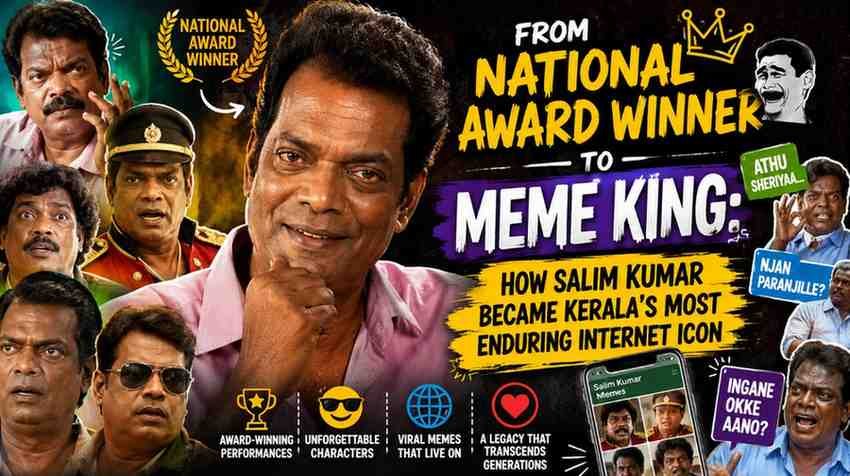
In the peculiar economy of internet fame, longevity is rarely guaranteed by talent alone. Actors win awards, disappear from screens, and fade from conversation within a season. Salim Kumar defied this logic entirely. During the years he was absent from Malayalam cinema, recovering from the health complications that had sidelined him after his peak, he did not fade he multiplied. Across WhatsApp forwards, Facebook comment sections and early Malayalam meme pages, his face and his words became a shared cultural shorthand for an entire generation of Kerala’s internet users.
This is a phenomenon worth examining seriously, because it speaks to something rare: a performer whose screen presence was so distinctively human, so rooted in the textures of ordinary Kerala life, that digital culture could absorb him wholesale and redeploy him endlessly without diminishing the original. Most celebrities become memes by accident. Salim Kumar became one by virtue of an artistic identity so legible, so immediately recognisable, that any frame extracted from his filmography arrived pre-loaded with meaning.
The Grammar of the Salim Kumar Meme
To understand why Salim Kumar’s image travelled so effectively across the internet, one must first understand what he represented on screen. Unlike the aspirational archetypes that dominate mainstream cinema the brooding hero, the reformed villain, the sacrificial patriarch Salim Kumar specialised in characters who were conspicuously, almost defiantly, average. His men were petty in the most sympathetic sense: small ambitions, large grievances, an inexhaustible capacity for self-justifying logic delivered with complete sincerity.
This is precisely the register that meme culture operates in. The internet’s most durable satirical formats are not portraits of the extraordinary they are mirrors held up to recognisable, slightly embarrassing human behaviour. The gap between how Salim Kumar’s characters perceived themselves and how the world actually received them was the gap that meme creators exploited with surgical precision. A still of his particular expression of wounded dignity, paired with a caption about being overlooked for a promotion or offering unsolicited advice, required no translation. The joke assembled itself.
The National Award That Preceded the Memes
The irony of Salim Kumar’s meme-king status is that it followed the most formally prestigious moment of his career. His National Award for Best Supporting Actor in 2011, for his performance in Adaminte Makan Abu, represented a different kind of recognition entirely the institutional acknowledgement of a performance of profound restraint and emotional authenticity. Directed by Salim Ahamed, the film was a quiet, deeply humane portrait of an ageing Muslim couple’s spiritual and financial struggle, and Salim Kumar’s work in it was a revelation to those who had primarily encountered him in comic roles.
The performance demonstrated a range that his mainstream filmography had only intermittently revealed. Here was an actor capable of sustaining a register of sustained, unperformed grief a quality that demands technical control of the highest order. The National Award was not a surprise to those who had watched his career carefully; it was, rather, a belated institutional catching-up with what perceptive audiences had understood for years.
| Dimension | Salim Kumar the Meme | Salim Kumar the Actor |
|---|---|---|
| Primary register | Comic indignation, petty grievance | Tragicomic humanism, restrained pathos |
| Source material | Commercial entertainers, comic roles | Full filmography including art-house work |
| Audience | Kerala internet users, pan-India Malayalam diaspora | Malayalam cinema audiences across decades |
| Peak period | 2011–2015, accelerating post-2013 | 2000–2011, climaxing with National Award |
| Cultural function | Satirical mirror of everyday behaviour | Empathetic portrayal of marginalised lives |
| Longevity mechanism | Viral circulation, remixability | Critical acclaim, awards recognition |
Absence as Amplification: The Three Silent Years
When Salim Kumar withdrew from films due to health concerns in the years following his National Award, the conventional expectation would have been a gradual dimming of public presence. Instead, his absence functioned as a kind of creative permission. With no new screen appearances to update or complicate the existing image, meme creators worked freely with a fixed, highly legible archive. The image stabilised into iconography.
There is a parallel here with how certain musicians become definitively associated with a particular era precisely because they stopped recording the absence preserves a version of the artist that continued presence would inevitably revise. Salim Kumar’s hiatus created a similar dynamic. The meme-Salim Kumar remained perpetually in the mid-2000s comedies, perpetually delivering that expression of injured righteousness, perpetually available for recontextualisation without the complication of new material.
His return to screens, when it came, was greeted with genuine warmth in part because internet users felt a proprietary affection for a figure they had kept alive in his absence. This is an unusual reversal of the normal celebrity-audience dynamic: the audience had, in a meaningful sense, sustained the actor’s cultural relevance during the period when he could not sustain it himself.
The Dialogue as Raw Material
Beyond visual frames, it was Salim Kumar’s dialogue delivery that gave the meme ecosystem its richest raw material. Malayalam popular cinema of the 2000s was generous with witty, aphorism-dense writing, and Salim Kumar was among its most reliable delivery vehicles. His timing was unhurried a quality that translates poorly to the quick cuts of commercial cinema but exceptionally well to the static image format of a meme, where the reader supplies the timing themselves.
Certain lines from his performances became detached entirely from their original contexts and achieved a second, independent life as general-purpose responses to the absurdities of daily existence. The lines worked because they were not merely funny they were structurally complete as observations. A well-constructed comic line, like a well-constructed proverb, carries its own logic and requires no context to function. Salim Kumar’s best dialogue, written for specific characters in specific situations, had this quality of self-sufficiency.
Meme Fame vs. Screen Fame: A New Cultural Equation
Salim Kumar’s trajectory raises a question that Malayalam cinema and Indian popular culture more broadly has only begun to grapple with seriously: what is the relationship between institutional recognition and digital cultural presence, and which form of fame is ultimately more durable?
His National Award represents the pinnacle of formal institutional recognition in Indian cinema. Yet the memes arguably reached a larger and more demographically diverse audience than any film he appeared in. They crossed linguistic barriers non-Malayalam speakers encountered and circulated the images without necessarily understanding the original dialogue. They crossed generational barriers teenagers who had never watched a full Malayalam film knew his face and his particular expression of comic dignity.
This is a genuinely new phenomenon in Indian celebrity culture. Earlier generations of character actors achieved regional fame and occasional national recognition, but their cultural presence was bounded by the distribution networks of physical cinema. The internet collapsed those boundaries, and in doing so, created a category of fame that has no precedent: the beloved supporting actor whose image escapes the films that created it and achieves independent circulation.
The Humanity Behind the Meme
What is easy to lose in the analysis of Salim Kumar’s meme career is what the memes actually represent: an audience’s deep, affectionate recognition of a particular kind of human being that he spent decades portraying with care and intelligence. The characters that became memes were not objects of ridicule they were portraits of recognisable people, drawn with sufficient empathy that audiences could simultaneously laugh at them and see themselves in them.
This is the mark of genuine comic artistry, as opposed to mere clowning. The internet did not make Salim Kumar a meme because he was a buffoon. It made him a meme because his characters were so precisely, generously observed that they functioned as mirrors the kind of mirrors that make you laugh at yourself without making you feel diminished. That quality of generous, intelligent comic observation is rarer than it appears, and it is what distinguishes the performers who generate enduring cultural imagery from those who generate merely temporary Entertainment.
Legacy: The Meme King Who Was Always More Than a Meme
Salim Kumar’s return to active filmmaking was received not merely as the comeback of a beloved actor but as the restoration of something the Malayalam film ecosystem had genuinely missed a particular quality of warmth, intelligence and comic humanity that his specific talent made available. The memes had kept him present, but presence is not the same as participation, and his physical return to sets signalled that the man behind the images had recovered sufficiently to inhabit new ones.
The deeper legacy, however, may be the template he established for how a regional language actor’s cultural impact can now scale globally through digital circulation. In the years since his meme peak, Malayalam cinema has produced multiple actors whose images and dialogues travel rapidly across internet platformsa pattern that his trajectory helped establish and normalise.
Salim Kumar did not become a meme king by accident or by algorithm. He became one because decades of intelligent, empathetic comic performance had created an archive of human observation so precisely rendered that the internet recognised itself in it and, recognising itself, could not stop sharing what it saw.</blockquot
For breaking news and live news updates, like us on Facebook or follow us on Twitter and Instagram. Read more on Latest Entertainment on thefoxdaily.com.






COMMENTS 0