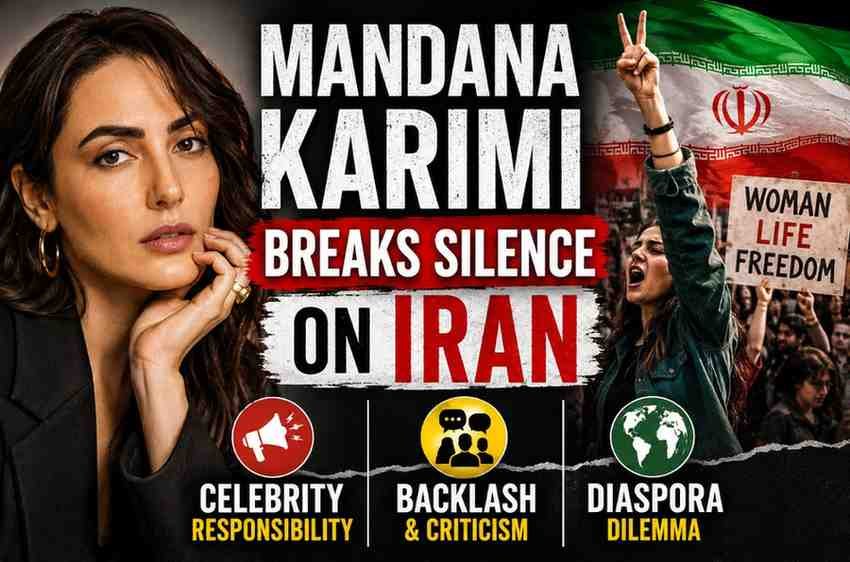
In an era where celebrities are increasingly held to account for what they say and just as fiercely, for what they don’t Mandana Karimi has found herself at the centre of a storm that goes far beyond Bollywood gossip. The Iranian-born model and actress, who has built her career and life in India over the past decade, is facing pointed criticism from sections of the public and diaspora communities who feel her silence on the escalating Iran conflict amounts to normalisation of oppression. This week, she responded directly, personally, and with evident emotion.
“I am not normalising oppression,” Karimi stated plainly, pushing back against critics who have questioned why someone with direct Iranian roots has not used her platform more vocally to condemn the conflict or the Iranian regime. Her response has reignited a broader conversation that extends well beyond one actress: what do we actually have the right to demand from public figures who carry the weight of their homeland’s crisis while trying to survive in a country that is not their own?
The Context: Iran, War, and the Diaspora Dilemma
To understand why Mandana Karimi’s situation resonates so deeply, it is necessary to understand what is unfolding in Iran and what it means to be Iranian abroad in this moment. Iran has been at the centre of a devastating military conflict that has drawn international condemnation and created an acute humanitarian crisis. The Iranian people particularly women and young people have been living under compounding pressures: economic strangulation from sanctions, political repression that has intensified since the Mahsa Amini protests of 2022, and now the trauma of active warfare.
For Iranians living outside the country, this creates a psychologically and politically complex position. Many have family members still inside Iran parents, siblings, extended relatives whose safety can be directly affected by the public statements their diaspora relatives make. Governments with authoritarian tendencies have long used the relatives of outspoken dissidents or critics as leverage. Speaking loudly from the safety of a foreign country while your family remains within reach of a retaliatory state apparatus is not a costless act. It is a calculation that involves real human stakes.
Mandana Karimi has lived in India for years, having come to prominence through Bollywood modelling and eventually the reality television circuit, including her appearance on Bigg Boss 9. She occupies a particular kind of celebrity liminal space visible enough to attract public expectations, yet without the insulated security of a truly A-list platform. Her position is not that of a detached bystander. It is that of a person navigating a crisis from inside a complicated personal geography.
What Mandana Actually Said and What It Reveals
Karimi’s response was notable not for its length or its specificity but for its emotional directness. She did not deflect behind PR language or vague statements of solidarity. She addressed the accusation head-on: that staying silent means staying complicit. Her rejection of that framing “I am not normalising oppression” signals that she has thought carefully about this distinction and refuses to accept a binary that equates public loudness with genuine resistance.
She also appeared to push back against the idea that a single social media post or public declaration constitutes meaningful political action, while simultaneously acknowledging the pain of her connection to Iran and its people. This is a nuanced position that critics in the age of performative activism often find unsatisfying because it does not produce the content, the hashtag, or the shareable moment that social media outrage cycles demand.
What Karimi’s statement implies, without stating outright, is something many diaspora individuals understand intimately: survival and silence are not the same as approval. The people who fled, who rebuilt lives elsewhere, who navigate dual identities across cultures they did not leave because they supported the systems they escaped. Many carry their opposition quietly, privately, and at personal cost that public commentators rarely account for.
The Double Standard Celebrities of Colour Face on Geopolitical Issues
There is a structural dimension to this controversy that deserves honest examination. The expectation that celebrities from conflict-affected countries must serve as vocal political representatives of their homelands is applied with remarkable inconsistency. Indian celebrities are rarely expected to speak out on every instance of communal violence or government overreach in India. Western celebrities are almost never held accountable for the foreign policy actions of their governments in the way diaspora entertainers are expected to personally answer for the regimes they fled.
The burden of geopolitical spokesperson falls disproportionately on individuals from countries currently in crisis, from communities already othered by the mainstream, and on women more than men. Mandana Karimi a woman, a foreigner in the country where she works, and someone without the institutional protection of a major production house or a powerful personal brand is being asked to take political risks that far more powerful and insulated figures routinely avoid without censure.
This is not to say that celebrity silence on humanitarian crises is never worth examining. It is worth examining consistently, and across all celebrities, not selectively applied to those already operating from positions of vulnerability.
Iran’s Diaspora and the Weight of Watching from Afar
The Iranian diaspora is one of the most politically engaged, culturally vibrant, and emotionally burdened communities in the world. Spread across the United States, Europe, Canada, India, and beyond, millions of Iranians abroad have watched their homeland convulsed by revolution, war, sanctions, and now renewed conflict often with family still inside, and always with the acute awareness that they cannot go back without risk.
The Woman, Life, Freedom movement that erupted globally following Mahsa Amini’s death in 2022 demonstrated the diaspora’s capacity for fierce, sustained, public solidarity. Iranian women abroad cut their hair in protest. Demonstrations filled streets in dozens of cities. Social media was flooded with Farsi solidarity content. And yet, even within that movement, there were Iranians who could not speak publicly who supported everything being said but whose family situations, visa statuses, or personal circumstances made vocal participation genuinely dangerous rather than merely uncomfortable.
Mandana Karimi exists within that spectrum. Judging every point on that spectrum by the same standard as if silence and speech carry equivalent costs for everyone is a failure of empathy dressed up as political accountability.
The Social Media Court of Public Opinion and Its Limits
What makes this episode instructive beyond Karimi herself is what it reveals about how social media processes geopolitical trauma. When a major conflict erupts, the internet develops an almost algorithmic expectation: public figures must post, must speak, must signal. The failure to produce that signal within a culturally determined window is treated as evidence of moral failure regardless of the individual’s private grief, family situation, or genuine reasons for restraint.
This dynamic produces a peculiar incentive structure. Celebrities learn to post something anything quickly enough to avoid the backlash cycle, regardless of whether their statement is informed, meaningful, or connected to any actual action. The post becomes the point. The performance of concern becomes indistinguishable from concern itself. And anyone who refuses to perform who chooses private grief or considered restraint over public signalling becomes, paradoxically, the most visible target.
Karimi’s case is a case study in this dynamic. Her eventual public response will generate more engagement than weeks of silence did. The controversy has made her a vehicle for a conversation she did not ask to host. And the underlying crisis the actual human suffering in Iran risks being further displaced by a secondary debate about a Bollywood actress’s social media behaviour.
What This Moment Asks of All of Us
There is something genuinely important embedded in the criticism Karimi faces, even if its expression is sometimes reductive. Platforms carry responsibility. Visibility creates opportunity to amplify voices that lack it. Silence can, under specific circumstances, function as complicity particularly when it is the silence of the powerful in the face of the suffering of the powerless.
But Mandana Karimi is not powerful in the ways that make that critique cleanly applicable. She is a working actress of Iranian origin, operating in an industry that is not her native one, in a country that is not her homeland, with family ties to a nation currently in crisis. The calculus she is navigating is genuinely complex, and she deserves the intellectual honesty of having that complexity acknowledged before judgment is rendered.
“I am not normalising oppression” is not a deflection. It is a statement of identity. It is a person refusing to have silence weaponised against her by a discourse that has already decided what her silence means and insisting that she, not the algorithm, gets to define what her silence is.
Conclusion: Beyond the Hashtag — What Real Solidarity Looks Like
The controversy around Mandana Karimi will likely fade as the news cycle moves on. But the questions it raises will not because they are not really about her. They are about what we expect from people living at the intersection of celebrity, diaspora, and crisis. They are about whether we have the sophistication to distinguish between different kinds of silence. And they are about whether our demand for public solidarity is genuinely motivated by concern for those suffering, or by our own need to see that concern performed for our consumption.
Real solidarity with the Iranian people or any people enduring conflict and oppression will not be built on Instagram posts or the policing of celebrity social media timelines. It will be built through sustained political pressure on governments, through support for humanitarian organisations working on the ground, through amplifying the voices of those directly affected who choose to speak, and through the hard, unglamorous work of keeping attention on a crisis long after the algorithm has moved on.
Mandana Karimi is one person, carrying a private weight in a public space. She is not Iran’s ambassador, its spokesperson, or its moral conscience. She is a woman trying to navigate an impossible position with dignity and her insistence on defining her own silence on her own terms deserves, at minimum, the respect of being taken seriously rather than simply condemned.
For breaking news and live news updates, like us on Facebook or follow us on Twitter and Instagram. Read more on Latest Entertainment on thefoxdaily.com.





COMMENTS 0