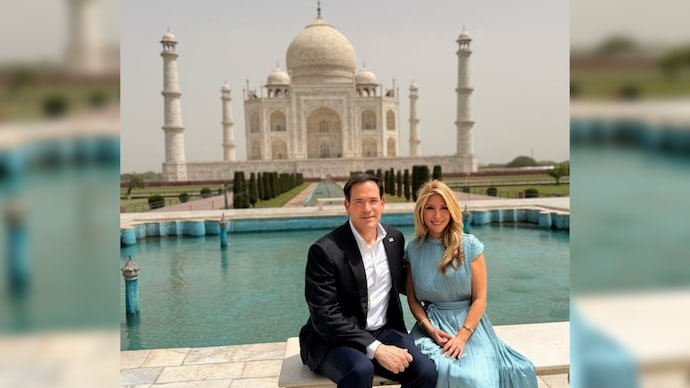
When US Secretary of State Marco Rubio posed for photographs in front of the Taj Mahal alongside his wife Jeanette Rubio during his India visit, it looked like a standard diplomatic photo opportunity. The Taj Mahal is one of the world’s most recognisable landmarks, routinely visited by presidents, prime ministers and global dignitaries.
But within hours, the visit sparked an unexpected geopolitical response.
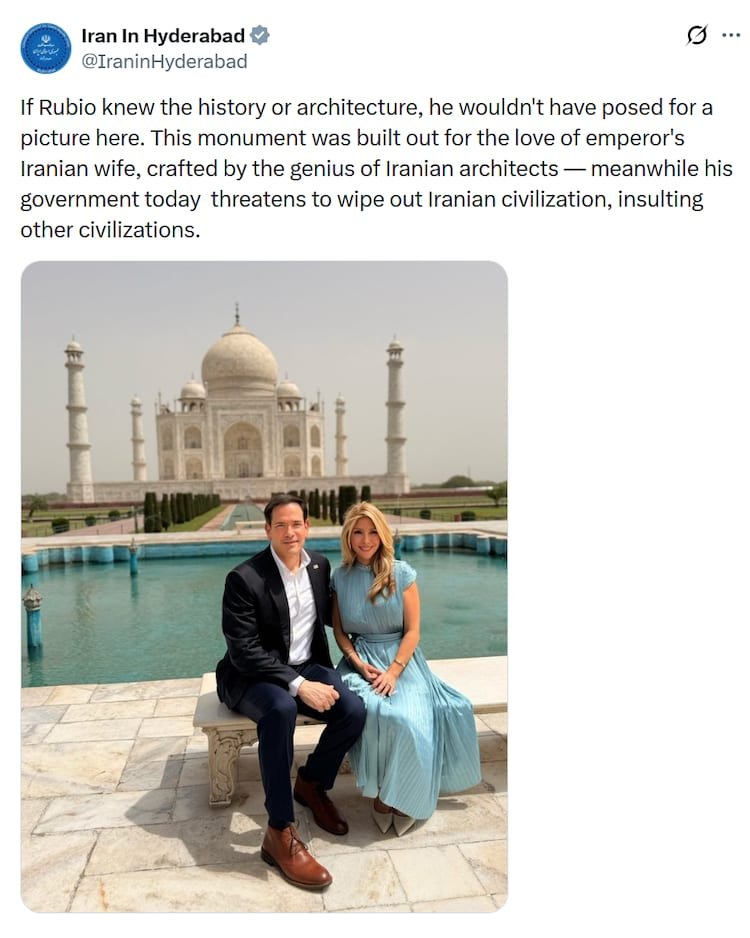
The Iranian Consulate in Hyderabad took a pointed swipe at Rubio on Social Media, suggesting that if the American diplomat truly understood the history and architectural legacy of the Taj Mahal, he may have reconsidered the symbolism behind the visit.
The remark quickly went viral because it touched on something much deeper than tourism or heritage. Iran was not merely talking about architecture. It was making a broader political argument about civilisation, cultural legacy and what Tehran views as contradictions in Washington’s approach toward Iran.
The episode demonstrates how monuments like the Taj Mahal are no longer just historical sites. In today’s geopolitical climate, they also function as symbols through which countries project narratives about identity, influence and legitimacy.
Why Iran Reacted So Strongly to Rubio’s Taj Mahal Visit
The Iranian Consulate’s criticism was carefully framed around history.
Its message argued that the Taj Mahal represents centuries of Persian cultural influence in the Indian subcontinent. By highlighting the Iranian roots connected to the monument, Tehran sought to contrast Persia’s historical contribution to global civilisation with what it sees as modern American hostility toward Iran.
The diplomatic subtext was unmistakable:
- Iran portrays itself as an ancient civilisation with deep cultural contributions
- The United States is portrayed as threatening that civilisation through sanctions, pressure and regional confrontation
- Rubio visiting a monument tied partly to Persian heritage therefore became symbolically ironic in Tehran’s eyes
In other words, Iran transformed a tourism moment into a geopolitical narrative.
This reflects a wider pattern in modern Diplomacy where cultural history increasingly becomes part of strategic messaging.
The Persian Influence Behind the Taj Mahal
The Iranian Consulate’s comments were rooted in genuine historical connections, although framed politically.
The Taj Mahal, commissioned by Mughal emperor Shah Jahan in memory of his wife Mumtaz Mahal, is deeply influenced by Persian artistic traditions.
Mumtaz Mahal herself, originally named Arjumand Banu Begum, came from a Persian noble lineage connected to the Mughal court.
Persian influence during the Mughal era extended far beyond family ties. It shaped:
- Architecture
- Court culture
- Language
- Poetry
- Calligraphy
- Garden design
- Decorative arts
The Mughal Empire heavily absorbed Persian aesthetics, especially during the reigns of Akbar, Jahangir and Shah Jahan.
That influence is visible throughout the Taj Mahal complex:
- Symmetrical Persian garden layouts
- Calligraphic Quranic inscriptions
- White marble inlay craftsmanship
- Geometric artistic patterns
- Dome architecture inspired partly by Persian-Islamic traditions
However, the Taj Mahal is not exclusively Persian in identity.
It is equally the product of Indian craftsmanship, Central Asian influence and Mughal imperial synthesis.
Thousands of artisans from multiple regions contributed to its construction over more than two decades.
That complexity is important because modern political narratives often simplify layered histories into nationalistic talking points.
The Taj Mahal Is a Global Monument Not a Single-Civilisation Symbol
One major nuance often overlooked in political debates is that Mughal architecture itself was highly hybrid in nature.
The Taj Mahal represents a fusion of:
| Influence | Contribution to Taj Mahal |
|---|---|
| Persian | Garden planning, calligraphy, aesthetics |
| Indian | Craftsmanship, stonework, decorative motifs |
| Central Asian | Mughal imperial design traditions |
| Islamic architecture | Domes, arches, symmetry |
| Local artisanship | Marble inlay and carving excellence |
This fusion is precisely what made Mughal architecture globally admired.
Trying to frame the Taj Mahal as belonging exclusively to one modern nation or civilisation oversimplifies centuries of interconnected history.
Ironically, that interconnectedness is exactly what makes the monument globally significant.
Why Cultural Heritage Has Become a Diplomatic Weapon
The Rubio episode also highlights a growing global trend: countries increasingly use culture and history as tools of soft power.
Soft power refers to a nation’s ability to influence global perception through culture, heritage, ideas and values rather than Military or economic force alone.
Iran has long relied heavily on civilisational identity in its diplomacy.
Unlike smaller states whose geopolitical influence depends mostly on economics or military alliances, Iran frequently frames itself as:
- An ancient civilisation
- A centre of Persian culture
- A historical intellectual power
- A guardian of regional identity
That narrative becomes especially important during periods of confrontation with the United States.
Whenever tensions escalate, Iranian officials often emphasise:
- Persian history
- Poetry and philosophy
- Scientific contributions
- Architectural heritage
- Cultural resilience
The Taj Mahal controversy fits into that broader communication strategy.
Marco Rubio’s India Visit Was About Much More Than Tourism
Rubio’s Taj Mahal stop came during a strategically important India visit focused on strengthening US-India relations amid rising global instability.
The trip involved discussions on:
- Trade cooperation
- Indo-Pacific security
- Supply chain resilience
- China’s regional influence
- Quad cooperation
- Energy security
- West Asia tensions
Rubio’s broader diplomatic messaging during the visit made it clear that Washington increasingly views India as one of its most important strategic partners.
That matters because Iran closely watches the growing US-India relationship.
Historically, India maintained relatively balanced relations across the Middle East, including ties with Tehran. But over the past two decades, India’s deepening strategic partnership with the United States and Israel has gradually altered regional equations.
From Tehran’s perspective, Rubio’s visit symbolised America strengthening influence in a region historically connected to Persian civilisation.
The Taj Mahal criticism therefore carried geopolitical undertones beyond architecture itself.
The Irony Iran Wanted the World to Notice
The Iranian Consulate’s social media message attempted to highlight what Tehran sees as a contradiction:
An American official admiring a monument shaped partly by Persian artistic influence while the US government simultaneously pressures Iran economically and strategically.
This rhetorical strategy is designed to create moral contrast.
Iran frequently argues that:
- Its civilisation contributed to global culture
- Western governments isolate it politically
- Its cultural legacy survives despite sanctions and pressure
By invoking the Taj Mahal’s Persian connections, Tehran tried to reinforce the idea that Iranian civilisation remains globally embedded regardless of contemporary Politics.
It was less about Rubio personally and more about narrative positioning.
The Timing Matters: Ongoing US-Iran Tensions
The diplomatic jab also came during a highly sensitive moment in US-Iran Relations.
Recent months have seen:
- Escalating regional tensions
- Negotiations over nuclear restrictions
- Disputes surrounding the Strait of Hormuz
- Sanctions-related disagreements
- Regional security confrontations
At the same time, the United States has been trying to strengthen strategic coordination with Gulf allies and India.
Iran likely viewed Rubio’s India visit through that broader geopolitical lens.
Diplomatic symbolism matters enormously during periods of heightened tension. Even seemingly ordinary gestures can become loaded with political meaning.
That is why Tehran responded publicly rather than ignoring the photo opportunity.
The Social Media Era Has Changed Diplomacy
One reason the exchange gained attention so quickly is because diplomacy today increasingly unfolds online.
In previous decades, such remarks may have remained buried in official statements or diplomatic briefings. Today:
- Consulates tweet directly
- Officials communicate through social media
- Diplomatic messaging becomes instantly viral
- Historical debates become public spectacle
This creates a faster and often more theatrical form of international communication.
Countries now use memes, sarcasm, historical references and public commentary to shape narratives globally.
The Iranian Consulate’s remark “If Rubio knew the history…” was crafted specifically for social media virality.
It combined:
- Historical reference
- Political criticism
- Cultural pride
- Diplomatic sarcasm
That formula works extremely well online.
Could This Affect India Diplomatically?
Probably not directly.
India generally avoids becoming entangled in rhetorical battles between the United States and Iran unless core strategic interests are involved.
India maintains important ties with both:
- The US is a critical strategic and economic partner
- Iran remains geographically and historically important
New Delhi has historically tried to balance relations carefully across competing regional blocs.
However, episodes like this do place India indirectly at the centre of wider geopolitical symbolism.
The Taj Mahal is not merely an Indian monument anymore in diplomatic terms. It has become part of broader global narratives involving:
- Civilisation
- Identity
- Soft power
- Historical ownership
- Cultural influence
The Deeper Reality: History Is Shared, Not Owned
One important lesson from the controversy is that major historical monuments rarely belong to a single modern identity.
The Taj Mahal reflects centuries of exchange between cultures, empires, artisans and traditions.
Its beauty emerged precisely because civilisations interacted rather than remained isolated.
That makes attempts to exclusively nationalise or politicise such heritage inherently incomplete.
The monument belongs simultaneously to:
- Indian history
- Mughal history
- Persian artistic legacy
- Global architectural heritage
Its enduring global appeal comes from that synthesis.
Conclusion
Marco Rubio’s Taj Mahal visit may have looked like a routine diplomatic stop, but Iran’s reaction transformed it into a revealing geopolitical moment.
The controversy exposed how deeply culture, history and diplomacy are now intertwined in modern international politics. Tehran used the episode to project civilisational pride, criticise US policy and remind the world of Persia’s historical influence far beyond modern Iranian borders.
At the same time, the debate highlighted a larger truth: monuments like the Taj Mahal cannot be reduced to single political narratives. They are products of layered histories shaped by multiple cultures and generations.
In an era where diplomacy increasingly plays out through symbolism and social media, even a photograph in front of a centuries-old monument can become part of a much larger global conversation.
And that conversation, much like the Taj Mahal itself, extends far beyond borders.
For breaking news and live news updates, like us on Facebook or follow us on Twitter and Instagram. Read more on Latest World on thefoxdaily.com.






COMMENTS 0