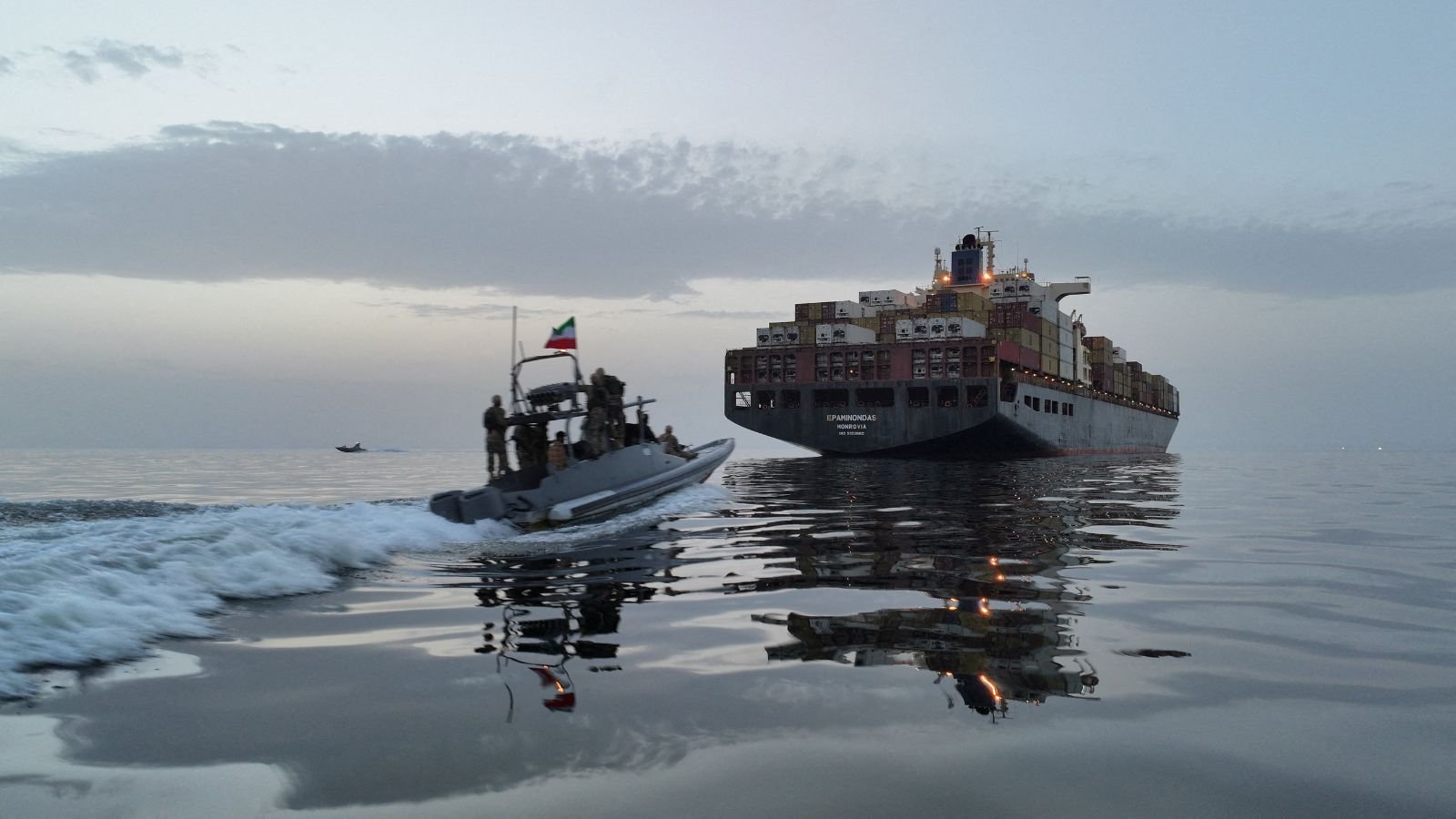
Iran is increasingly treating the Strait of Hormuz as its most powerful bargaining tool in the war with the United States, betting that control over one of the world’s most important energy routes can force Washington to reconsider its military and economic pressure on Tehran.
The strategy gives Iran a powerful source of leverage because the narrow waterway connects the Persian Gulf with the Gulf of Oman and carries a substantial share of globally traded oil and gas. But the same tactic that could strengthen Tehran’s negotiating position also threatens to deepen an economic crisis inside Iran, where the war has already damaged infrastructure, reduced oil exports and intensified pressure on households.
Iran appears to believe that the longer the conflict continues, the more political and economic costs will accumulate for the United States and its allies. Tehran is also calculating that reopening the waterway by force could be expensive and potentially require a much larger American military commitment.
For Iran, however, the calculation is not without danger. Keeping the strait closed or restricting passage risks damaging its own economy, provoking stronger international action and creating additional pressure on a population already struggling with high prices and the consequences of war.
Why the Strait of Hormuz matters so much
The Strait of Hormuz is one of the world’s most strategically important maritime chokepoints.
It sits between Iran and Oman and provides the main maritime connection between the Persian Gulf and international waters. Oil and gas producers in the Gulf rely on the route to reach customers around the world.
That makes the strait far more than a geographical feature. Control over shipping through the waterway can affect energy prices, insurance costs, supply chains and the economic calculations of countries thousands of kilometres away.
Before the war, the strait functioned as an international shipping route. Iran’s current position represents a fundamental change because Tehran says the waterway will not simply return to unrestricted passage on the previous terms.
Iranian officials have described restrictions on ships attempting to pass without Iranian permission as a firm military position.
That makes the dispute about sovereignty and control as well as energy.
Iran sees Hormuz as its strongest bargaining chip
Iranian officials and analysts increasingly describe the strait as a central element of the country’s strategy.
The logic is straightforward. The United States can impose sanctions and conduct military operations against Iran, but Tehran can impose costs of its own by disrupting a waterway that matters to the Global Economy.
Abdolreza Davari, an analyst who previously advised former Iranian President Mahmoud Ahmadinejad, said the main objective was not necessarily to generate revenue from the waterway but to establish Iranian management and sovereignty over it.
That distinction is important.
If Iran were primarily interested in collecting fees from ships, the dispute could potentially be resolved through a commercial arrangement. But if Tehran is seeking formal recognition of its control over the strait, the issue becomes a much larger geopolitical confrontation.
Such an arrangement could represent a significant strategic gain for Iran and a setback for Washington, particularly if it established a new precedent for control over an international maritime route.
Iran says a deal with Oman could manage the strait
Iran says it is close to an arrangement with Oman concerning management of the Strait of Hormuz.
Any agreement, however, would be closely linked to the wider conflict and the US blockade. Tehran has indicated that the United States would need to lift the blockade for such an arrangement to work.
The details remain uncertain, including whether Iran would receive fees or other economic benefits from managing passage.
What is clearer is that Tehran wants any future arrangement to recognise the new reality it claims to have established during the war.
That creates a difficult negotiating problem for Washington. Accepting a formal Iranian role in managing the waterway could be portrayed as conceding to pressure. Rejecting it could leave the United States facing the costs and risks associated with trying to restore unrestricted passage militarily.
Why reopening Hormuz by force could be difficult
The United States has significant military capabilities in the Gulf and has experience protecting commercial shipping in the region. But reopening a contested maritime route during an active war is not necessarily a simple military operation.
Iran has naval assets, missiles, Drones and other capabilities that can threaten ships and military forces operating near the waterway.
Even if American forces could restore passage, protecting commercial shipping afterward could require a continuing military presence.
That is part of Iran’s calculation.
Tehran appears to believe that Washington has to consider not only whether it can reopen the strait, but also how much it would cost to keep it open and prevent renewed attacks.
The political calculation is equally important. Any prolonged military operation that pushes fuel and consumer prices higher could create additional pressure on the US administration.
Iran therefore sees time as a potential strategic asset.
Tehran believes US political pressure could grow
Iran’s strategy rests partly on the assumption that the economic consequences of the war will eventually become more difficult for Washington to absorb.
Higher energy prices can affect transportation, manufacturing and household spending. That makes disruption in the Gulf politically sensitive, particularly ahead of the US congressional elections in November.
Iran also points to US stocks of certain weapons and the potential costs of maintaining a prolonged military campaign.
These calculations are not guarantees that Washington will retreat. They are part of Tehran’s assessment of the pressure points available to it.
The United States could instead decide that allowing Iran to establish greater control over Hormuz would create a much larger long-term security problem and therefore justify a stronger response.
That is why the current standoff remains so dangerous: both sides may believe that time works in their favour.
China has also called for safe passage
Iran’s position has implications beyond its confrontation with Washington.
China is an important buyer of Iranian oil and maintains influence in Tehran. Beijing has previously said that normal and safe passage through the Strait of Hormuz should be restored.
That position highlights the difficulty Iran faces in presenting control of the strait as an exclusively bilateral issue with the United States.
Other countries depend on the waterway too. Gulf producers need it to export energy, Asian economies depend on reliable supplies and international shipping companies must consider the security of their vessels and crews.
The longer the restrictions continue, the more governments have an incentive to seek alternatives or pressure Iran to restore predictable navigation.
Iran’s economy is paying a heavy price
Iran’s strategic leverage comes with a substantial economic cost.
US and Israeli strikes have damaged parts of Iran’s industrial infrastructure, while the US blockade has sharply restricted the country’s ability to export oil.
Inside Iran, the consequences are being felt through high prices and deteriorating economic conditions.
The economic pressure matters politically because the government must maintain public support while fighting a major external conflict.
Iran has experienced significant domestic unrest in recent years, demonstrating that economic hardship can quickly become a political issue.
The leadership therefore faces a difficult choice. Maintaining pressure through Hormuz may strengthen Iran’s position against the United States, but prolonged disruption could make life harder for ordinary Iranians and create another source of dissatisfaction with the government.
The risk of renewed unrest is a major concern
The possibility of renewed Protests is one of the most serious domestic risks facing Tehran.
According to the supplied account, a currency crisis triggered major anti-government demonstrations in December, followed by a severe crackdown.
The economic damage caused by the current war could add to those pressures if food prices, shortages and unemployment worsen.
This creates an uncomfortable contradiction for Iranian leaders.
The government can use confrontation with the United States to rally nationalist support and present itself as defending Iranian sovereignty. But the same confrontation can deepen the economic hardship that fuels public anger.
That is why the Strait of Hormuz is both an external weapon and an internal political gamble.
Some Iranian voices are warning against pushing too far
Not everyone inside Iran appears convinced that prolonged confrontation is sustainable.
Mohammad Javad Zarif, who played a central role in negotiating the 2015 Nuclear Agreement as foreign minister, has argued that Iran’s position in the conflict could create an opportunity for diplomacy.
His warning is essentially economic: military gains may become less meaningful if Iran cannot translate them into a sustainable political and economic settlement.
That argument reflects a broader strategic question facing Tehran.
Winning leverage is not the same as achieving an outcome.
Iran may be able to impose costs on the United States through Hormuz, but eventually it must decide what it wants in return. If the objective is sanctions relief, economic recovery or recognition of its regional position, those goals require negotiations at some stage.
Iran also sees Hormuz as a way to show it has survived
The psychological dimension of the strategy should not be overlooked.
The conflict has reportedly inflicted serious damage on Iran’s leadership and military infrastructure. Tehran therefore has an incentive to demonstrate that it retains the ability to impose costs on its adversaries.
Control over the Strait of Hormuz provides a highly visible way to make that argument.
As Iranian analyst Rahman Ghahremanpour has argued, the strait allows Tehran to demonstrate that it has not been defeated and can still influence the regional balance of power.
That can also matter domestically.
For a government under economic and political pressure, demonstrating that military confrontation has produced tangible leverage can help reinforce its narrative of resistance.
But that advantage could disappear if the economic consequences become too severe.
The nuclear issue has temporarily moved into the background
The standoff over Hormuz has also changed the diplomatic agenda.
Iran’s nuclear programme has been one of the central points of confrontation between Tehran and Washington for years. The current maritime crisis has pushed that issue further into the background.
From Tehran’s perspective, that can be useful.
The government can negotiate over an immediate and highly visible security issue rather than having every diplomatic discussion centred on nuclear restrictions.
If nuclear talks resume later, Iran could potentially use its control over Hormuz as an additional bargaining chip.
That would give Tehran several issues to negotiate simultaneously: maritime access, sanctions, oil exports and nuclear restrictions.
What happens if Iran refuses to reopen the waterway?
The biggest danger is escalation.
If commercial ships attempt to pass without Iranian approval and Iran attacks them, the United States could face pressure to respond militarily. Any such exchange could quickly widen the conflict.
There is also a risk that other countries would become involved to protect their energy supplies and commercial shipping.
Iran would then have to manage the consequences of confronting not only Washington but potentially a much broader international coalition interested in freedom of navigation.
That is why a negotiated mechanism could eventually become attractive to all sides.
A system that provides predictable passage without requiring either Washington or Tehran to publicly surrender its core position could offer a way out of the immediate crisis.
Why Hormuz could determine the next phase of the war
The Strait of Hormuz has become more than another front in the conflict. It is now central to the question of who can impose costs on whom.
Iran believes its ability to restrict one of the world’s most important energy routes gives it leverage that cannot easily be neutralised without significant military and economic consequences.
The United States, however, faces a strategic choice between accepting a new Iranian role in the waterway and taking greater risks to restore unrestricted passage.
Neither option is straightforward.
For Iran, maintaining control could strengthen its negotiating position, but prolonged disruption threatens an economy already under severe strain. For the United States, allowing Iran to consolidate control could weaken American influence in the Gulf, while a military effort to reopen the route could expand the war.
What to watch next
The next developments will depend heavily on whether Washington and Tehran can convert the current standoff into a negotiated arrangement.
- The US blockade: Any decision by Washington to ease or tighten restrictions could directly affect negotiations over Hormuz.
- Commercial shipping: Attempts by vessels to resume passage will indicate whether Iran’s restrictions are becoming more or less durable.
- Oil prices and exports: Changes in global energy prices could alter the political calculations of both sides.
- Domestic conditions in Iran: Rising prices or renewed protests could increase pressure on Tehran to reach an agreement.
- US military decisions: Any move to expand operations around the strait would raise the risk of a wider regional conflict.
- Nuclear diplomacy: If talks resume, Iran’s control over Hormuz could become an additional bargaining issue.
Iran’s leverage comes with a deadline
Iran has managed to turn the Strait of Hormuz into one of the most important bargaining issues in the war. By restricting access to a critical energy route, Tehran can impose economic and strategic costs far beyond its borders.
But leverage has limits.
The longer the confrontation continues, the more pressure builds on Iran’s own economy. High food prices, reduced oil revenues, damaged infrastructure and the threat of renewed unrest could eventually make a prolonged standoff harder for Tehran to sustain.
That leaves Iran with a difficult strategic objective: use Hormuz to secure better terms without allowing the confrontation to become so costly that its bargaining position collapses.
The coming phase of the war may therefore depend less on who can deliver the next military strike and more on whether either side can turn its leverage into a workable political settlement.
For breaking news and live news updates, like us on Facebook or follow us on Twitter and Instagram. Read more on Latest World on thefoxdaily.com.





COMMENTS 0