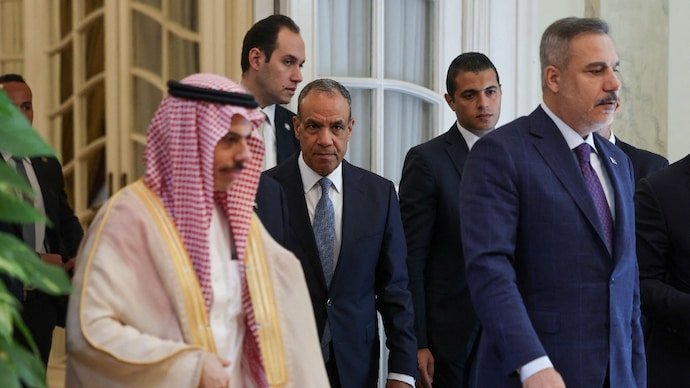
Turkey is assessing how it can help Saudi Arabia defend against attacks by Yemen’s Iran-aligned Houthi movement under the Mecca Joint defence Agreement, Turkish Foreign Minister Hakan Fidan said on Thursday.
Fidan described the agreement as defensive rather than offensive and said Turkish officials were examining what kind of support Ankara could provide, particularly in the area of air defence.
His comments come as Turkey prepares to send the Mecca Pact to Parliament for ratification, potentially moving the agreement from a recently signed political commitment towards a more formal stage of implementation.
Turkey Examines Air Defence Support for Saudi Arabia
Speaking at a joint news conference with his Hungarian counterpart in Ankara, Fidan said Turkey was studying ways to assist Saudi Arabia in countering attacks originating from Yemen.
He said the work was focused particularly on determining what Turkey could contribute to Saudi Arabia’s air defence capabilities.
The comments are significant because Saudi Arabia has faced renewed security threats from Houthi attacks, including missile and drone threats. Rather than describing the Mecca Joint Defence Agreement as a framework for offensive military action, Fidan presented it as a defensive arrangement intended to help member states respond to attacks against them.
Fidan also said preparations to send the text of the agreement to the Turkish Parliament for ratification had been completed.
What Is the Mecca Joint Defence Agreement?
The Mecca Joint Defence Agreement was signed on August 7, 2026, by Saudi Crown Prince Mohammed bin Salman, Turkish President Recep Tayyip Erdogan and Pakistani Prime Minister Shehbaz Sharif.
The agreement brought Turkey into a collective defence framework that had been established by Saudi Arabia and Pakistan in September 2025.
At its core, the pact commits the three participating countries to treating an armed attack against one member as an attack against all three. It also provides for closer defence cooperation between the signatories.
The arrangement creates a political commitment to collective defence, but the precise military mechanisms through which that commitment would operate remain unclear.
Turkey’s Parliament Still Has to Ratify the Pact
Fidan’s statement that the text is ready to be sent to Parliament marks an important step in Turkey’s participation in the agreement.
The ratification process is particularly significant because the practical implications of the pact depend partly on how Turkey’s domestic institutions formally approve and interpret the agreement.
Until the parliamentary process is completed, questions remain over the exact extent of Turkish military commitments under the arrangement.
Fidan’s comments indicate that Ankara is already examining potential forms of assistance, particularly defensive capabilities, while the political and legal process surrounding the agreement moves forward.
Mecca Pact’s Military Role Remains Unclear
Despite the agreement’s mutual-defence language, its practical military implications have not been fully defined.
The complete text of the pact has not been made public, and the agreement does not appear to establish a joint military command or permanent forces under a unified structure.
It also does not clearly define a specific military mechanism that would automatically determine how the three countries would respond if one member were attacked.
As a result, some analysts have viewed the mutual-defence commitment as primarily political rather than an immediately operational military arrangement.
That distinction could be important if Saudi Arabia faces further attacks from Yemen. The agreement creates a basis for closer cooperation, but the specific military contributions of Turkey and Pakistan would still need to be determined.
Air Defence Could Become an Early Area of Cooperation
Fidan’s emphasis on air defence provides one indication of how Turkey’s role could develop.
Saudi Arabia’s security concerns include threats from missiles and Drones launched from Yemen. Air defence systems, detection capabilities and related technologies could therefore form an important part of any practical cooperation under the pact.
Turkey’s potential contribution could focus on defensive capabilities designed to help Saudi Arabia protect its territory and critical Infrastructure.
Fidan’s description of the agreement as defensive also suggests that Ankara is framing its potential involvement around protection against attacks rather than participation in offensive military operations.
The exact systems, personnel or other capabilities Turkey could provide have not been specified.
Defence Cooperation Could Go Beyond Air Defence
Although air defence is currently receiving particular attention, the broader agreement could create opportunities for deeper military cooperation between Saudi Arabia, Turkey and Pakistan.
Potential areas include defence production, joint military exercises and intelligence sharing.
Closer cooperation in these areas could strengthen coordination among the three countries and create more institutional links between their armed forces over time.
Such cooperation would not necessarily mean the establishment of a permanent joint military force. Instead, it could develop through separate defence programmes, exercises, technology cooperation and information-sharing arrangements.
Saudi Arabia, Turkey and Pakistan Seek Closer Defence Links
The agreement brings together three countries with different military capabilities and strategic priorities but a shared interest in strengthening defence cooperation.
For Saudi Arabia, closer relations with Turkey and Pakistan could provide additional defence-industrial and diplomatic options. For Turkey and Pakistan, the agreement provides a framework for deeper security cooperation with Riyadh.
The arrangement could therefore have significance beyond any immediate response to Houthi attacks, particularly if the three countries expand cooperation in defence production and military training.
Mecca Pact Does Not Replace US-Saudi Security Ties
The new defence arrangement also exists alongside Saudi Arabia’s longstanding security relationship with the United States.
The Mecca Pact does not replace that relationship, and the countries participating in the new agreement are themselves US partners rather than strategic adversaries of Washington.
The United States has therefore not opposed the arrangement.
US President Donald Trump welcomed the agreement and said the participating countries would “finally be able to defend themselves in a more meaningful way”.
His response indicates that the new framework is not necessarily being viewed as a challenge to the existing US security relationship with Saudi Arabia.
What the Pact Could Mean for Saudi Arabia
For Riyadh, the agreement could provide additional avenues for defence cooperation at a time when the country faces continuing security concerns linked to the conflict in Yemen.
Its potential value may extend beyond the immediate question of whether Turkish or Pakistani military capabilities are deployed in response to an attack.
Expanded defence-industrial cooperation could give Saudi Arabia access to additional partners for military technology and production. Joint exercises and intelligence sharing could also improve coordination between the three countries.
At the same time, the absence of a clearly defined joint command structure or permanent force means the pact’s immediate military value remains dependent on decisions taken by each member when a security crisis occurs.
Turkey’s Next Step Will Be Parliamentary Ratification
Fidan’s announcement that the agreement’s text is ready to be sent to the Turkish Parliament brings the domestic ratification process into focus.
Parliamentary consideration will help determine how Turkey formally participates in the collective defence framework and could provide greater clarity over Ankara’s commitments.
In the meantime, Turkish officials are studying what practical assistance could be provided to Saudi Arabia, with air defence identified as a particular area of focus.
The Mecca Joint Defence Agreement is therefore moving into a more consequential phase. Its immediate emphasis remains defensive, but its longer-term significance could depend on whether Turkey, Saudi Arabia and Pakistan turn the political commitment into deeper military, industrial and intelligence cooperation.
For breaking news and live news updates, like us on Facebook or follow us on Twitter and Instagram. Read more on Latest World on thefoxdaily.com.




COMMENTS 0