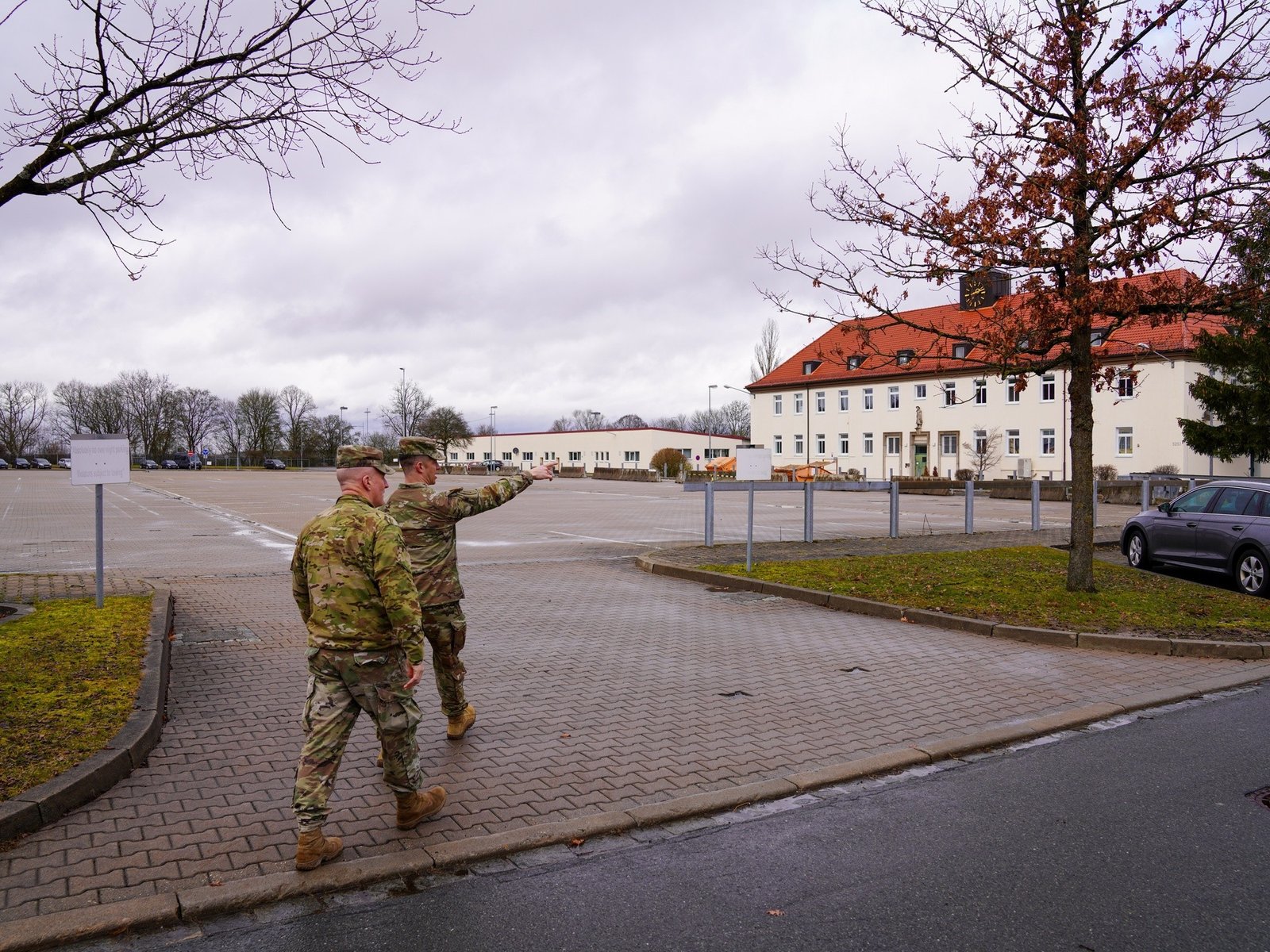
Two Drones were detected over a Bundeswehr military base in western Germany days after an explosive-laden drone was discovered at Leipzig/Halle Airport, intensifying concerns about the security of military facilities, cargo hubs and other sensitive Infrastructure.
German authorities are investigating two separate but closely timed drone incidents that have raised fresh questions about the country’s ability to protect critical sites from increasingly sophisticated unmanned aircraft. The latest incident occurred at a military base in Mechernich, western Germany, on Thursday night, while an explosive device attached to a drone had been discovered at Leipzig/Halle Airport two days earlier.
The incidents do not establish a connection between the two cases. However, their proximity in time has increased scrutiny of drone activity around locations that play important roles in Germany’s defence and logistics networks.
What happened at the German military base?
According to the German Armed Forces, security personnel at the Bundeswehr base in Mechernich detected two drones at about 10 p.m. on Thursday.
The sightings were confirmed, and military police were dispatched to the site. The Euskirchen Police Department subsequently opened an Investigation into the incident.
The military has not publicly identified who operated the drones, where they came from or what their purpose may have been. Authorities have also not said that the aircraft were carrying weapons or explosives.
That distinction is important. A drone being detected over a restricted military facility is a serious security matter, but the available information does not establish that the Mechernich aircraft were part of an attack.
The incident nevertheless highlights a basic security problem facing modern military installations: relatively small unmanned aircraft can enter controlled airspace, observe sensitive locations and potentially create disruption without requiring a conventional aircraft or a large operational footprint.
Why the Leipzig airport drone has raised greater alarm
The Mechernich sighting came only two days after a much more serious incident at Leipzig/Halle Airport.
On Tuesday night, a drone carrying an explosive device was discovered in a restricted area of the airport. German authorities neutralised the device, preventing it from detonating.
Interior Minister Alexander Dobrindt described the incident as representing a “new quality of danger”, reflecting the difference between ordinary unauthorised drone activity and the deliberate use of an unmanned aircraft in connection with an explosive device.
The investigation has since been taken seriously at the federal level. German authorities are examining whether the drone was intended to damage an aircraft, disrupt airport operations or target a particular facility or asset.
At this stage, however, the identity and motive of whoever placed the device remain matters for investigators.
Leipzig/Halle is more than a passenger airport
One reason the Leipzig/Halle incident has attracted particular attention is the airport’s role in European freight and military logistics.
Leipzig/Halle is one of Germany’s important air-cargo centres and operates around the clock. It hosts major cargo operations, including DHL’s Leipzig hub, and has also played a role in NATO‘s Strategic Airlift International Solution, commonly known as SALIS.
The airport’s military significance is linked in part to its ability to handle large cargo aircraft and support strategic transportation requirements. Antonov transport aircraft associated with the SALIS programme have operated from Leipzig/Halle, making the airport relevant to the movement of heavy equipment and other military cargo.
The airport’s location also matters. Germany is a major logistical gateway for European support to Ukraine and for NATO activity along the alliance’s eastern flank. That means an incident affecting the airport can have implications beyond normal civilian aviation.
For security planners, the challenge is therefore not simply protecting passengers. It is also protecting cargo operations, aircraft, military logistics and the infrastructure that connects them.
How a drone changes the security equation
Drones present a different security problem from traditional aircraft.
A large aircraft is relatively easy to detect because of its size, flight profile and radar signature. Small drones can be much harder to identify and track, particularly when they operate at low altitude or near buildings and other sources of interference.
That makes sensitive locations such as airports, military bases, energy facilities and logistics centres particularly challenging to defend.
A drone can potentially be used for several purposes without necessarily carrying an explosive payload. It can be used for surveillance, reconnaissance, disruption or simply to test how quickly security personnel respond to an intrusion.
The Leipzig incident raises the stakes because the drone was not merely an unauthorised aircraft. It was found with an explosive device and detonator, according to reports on the investigation.
That changes how authorities have to assess future sightings. A drone that might previously have been treated primarily as an aviation safety problem may now have to be considered a potential security threat until investigators establish otherwise.
Why the timing of the two incidents matters
The two incidents occurred close together, but investigators have not publicly established that they were coordinated.
That means it would be premature to describe the Mechernich drones as a second part of the Leipzig operation. There is currently no confirmed evidence in the available information that the same people were responsible for both incidents.
Even without a proven connection, however, the sequence is significant from a security perspective.
Germany is dealing with increased attention on drone activity around sensitive infrastructure, while European authorities have also faced repeated reports of unidentified or unauthorised drones near airports and other strategic locations.
For authorities, every new incident creates a difficult balance. Overreacting to harmless or unexplained drone activity can cause unnecessary disruption. Underestimating a genuine reconnaissance or attack attempt can leave critical infrastructure exposed.
The Leipzig incident demonstrates why that balance is becoming more difficult.
Germany has already faced a drone and sabotage problem
The latest incident is not the first security scare involving Leipzig/Halle Airport.
In 2024, an incendiary device concealed in a parcel ignited at a DHL logistics facility at the airport, setting fire to a freight container. The incident became part of a wider European investigation into suspected sabotage involving incendiary packages.
Western security officials subsequently suspected Russian intelligence involvement in that wider activity. Investigators in several European countries examined links between incidents involving logistics facilities and cargo transportation.
Those earlier events are relevant because they show why security officials are paying close attention to another suspicious incident at the same airport.
But the two cases should not be treated as automatically connected. The 2024 parcel incident and the 2026 drone investigation involve different methods, and responsibility for the latest event has not been publicly established.
Russia allegations remain unproven in the latest case
The geopolitical background has inevitably shaped discussion of the Leipzig drone incident.
Germany is one of Ukraine’s important European supporters, while Leipzig/Halle has a role in military and strategic cargo transportation. That has prompted speculation that an attack on the airport could be connected to efforts to disrupt European assistance to Ukraine.
Some Western officials and politicians have raised the possibility of Russian involvement, particularly in light of previous allegations of Russian-linked sabotage operations across Europe.
Russia, however, has rejected the accusations. The Russian Embassy in Germany described the Leipzig incident as part of what it called a new wave of “anti-Russian hysteria”.
There is an important difference between suspicion and proof. Unless investigators establish who controlled the drone, how it entered the airport area and what objective the operator intended to achieve, attribution remains unresolved.
That makes the investigation itself one of the most important parts of the story.
A separate aviation incident added to the concern
The Leipzig airport episode also involved another unusual development.
A DHL cargo aircraft encountered an unidentified object after flight operations were disrupted by the security incident. The aircraft was able to land safely, although it sustained minor damage, according to reports on the investigation.
Authorities have been examining whether the object was another drone.
If confirmed, that would make the aviation-security implications even more significant because it would demonstrate the potential for drone activity to interfere directly with aircraft operations.
Even when a drone does not carry explosives, a collision with an aircraft can cause serious damage. That is why airports have increasingly treated unauthorised drone sightings as an operational and safety issue rather than merely a nuisance.
Europe has seen the consequences of drone incursions
The concern is not limited to Germany.
European airports have experienced repeated drone sightings in recent years, sometimes resulting in temporary airspace restrictions, diverted aircraft and cancelled flights.
One of the clearest lessons from previous incidents is that a relatively small unmanned aircraft can cause a disproportionately large disruption.
An airport cannot simply assume that an unidentified object is harmless. Once a drone is reported close to an active runway, authorities may have to slow or stop operations while they determine whether aircraft and passengers are at risk.
This creates a potential security dilemma: even an attacker who does not intend to destroy an aircraft could potentially create disruption simply by forcing authorities to respond to repeated drone sightings.
What authorities will likely focus on next
The investigation into the Mechernich incident is expected to focus on identifying the operators and determining whether the drones were conducting surveillance or simply entered restricted airspace.
At Leipzig/Halle, investigators face a more complex set of questions. They will need to determine how the explosive-equipped drone reached the restricted area, who controlled it, whether it was deliberately positioned near a particular aircraft or facility, and whether the device was capable of detonating as intended.
Investigators may also examine communications equipment, flight paths, recovered components and surveillance footage. Such evidence could help establish whether the operation was improvised or carefully planned.
The answers could influence how Germany changes its approach to protecting critical infrastructure from small unmanned aircraft.
What the incidents mean for German security
The immediate lesson is that drone security can no longer be treated as a problem limited to airports.
Military bases, logistics centres and other sensitive sites can also become potential targets for surveillance or disruption. The Mechernich incident demonstrates that concern is extending directly into the defence environment.
For Germany, the challenge is particularly complicated because many strategically important facilities operate within or alongside civilian infrastructure. Leipzig/Halle is a clear example: it is a commercial cargo airport that also supports military logistics.
That overlap creates security requirements that are broader than conventional airport screening. Protecting the ground perimeter is not enough if an aircraft can approach from above.
Possible responses could include stronger drone detection systems, improved coordination between police and military authorities, faster identification of operators and clearer procedures for responding to suspicious aircraft. The precise measures Germany adopts will depend on what investigators learn from the current cases.
The bigger issue: protecting critical infrastructure
The incidents also illustrate a wider European Security challenge.
Modern infrastructure depends on interconnected airports, warehouses, communications systems, military facilities and transport networks. Disrupting one part of that network can sometimes create effects far beyond the original location.
That is why drone activity around strategic sites attracts attention even when no physical damage occurs.
For Germany and its European partners, the objective is not simply to prevent a drone from reaching a runway or military base. It is to make sure that a low-cost unmanned aircraft cannot repeatedly exploit gaps between civilian aviation rules, police responsibilities and military security arrangements.
The Leipzig and Mechernich incidents therefore matter for more than the individual investigations. They are tests of how quickly Germany can detect, assess and respond to a category of threat that is becoming increasingly accessible.
What happens next
The most important development will be whether investigators can establish who was behind the Leipzig/Halle drone and whether the Mechernich sightings have any connection to a broader operation.
For now, the evidence does not justify treating the two incidents as a confirmed coordinated attack. But the discovery of an explosive device at a major cargo airport, followed days later by confirmed drone sightings over a military base, ensures that German security agencies will examine the cases with heightened attention.
The broader concern is clear: drones are becoming easier to obtain and can be used in environments where traditional security systems were not designed to deal with them. The challenge for Germany is to determine whether these recent incidents are isolated breaches or signs of a more persistent threat to critical infrastructure.
Until investigators provide clearer answers, the most significant fact is not who is being blamed, but what has already changed. A drone over a sensitive German site can no longer be dismissed automatically as a harmless intrusion, particularly when authorities have just dealt with an aircraft carrying an explosive device.
For breaking news and live news updates, like us on Facebook or follow us on Twitter and Instagram. Read more on Latest World on thefoxdaily.com.





COMMENTS 0