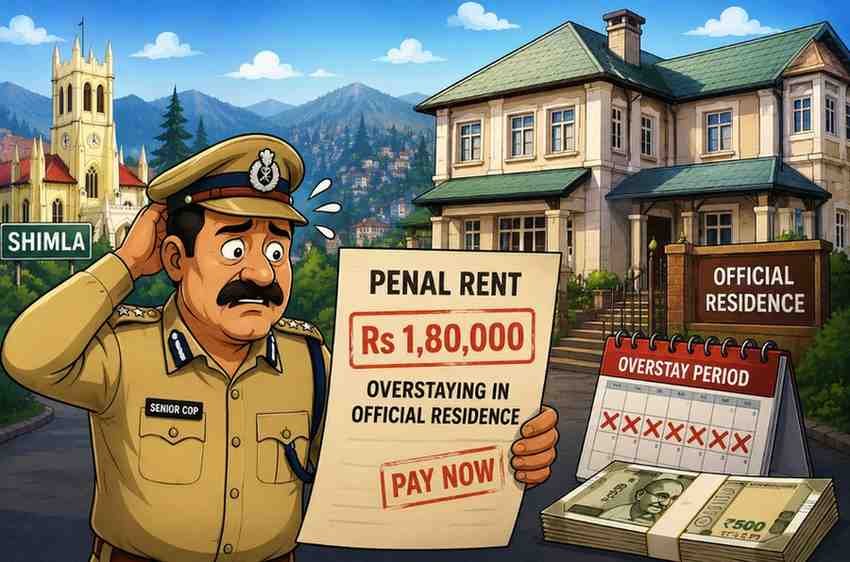
The issue of government accommodation often attracts attention only when disputes arise, but a recent case involving a senior police officer in Himachal Pradesh has brought the subject into sharp focus. Former Shimla Senior Superintendent of Police Sanjeev Kumar Gandhi, WHO was promoted and transferred to the position of Deputy Inspector General (Traffic, tourism and Railways), has been directed to pay more than Rs 1.8 lakh in penal rent for allegedly overstaying in an official residence after his transfer.
The matter has become significant not merely because of the amount involved but because it reflects a broader push by government departments to enforce housing regulations more strictly. The case also highlights challenges associated with the allocation, occupation, and management of official residences, especially in states where government housing remains a limited and highly sought-after resource.
At its core, the Controversy revolves around a straightforward question: how should government departments balance administrative rules with practical challenges faced by officers awaiting new accommodation?
What Happened in the Shimla Government Housing Case?
According to officials, Sanjeev Kumar Gandhi continued occupying an official residence earmarked for the Shimla Senior Superintendent of Police even after relinquishing charge and assuming a new role.
The Himachal Pradesh Police Department subsequently treated the continued occupation as unauthorized under existing government housing regulations.
The financial penalty reportedly includes:
- More than Rs 1.28 lakh for March and April.
- Nearly Rs 51,000 for May.
- Additional monthly deductions until the residence is vacated.
The total liability has crossed Rs 1.8 lakh and could continue increasing if the accommodation remains occupied.
Understanding Government Housing Rules in Himachal Pradesh
Government accommodation is governed by detailed regulations designed to ensure fair allocation and efficient use of limited residential resources.
Officials cited provisions under the Himachal Pradesh Allotment Government Residence (General Pool) Rules, 1994.
According to the relevant provisions:
- Officers transferred from a post must vacate designated accommodation within a specified period.
- Residences attached to particular positions are meant for the successor officer.
- Unauthorized occupation attracts penal rent.
- Departments may recover dues directly from salaries.
The objective is to prevent housing shortages and ensure smooth administrative transitions when officers are transferred or promoted.
Why Penal Rent Exists
Penal rent is not simply a fine. It serves as a deterrent against prolonged occupation of government properties beyond authorized periods.
Unlike regular license fees or rent, penal rent is intentionally higher to discourage delays in vacating official accommodations.
The Policy aims to:
- Ensure timely turnover of residences.
- Reduce waiting periods for incoming officers.
- Protect public assets.
- Promote administrative discipline.
- Prevent misuse of government housing.
Without such provisions, housing allocations could become significantly more complicated, particularly in cities where government residential units are limited.
The Officer’s Position
Reports indicate that Gandhi has disputed aspects of the proceedings.
According to statements attributed to him, he claimed he had not received the notice and questioned how details reached media organizations.
He also reportedly argued that he had not vacated the accommodation because alternative official housing had not yet been allotted.
This introduces an important dimension to the debate.
Many government officers across India face practical difficulties during transfers, particularly when new accommodations are unavailable immediately after assuming fresh responsibilities.
The Larger Problem of Government Housing Shortages
The case highlights a challenge faced by governments across India: demand for official housing frequently exceeds supply.
Major cities often witness:
- Long waiting lists.
- Delays in allotments.
- Maintenance issues.
- Limited premium housing stock.
- Administrative bottlenecks.
When an officer is transferred before new accommodation becomes available, difficult situations can arise despite the existence of clear rules.
This tension between regulatory compliance and practical realities often leads to disputes similar to the one currently under discussion.
Why Official Accommodation Matters for Public Administration
Government housing is not merely an employee benefit. In many cases, it serves important administrative functions.
Senior officials, police officers, judges, and civil servants often require accommodation close to their place of work for operational reasons.
Advantages include:
- Faster emergency response.
- Improved administrative coordination.
- Enhanced security arrangements.
- Reduced commuting challenges.
- Greater availability during crises.
Because these residences play a functional role, governments generally insist on strict compliance with allotment rules.
The Administrative Challenge of Enforcement
One reason this case has attracted attention is the decision to enforce penalties through salary deductions.
Such measures demonstrate that departments are increasingly willing to use stronger mechanisms to ensure compliance.
From an administrative perspective, enforcement serves several purposes:
- Maintaining fairness.
- Ensuring accountability.
- Preventing precedents.
- Protecting institutional credibility.
- Avoiding selective application of rules.
If exceptions become routine, housing regulations can quickly lose effectiveness.
Government Housing: Rules vs Practical Reality
| Regulatory Requirement | Practical Challenge |
|---|---|
| Vacate residence after transfer | New accommodation may not be available |
| Timely occupancy turnover | Administrative delays can occur |
| Strict compliance with rules | Personal relocation challenges |
| Penal rent for overstaying | Officers may face housing uncertainty |
| Fair allocation process | Limited housing inventory |
How Other Government Departments Handle Similar Situations
Across India, government departments generally follow comparable principles regarding official accommodation.
Although specific regulations vary by state and department, common features include:
- Grace periods after transfer.
- Enhanced charges for unauthorized occupation.
- Recovery through payroll systems.
- Eviction proceedings in extreme cases.
- Periodic audits of housing occupancy.
Central government departments and public sector undertakings also maintain detailed housing rules aimed at maximizing efficient utilization.
Why This Case Could Set an Example
The significance of this case extends beyond one officer or one residence.
When senior officials are subjected to the same housing rules as other government employees, it sends a broader message about institutional accountability.
Public administration experts often argue that consistent enforcement strengthens confidence in Governance systems.
Conversely, perceptions of preferential treatment can undermine trust in regulatory frameworks.
An Overlooked Insight: Housing Management Is a Governance Issue
Most discussions surrounding official accommodation focus on individual disputes. However, the deeper issue is one of public asset management.
Government residences represent valuable public resources funded by taxpayers.
Efficient utilization of these assets affects:
- Administrative efficiency.
- Government expenditure.
- Employee welfare.
- Urban planning.
- Public accountability.
Viewed from this perspective, housing allocation is not merely a personnel matter but a governance challenge requiring transparent systems and effective oversight.
The Financial Impact of Delayed Vacating
When designated residences are not vacated on time, the consequences can ripple through the administrative system.
Potential impacts include:
- Delays in accommodating incoming officers.
- Additional temporary housing expenses.
- Administrative disputes.
- Legal proceedings.
- Reduced efficiency in housing allocation.
These indirect costs often exceed the immediate financial value of the residence itself.
Could Housing Policies Need Reform?
Cases such as this frequently reignite discussions about modernizing government housing policies.
Potential reforms sometimes proposed by policy experts include:
- Digital housing allocation systems.
- Real-time occupancy monitoring.
- Faster allotment procedures.
- Expanded housing inventories.
- Temporary accommodation frameworks for transferred officers.
Such measures could reduce disputes while maintaining strict compliance standards.
Future Outlook
The immediate future of the case will likely depend on whether the residence is vacated and whether any formal challenge is made regarding the penal rent calculation or enforcement process. The police department appears committed to applying existing housing rules, while the officer’s reported concerns highlight practical issues surrounding accommodation availability after transfers.
More broadly, the episode may encourage government departments to review occupancy records and strengthen compliance mechanisms. As public institutions increasingly emphasize transparency and accountability, stricter enforcement of housing regulations is likely to become more common.
Conclusion
The penal rent imposed on former Shimla SSP Sanjeev Kumar Gandhi is more than a routine housing dispute. It reflects the ongoing challenge of balancing administrative regulations with practical realities faced by government officials during transfers and promotions.
While housing rules exist to ensure fair and efficient use of public assets, cases such as this also highlight systemic issues related to accommodation availability and allocation processes. The decision to recover more than Rs 1.8 lakh through salary deductions underscores a growing emphasis on accountability within public administration.
Ultimately, the controversy serves as a reminder that government housing is not simply a benefit but a public resource whose management has implications for governance, efficiency, and institutional credibility.
For breaking news and live news updates, like us on Facebook or follow us on Twitter and Instagram. Read more on Latest India on thefoxdaily.com.






COMMENTS 0