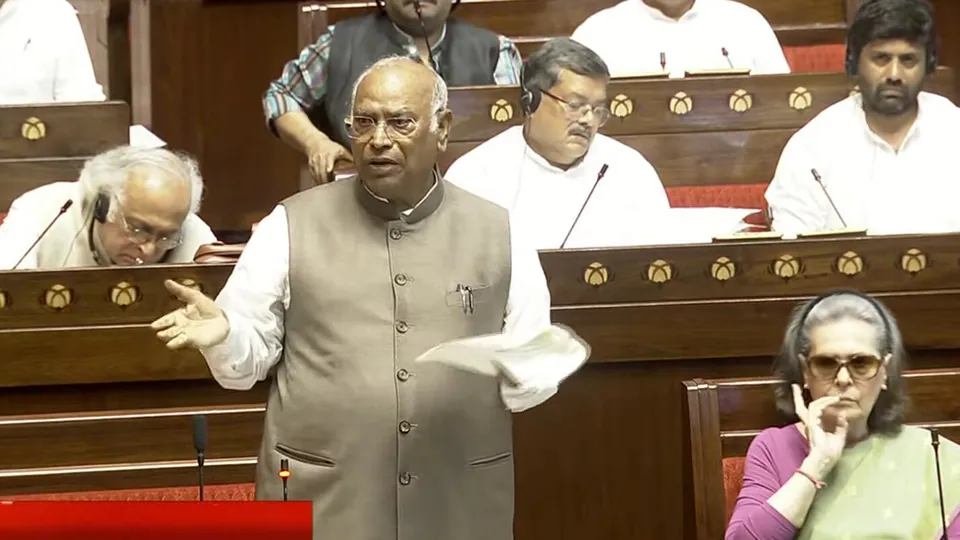
Political tensions escalated in Parliament after Mallikarjun Kharge, Leader of Opposition in the Rajya Sabha, sharply questioned Union Home Minister Amit Shah over his absence during discussions surrounding the police response to the nationwide student protests linked to the NEET-UG controversy. Kharge accused the government of avoiding accountability over allegations of excessive force used during demonstrations and argued that Parliament deserved direct answers from the country’s top leadership.
The remarks came as the Public Examinations (Prevention of Unfair Means) Amendment Bill, 2026 was introduced in the Rajya Sabha following its passage in the Lok Sabha. While the government presented the legislation as a major step toward strengthening examination integrity, opposition leaders maintained that the proposed changes focused more on punishment than preventing future examination irregularities.
The debate reflected two parallel issues dominating the parliamentary session: demands for accountability over the handling of student protests and differing political views on how India’s examination system should be reformed.
Why Kharge Targeted Amit Shah
During his address in the Rajya Sabha, Kharge questioned why the Home Minister had not publicly responded to allegations regarding the police action taken during protests held in Delhi and other parts of the country.
Using strong political rhetoric, Kharge asked whether someone had “stitched” the Home Minister’s mouth shut, referring to what he described as the government’s silence over the events surrounding the July 20 demonstrations.
The statement immediately drew objections from members of the ruling alliance, who argued that the language was inappropriate for parliamentary proceedings. Kharge later clarified that his comments were directed toward seeking accountability rather than making personal remarks.
Political Background Behind the Debate
The confrontation follows weeks of political developments linked to the NEET-UG controversy and nationwide student protests.
| Development | Political Significance |
|---|---|
| Student Protests | Triggered nationwide debate on examination integrity. |
| Police Action | Raised allegations regarding use of force against protesters. |
| Ministerial Resignation | Increased demands for wider accountability. |
| New Examination Bill | Government proposes stronger legal framework. |
| Parliament Debate | Opposition questions both accountability and legislative approach. |
The issue has evolved beyond examination reforms into a broader political discussion involving governance, public accountability, and the handling of democratic protests.
Opposition Raises Questions Over Police Action
Congress leaders have consistently argued that the government should provide a detailed explanation regarding allegations of excessive force used during demonstrations at Delhi’s Jantar Mantar and elsewhere.
During the debate, Kharge referred to reports of injuries suffered by protesters and argued that Parliament should receive a comprehensive explanation regarding the decisions taken during crowd-control operations.
The opposition maintains that transparency is necessary to restore public confidence, while the government has emphasized maintaining law and order during large-scale demonstrations.
Rahul Gandhi and Other Opposition Leaders Join the Criticism
Kharge’s remarks came shortly after senior Congress leader Rahul Gandhi also questioned the Home Minister’s silence through social media, arguing that the government should respond directly to public concerns surrounding the protests.
Several opposition members have similarly called for detailed answers regarding operational decisions taken during the demonstrations, making the issue one of the central themes of the current Parliament session.
The coordinated criticism reflects the opposition’s strategy of linking examination reforms with broader questions of administrative accountability.
Government’s Examination Reform Bill Under Scrutiny
Alongside criticism of the government’s handling of protests, Kharge also challenged the effectiveness of the proposed anti-paper leak legislation.
According to the opposition, stronger punishments alone cannot eliminate examination malpractice if deeper structural weaknesses remain unresolved.
Kharge argued that meaningful reform should focus on improving how examinations are planned, conducted, monitored, and secured rather than relying primarily on stricter penalties after violations occur.
Government’s Position Versus Opposition’s Concerns
| Government Position | Opposition View |
|---|---|
| Stronger penalties will deter examination fraud. | Prevention is more important than punishment. |
| Legal framework requires tougher enforcement. | Administrative reforms must accompany legislation. |
| Fast-track mechanisms improve accountability. | Operational transparency remains essential. |
| New measures strengthen examination security. | Existing implementation challenges remain unresolved. |
The differing perspectives illustrate contrasting approaches to addressing examination-related controversies.
Why Examination Reform Requires More Than New Laws
Education policy experts often note that preventing examination malpractice involves several interconnected reforms.
- Improved examination security.
- Technology-driven monitoring systems.
- Greater institutional accountability.
- Transparent investigation mechanisms.
- Faster response to reported irregularities.
- Public confidence through consistent implementation.
Legislation can provide legal authority, but long-term success depends on effective administration and continuous oversight.
The Broader Parliamentary Debate
The discussion surrounding the anti-paper leak bill demonstrates how education policy has become intertwined with larger constitutional and governance issues.
Questions regarding the right to peaceful protest, the responsibilities of law enforcement, ministerial accountability, and institutional transparency have all become part of the same national conversation.
As a result, parliamentary debates are increasingly addressing not only legislative proposals but also the broader functioning of democratic institutions.
A Unique Insight: Public Trust Is Becoming the Central Issue
While political attention has focused on examination security and protest management, the underlying issue increasingly appears to be public trust.
Students expect examinations to be conducted fairly, governments seek to maintain public order, and opposition parties demand greater accountability. Each objective ultimately depends on confidence in institutions.
Whether through stronger laws, transparent investigations, or parliamentary scrutiny, rebuilding trust may prove more significant than any single legislative amendment. Public confidence develops when policies are implemented consistently, institutions communicate openly, and accountability mechanisms function effectively.
What Happens Next?
The anti-paper leak legislation will continue through the parliamentary process while political debate over the handling of student protests is expected to remain active.
Opposition parties are likely to continue demanding explanations regarding police action and ministerial accountability, while the government is expected to defend both its legislative reforms and administrative decisions.
Attention will also remain focused on implementation of examination reforms, judicial proceedings connected to protest-related issues, and future policy measures aimed at strengthening public examination systems.
Conclusion
Mallikarjun Kharge’s remarks in the Rajya Sabha underscored the increasingly political nature of the national debate surrounding examination reforms and student protests. By questioning Amit Shah’s silence and criticizing the government’s proposed legislation, the opposition sought to broaden the discussion beyond examination security to include issues of accountability, transparency, and democratic governance.
As Parliament continues debating reforms to India’s examination system, the central challenge will be balancing stronger legal safeguards with meaningful administrative improvements. Ultimately, restoring public confidence will depend not only on new laws but also on transparent implementation, institutional accountability, and constructive engagement between the government, opposition, and the country’s millions of students.
For breaking news and live news updates, like us on Facebook or follow us on Twitter and Instagram. Read more on Latest India on thefoxdaily.com.






COMMENTS 0