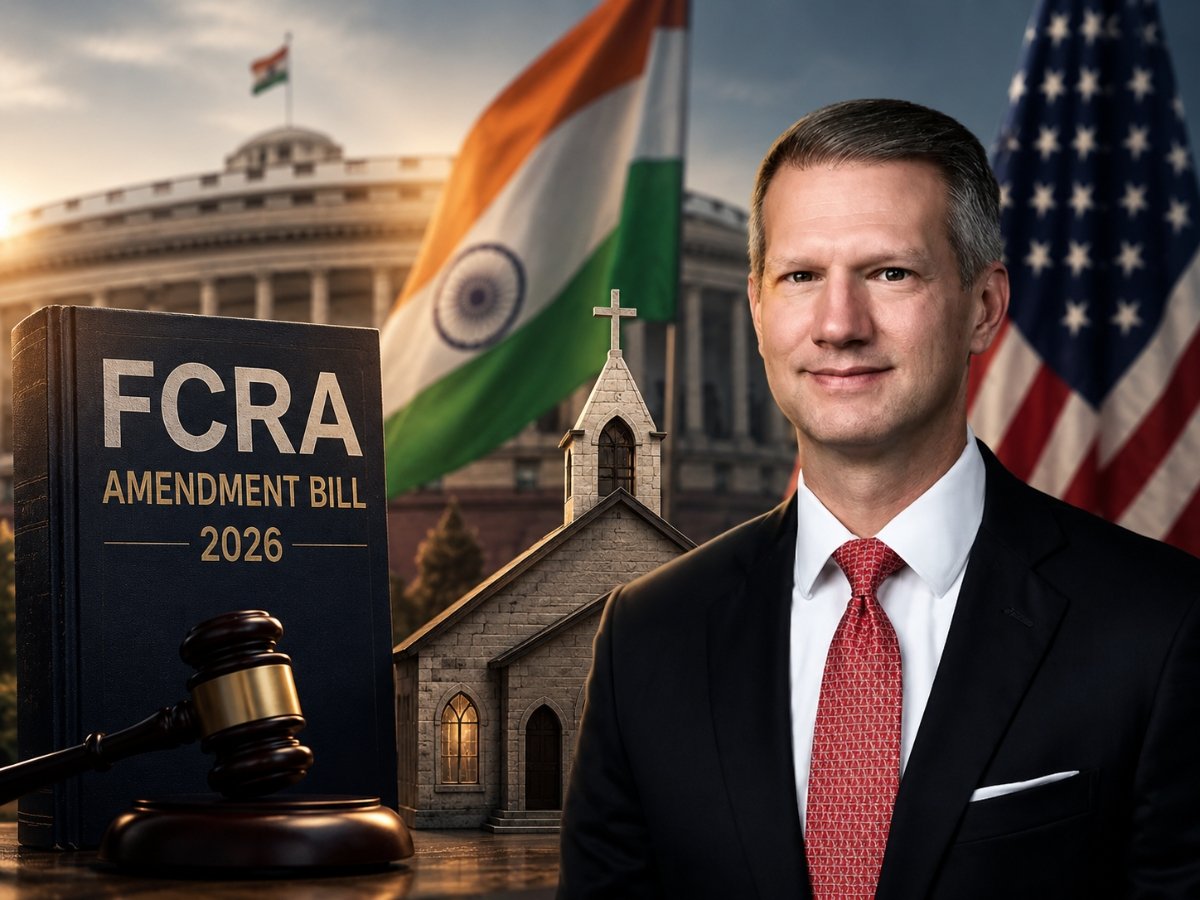
India‘s proposed amendments to the Foreign Contribution (Regulation) Act (FCRA) have attracted international attention after US Congressman Riley Moore voiced strong concerns over the legislation, warning that its current provisions could become a point of friction in India-US Relations.
The Republican lawmaker from West Virginia said the proposed changes could permit government control over churches and religious charities whose FCRA registration is cancelled, surrendered or not renewed. He described the proposal as a “clear attack against Christians” and urged attention to the issue as India’s Parliament considers the legislation.
The proposed amendments come as India reviews its legal framework governing foreign donations received by non-governmental organisations (NGOs), charitable trusts, educational institutions and religious organisations. Supporters of the Bill argue it provides a mechanism for managing foreign-funded assets after an organisation loses its FCRA registration, while critics have raised concerns about its possible implications for religious institutions and civil society organisations.
What Is the FCRA and Why Does It Matter?
The Foreign Contribution (Regulation) Act (FCRA) is India’s primary law regulating foreign financial contributions received by organisations operating within the country.
The legislation governs donations received from foreign sources by entities including:
- Non-governmental organisations (NGOs).
- Charitable trusts.
- Educational institutions.
- Religious organisations.
- Certain research and social welfare bodies.
The law aims to regulate how foreign contributions are received and used while ensuring compliance with Indian legal requirements. Organisations seeking foreign funding must obtain FCRA registration or prior permission under the Act.
What the Proposed Amendment Would Change
The Foreign Contribution (Regulation) Amendment Bill, 2026 proposes several changes to the existing legal framework.
Among its key provisions is the creation of a Designated Authority that would manage foreign contributions and assets created using foreign funds when an organisation’s FCRA registration:
- Is cancelled.
- Is voluntarily surrendered.
- Expires without renewal.
According to the Bill, the authority would oversee the management of such assets after an organisation loses its legal authority to receive foreign contributions under the Act.
How the Bill Addresses Places of Worship
One of the provisions attracting attention concerns religious properties created or maintained using foreign contributions.
The Bill states that where affected assets include a place of worship, the Designated Authority must ensure that the religious character of the property is preserved.
This provision has become central to the debate surrounding the legislation, with different stakeholders interpreting its practical implications in different ways.
Penalty Provisions Would Also Change
The proposed legislation also seeks to reduce the maximum punishment for violations of the Act.
| Provision | Current Law | Proposed Amendment |
|---|---|---|
| Maximum imprisonment for certain violations | Up to 5 years | Up to 1 year |
| Management of foreign-funded assets after registration ends | Existing provisions | Handled by a proposed Designated Authority |
| Places of worship | Existing framework | Religious character to be maintained by the Authority |
The reduction in maximum imprisonment represents one of the notable legal changes proposed alongside the new asset management mechanism.
Congressman Riley Moore’s Concerns
Congressman Riley Moore expressed his views in a statement posted on X while Parliament was considering the legislation.
He argued that Christians have maintained a longstanding presence in India and expressed concern that the proposed amendments could permit government takeovers of churches and religious charities.
Moore further stated that, if enacted in its present form, the legislation would become a matter of concern in bilateral relations between India and the United States.
These remarks reflect the lawmaker’s interpretation of the proposed legislation and his assessment of its possible diplomatic implications.
What the Bill Actually Says
Based on the text described in the available information, the proposed legislation focuses on the management of foreign-funded assets after an organisation’s FCRA registration is no longer valid.
It specifically provides for:
- Creation of a Designated Authority.
- Management of foreign-funded assets under defined circumstances.
- Retention of the religious character of places of worship where applicable.
- Reduction in maximum criminal penalties for violations.
The supplied information does not indicate that the legislation specifically targets any particular religious community.
Scale of Foreign Contributions Under the FCRA
Data cited from the Ministry of Home Affairs illustrates the scale of foreign funding regulated under the Act.
According to the ministry:
- 13,520 organisations received foreign contributions between 2019 and 2022.
- The total foreign contribution during that period amounted to approximately Rs 55,741 crore.
These figures demonstrate the significant role the FCRA plays in regulating overseas funding received by organisations operating across multiple sectors in India.
Current Status of FCRA Registrations
According to information available on the FCRA portal as of July 15, 2026:
| FCRA Registration Status | Number of Organisations |
|---|---|
| Active certificates | 14,449 |
| Cancelled certificates | 22,498 |
| Certificates deemed expired | 15,212 |
These figures highlight the large number of organisations affected by India’s foreign contribution regulatory framework over the years.
Why the FCRA Often Draws Public Attention
The FCRA has frequently been the subject of public debate because it governs foreign funding received by organisations involved in charitable work, Education, Healthcare, religious activities and social development.
Changes to the law can therefore affect a broad range of institutions that rely on overseas donations for various programmes and services.
Supporters of stronger regulation generally argue that foreign contributions should remain subject to transparent oversight and legal accountability. Critics, meanwhile, sometimes express concerns about the operational impact on civil society organisations and religious institutions.
The current parliamentary debate reflects these broader discussions surrounding regulation and Governance of foreign-funded entities.
Potential Diplomatic Significance
The comments made by Congressman Moore introduce an international dimension to what is primarily a domestic legislative proposal.
Although individual members of the US congress do not determine American foreign policy, statements from lawmakers can contribute to wider political discussions surrounding bilateral issues.
The available information does not indicate any official response from the Indian government specifically addressing Moore’s remarks or suggesting any change in India’s legislative process as a result.
Timeline of Recent Developments
| Development | Status |
|---|---|
| FCRA Amendment Bill, 2026 | Under consideration in Parliament |
| Congressman Riley Moore’s statement | Expressed concern over proposed amendments |
| Proposed Designated Authority | Would manage foreign-funded assets under specified conditions |
| Penalty changes | Maximum imprisonment proposed to be reduced from five years to one year |
What Could Happen Next?
The next stage will depend on Parliament’s consideration of the proposed amendments and whether any modifications are introduced before the legislation is enacted. As with any Bill, provisions may be debated, revised or retained during the legislative process.
If the amendments are ultimately approved, implementation will determine how the proposed Designated Authority functions in practice and how its responsibilities are applied in cases involving organisations that lose FCRA registration.
From a diplomatic perspective, the long-term significance of Congressman Moore’s remarks will likely depend on whether concerns raised by individual lawmakers develop into broader discussions within official India-US engagements. At present, the available information reflects comments from a US legislator alongside the provisions contained in the proposed Bill, while Parliament continues its consideration of the legislation.
For breaking news and live news updates, like us on Facebook or follow us on Twitter and Instagram. Read more on Latest World on thefoxdaily.com.






COMMENTS 0