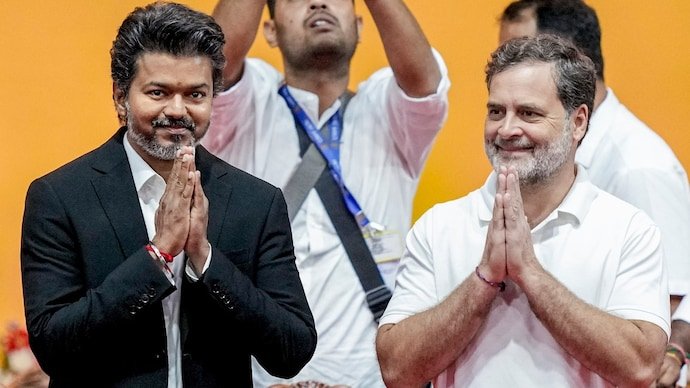
The absence of Vijay‘s Tamilaga Vettri Kazhagam (TVK) from the opposition INDIA Bloc meeting has sparked fresh debate about the coalition’s structure, membership criteria, and internal political equations. While Congress leaders have clarified that parties without Members of Parliament are generally not invited to such meetings, the episode has exposed deeper questions about how India’s opposition alliance intends to adapt to changing political realities.
TVK’s rise from a newcomer political outfit to a governing force in Tamil Nadu has been one of the most significant political developments in recent years. Yet, despite its growing influence and alliance with Congress in the state, the party found itself outside the room during one of the opposition bloc’s most important strategy meetings.
The development reflects not only procedural issues but also the evolving nature of coalition politics in India.
The Immediate Reason: No MPs, No Invitation
According to Congress leaders, the primary reason for TVK’s exclusion was straightforward: the INDIA bloc traditionally invites parties represented in Parliament.
Since TVK currently does not have any Members of Parliament in either the Lok Sabha or Rajya Sabha, party representatives were not automatically included among invitees.
Congress leaders emphasized that the criterion was institutional rather than political.
However, the explanation has not entirely settled the Controversy because TVK is no longer a fringe political organization. It is now a ruling force in Tamil Nadu and a significant player in one of India’s most politically influential states.
| Issue | Status |
|---|---|
| TVK Participation | Not initially invited |
| Congress Position | Parties without MPs are generally not invited |
| TVK MPs | None currently |
| Alliance with Congress | Yes, in Tamil Nadu |
| Final Decision | Reportedly under consideration |
TVK’s Remarkable Political Rise
What makes the situation unusual is the speed with which TVK has transformed from a celebrity-led political experiment into a serious electoral force.
Historically, Indian Politics has seen numerous film stars enter public life. However, only a handful have successfully translated popularity into durable political power.
Vijay’s political journey has drawn comparisons with several influential leaders from South India who successfully leveraged mass appeal into electoral success.
The party’s emergence has altered Tamil Nadu’s political landscape, traditionally dominated by two major Dravidian formations.
Its rise has also forced national parties such as Congress and BJP to rethink their strategies in the state.
The Larger Challenge Facing the INDIA Bloc
The controversy surrounding TVK’s invitation highlights a broader challenge confronting the INDIA alliance.
The opposition coalition was originally formed to unite diverse political parties against the BJP at the national level. However, as regional politics evolves, the alliance increasingly faces questions about representation and decision-making.
Several emerging political realities complicate matters:
- Regional parties are gaining influence.
- State-level alliances differ significantly across India.
- New political movements are challenging established parties.
- Electoral interests often vary from state to state.
- Leadership ambitions frequently clash within coalitions.
As a result, maintaining unity while accommodating new stakeholders has become increasingly difficult.
The DMK Factor Adds Another Layer
The issue becomes even more complicated because of the evolving relationship between TVK and the Dravida Munnetra Kazhagam (DMK).
The DMK, once a key component of the INDIA alliance, reportedly chose not to participate in the meeting following political developments in Tamil Nadu.
After Congress aligned with TVK in the state, relations between the Congress and DMK deteriorated significantly.
The fallout illustrates one of the biggest weaknesses in national coalitions: alliances that work in one state may create conflicts in another.
Political cooperation at the national level often collides with fierce competition at the state level.
Why Tamil Nadu Matters Nationally
Tamil Nadu remains one of India’s most politically significant states.
Beyond its substantial parliamentary representation, the state often shapes national political narratives and coalition strategies.
Several factors make Tamil Nadu particularly important:
- Large parliamentary representation
- Strong regional political identity
- High voter participation
- Economic significance
- Influence on coalition arithmetic
Any realignment in Tamil Nadu has implications that extend well beyond the state’s borders.
This is why developments involving TVK, DMK, Congress, and other regional actors are being closely watched across the country.
Opposition Unity Under Increasing Pressure
The INDIA bloc meeting itself comes at a critical moment.
Recent electoral setbacks have increased pressure on opposition parties to demonstrate cohesion and present a unified strategy.
However, the absence of certain parties and ongoing disagreements among allies suggest that maintaining unity remains a work in progress.
Coalitions are often strongest when they are fighting a common opponent and weakest when internal questions about leadership, representation, and strategy begin to emerge.
The TVK invitation controversy reflects exactly this challenge.
The BJP’s Political Opportunity
The ruling BJP has been quick to highlight divisions within the opposition alliance.
Party leaders argue that disagreements between INDIA bloc members reveal structural weaknesses that make coordinated opposition difficult.
For the BJP, every visible disagreement within the opposition presents an opportunity to reinforce its narrative that rival parties are united primarily by opposition rather than a shared Governance vision.
This makes internal coordination particularly important for opposition leaders seeking to project stability and credibility.
Could Membership Rules Change in the Future?
The TVK episode raises an important question: should parliamentary representation be the only criterion for participation in alliance meetings?
Political landscapes evolve rapidly.
A party without MPs today may govern a major state tomorrow.
Similarly, emerging political movements can influence millions of voters even before gaining parliamentary representation.
Some analysts argue that opposition alliances may eventually need more flexible participation rules that recognize electoral strength, state-level influence, and governance responsibilities alongside parliamentary numbers.
Such reforms could become increasingly necessary as Indian politics becomes more fragmented and regionally diverse.
What This Means for Vijay’s Political Future
Ironically, the controversy may benefit Vijay politically.
Public discussions about TVK’s exclusion have generated national attention for the party at a time when it is seeking to establish itself beyond Tamil Nadu.
Political movements often gain momentum when supporters perceive them as being underestimated or overlooked by established power structures.
For TVK, the episode provides an opportunity to position itself as an emerging force demanding recognition on the national stage.
Whether the party eventually joins future INDIA bloc meetings may be less important than the visibility the controversy has already generated.
The Key Insight: India’s Coalition Politics Is Entering a New Phase
The real significance of the TVK invitation issue extends beyond a single meeting.
It reflects a broader transformation in Indian politics.
Traditional party structures are being challenged by new political actors, regional parties are exercising greater influence, and national coalitions are becoming increasingly complex.
Future alliances may need to balance parliamentary strength with electoral relevance, state-level influence, and emerging political realities.
The TVK case may ultimately be remembered as an early example of this transition.
Future Outlook
The coming months will likely determine whether TVK becomes formally integrated into broader opposition structures or continues to operate primarily through state-level alliances.
Much will depend on parliamentary developments, alliance negotiations, and the party’s ability to expand its political footprint.
At the same time, the INDIA bloc faces the challenge of maintaining unity while adapting to an increasingly dynamic political Environment.
How it handles emerging parties such as TVK could influence its effectiveness in future electoral battles.
Conclusion
TVK’s absence from the INDIA bloc meeting may have been explained by procedural rules regarding parliamentary representation, but the controversy has highlighted much larger questions about opposition unity, coalition management, and political representation in modern India.
As Vijay’s party continues to grow and reshape Tamil Nadu politics, pressure is likely to increase on national alliances to accommodate influential regional players regardless of their current parliamentary numbers.
Ultimately, the episode is less about a missing invitation and more about the changing nature of Indian politics—where electoral influence, regional power, and political momentum increasingly matter as much as traditional parliamentary arithmetic.
For breaking news and live news updates, like us on Facebook or follow us on Twitter and Instagram. Read more on Latest India on thefoxdaily.com.





COMMENTS 0