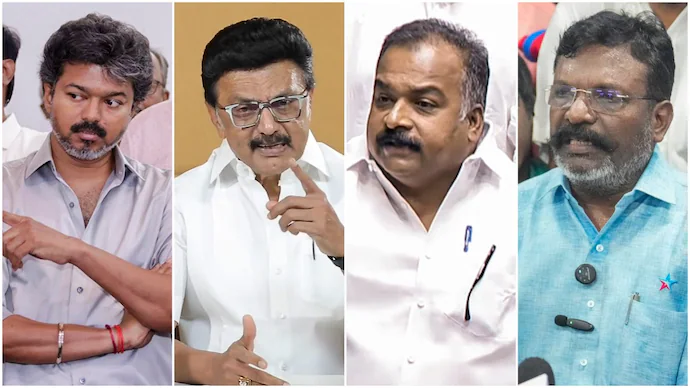
Several political parties in Tamil Nadu, including the ruling Tamilaga Vettri Kazhagam (TVK), the principal opposition Dravida Munnetra Kazhagam (DMK) and their allies, walked out of an all-party meeting convened by the Election Commission on Friday. The parties demanded the resignation of Chief Election Commissioner Gyanesh Kumar, alleging irregularities and a lack of transparency in the previous electoral roll revision exercise.
The meeting, convened by Tamil Nadu Chief Electoral Officer Archana Patnaik at the Secretariat, was organised to discuss the Special Summary Revision (SSR) of electoral rolls. Representatives of recognised political parties, including the DMK, AIADMK, TVK, Viduthalai Chiruthaigal Katchi (VCK) and Naam Tamilar Katchi (NTK), were invited to participate.
However, the TVK, Congress, VCK, Left parties and DMK boycotted the meeting, arguing that alleged discrepancies from the previous Special Intensive Revision (SIR) had to be addressed before another revision could proceed. The parties questioned the credibility of the Election Commission’s leadership and called for accountability over the removal of voters from electoral rolls.
The AIADMK and the Bharatiya Janata Party (BJP), meanwhile, attended the meeting. The AIADMK said it wanted to formally place its concerns and demands before the poll panel rather than join the walkout.
Why Did TVK, DMK and Other Parties Walk Out of the EC Meeting?
The protesting parties alleged that the previous Special Intensive Revision of electoral rolls lacked transparency and raised concerns about the deletion of large numbers of voters. They argued that proceeding with another revision without first resolving the alleged anomalies would undermine public confidence in the electoral process.
The parties also demanded the resignation of Chief Election Commissioner Gyanesh Kumar, holding the current Election Commission leadership responsible for what they described as irregularities during the earlier exercise.
Their central demand was that the Election Commission clarify the status of voters whose names were removed or whose entries were flagged during the SIR. They also called for the alleged mistakes to be corrected before the new Special Summary Revision moved forward.
The walkout highlighted differences among Tamil Nadu’s political parties over how the electoral roll revision should be conducted and how the Election Commission should respond to concerns about voter entries.
DMK Questions Deletion of More Than 74 Lakh Voters
The DMK led the protest against the Election Commission’s handling of the previous revision. DMK Legal Wing Joint Secretary I Paranthamen questioned the removal of more than 74 lakh voters from the electoral rolls during the final SIR process and demanded an explanation about their status.
Paranthamen alleged that the Election Commission had not adequately clarified what had happened to the affected voters.
“Over 74 lakh voters were removed from the electoral rolls during the final SIR process. Where have they gone? Have they been deported or are they no longer residing in India and Tamil Nadu? The EC has provided no answer,” he said.
He further argued that any electoral revision conducted under the current Chief Election Commissioner lacked credibility. Describing the exercise as an “eyewash and a futile exercise”, he said the commission needed to address the questions raised by political parties before undertaking another revision.
DMK Demands Gyanesh Kumar’s Resignation
Paranthamen said the Chief Election Commissioner should either resign voluntarily or face removal through the constitutional process.
“He should either step down voluntarily or be removed constitutionally,” he said.
He added that DMK MPs had already resolved to seek the CEC’s resignation and submit a petition to the President. The party maintained that the alleged discrepancies in the previous revision needed to be examined and corrected before the Election Commission proceeded with the next exercise.
The DMK’s position was echoed by several parties that joined the walkout, which argued that the credibility of a fresh revision depended on addressing concerns about the earlier process.
Tamil Nadu Minister R Nirmal Kumar Calls for Correction of Electoral Roll Anomalies
Tamil Nadu Minister for Energy Resources and Law R Nirmal Kumar also demanded the resignation of Chief Election Commissioner Gyanesh Kumar. He alleged that a substantial number of voters had been arbitrarily removed from the electoral rolls during the previous revision, with young people and women among those affected.
Nirmal Kumar said the Chief Election Commissioner should accept moral responsibility for the alleged lapses and step down.
“A massive number of electors, especially youth and women, were arbitrarily struck off the voter rolls under the guise of the previous revision. The CEC must take moral responsibility for these lapses and resign immediately,” he said.
The minister also objected to conducting another summary revision without first addressing the alleged errors in the earlier exercise.
“Without rectifying these glaring mistakes first, conducting another summary revision is completely unacceptable,” he added.
The protesting parties said that correcting the alleged anomalies and providing clarity about deleted or flagged voter entries should be a priority before further electoral roll updates are undertaken.
Congress Refuses to Attend Meetings Under Current EC Leadership
The Congress also joined the boycott, citing a lack of trust in the Election Commission and concerns about the conduct of the current election commissioners.
A Congress representative confirmed that the party had decided to walk out of the meeting. The representative said the Congress would not participate in meetings chaired by the current commission leadership until Gyanesh Kumar resigned.
The Congress’s position aligned with the demands raised by the DMK, TVK and other parties that boycotted the meeting. Their objections centred on the previous SIR exercise, the alleged deletion of voters and the need for the Election Commission to explain how electoral roll entries had been reviewed.
The parties maintained that public confidence in the electoral process required transparency and accountability, particularly when large numbers of voter entries were being removed or flagged.
AIADMK Attends Meeting, Cites 97 Lakh Affected Voter Entries
Unlike the parties that staged a walkout, the AIADMK attended the Election Commission meeting and said it intended to place its concerns on record.
Senior AIADMK leader and former minister D Jayakumar defended the decision to participate, saying that attending the meeting was a democratic choice and an opportunity to present specific concerns directly to the poll panel.
“Whether to stage a walkout or participate is a party’s democratic right. We chose to participate to place concrete facts on record,” Jayakumar said.
He cited Election Commission data from the SIR exercise in Tamil Nadu, stating that approximately 97 lakh voter entries had been flagged or affected during the process.
Breakdown of the 97 Lakh Voter Entries Cited by AIADMK
According to Jayakumar, the entries comprised the following categories:
| Category | Number of voter entries |
|---|---|
| Deceased voters | 26 lakh |
| Voters who had shifted | 52 lakh |
| Duplicate entries | 4 lakh |
| Voters who had permanently relocated | 13 lakh |
| Total cited by AIADMK | 97 lakh |
The figures above reflect the breakdown cited by Jayakumar during the meeting. The categories describe entries identified during the SIR process and should not, by themselves, be interpreted as proof that every affected entry was invalidly deleted.
AIADMK Seeks Transparency and Public Disclosure
Jayakumar said the AIADMK had asked the Election Commission to review the 97 lakh entries during the current revision and publicly disclose how many had been verified as legitimate.
“We demanded that the EC thoroughly review these 97 lakh entries transparently during this revision and publicly clarify how many were legitimately verified,” he said.
He also said the commission had a responsibility to address public concerns surrounding the SIR exercise.
“People have doubts about the SIR exercise, and it is the commission’s foremost duty to clear them,” Jayakumar added.
The AIADMK’s approach differed from that of the parties that boycotted the meeting. While the protesting parties demanded that the CEC resign and that alleged anomalies be corrected before a new revision, the AIADMK chose to participate and press the commission for a review and public disclosure of the affected entries.
AIADMK Requests Rescheduling of November Special Camps
In addition to its concerns about electoral roll entries, the AIADMK urged the Election Commission to reschedule special camps planned for November.
Jayakumar cited the monsoon season as a reason to reconsider the timing of the camps. The request was among the concerns the party wanted to formally communicate to the election authorities during the meeting.
The issue adds a practical dimension to the debate over the revision process, as political parties seek clarity not only on the status of voter entries but also on the arrangements for reviewing and updating electoral rolls.
What Is the Special Summary Revision of Electoral Rolls?
The Special Summary Revision (SSR) is a routine process used to update electoral rolls. According to the Election Commission, the exercise is intended to include eligible voters and remove entries that are no longer eligible, helping maintain accurate and up-to-date voter lists.
Electoral roll revisions are important because voter lists need to reflect changes such as newly eligible electors, deaths, changes of residence and duplicate registrations. Updating these records helps ensure that electoral rolls accurately represent eligible voters.
However, the latest dispute in Tamil Nadu centres on concerns about how entries were handled during the previous Special Intensive Revision (SIR). The protesting parties allege that the earlier process lacked transparency and resulted in the arbitrary deletion of voters. They want the Election Commission to address these allegations before carrying out another revision.
The distinction between the two exercises is important in understanding the dispute: the SSR is described by the commission as a routine update of electoral rolls, while the parties’ objections relate primarily to the alleged problems associated with the previous SIR process.
Opposition Parties Allege Systematic Voter Deletions
The opposition parties have alleged that the previous SIR exercise amounted to a systematic attempt to remove voters from electoral rolls in a manner that could favour the BJP in elections. These allegations form a central part of their opposition to the Election Commission’s handling of the revision process.
The claims remain allegations raised by the political parties. The supplied account does not establish that voter deletions were carried out to benefit a particular party, nor does it provide an independent determination of the reasons behind the affected entries.
The AIADMK, while also calling for transparency, chose to attend the meeting and demanded a detailed review of the entries flagged during the SIR. Its position underlined that political parties could share concerns about electoral roll accuracy while taking different approaches to engaging with the Election Commission.
The dispute has therefore focused on several connected questions: why large numbers of voter entries were flagged or removed, how the Election Commission verified their status, whether the process was sufficiently transparent and what corrective action should be taken before another revision.
Key Differences Between the Parties’ Positions
| Political party or group | Position at the meeting | Main demand or concern |
|---|---|---|
| TVK and its allies | Walked out | Objected to the previous revision and demanded accountability from the CEC. |
| DMK | Walked out | Questioned the removal of more than 74 lakh voters and demanded Gyanesh Kumar’s resignation. |
| Congress | Walked out | Said it would not participate in meetings under the current commission leadership until the CEC resigned. |
| VCK and Left parties | Joined the boycott | Supported objections to the previous revision and calls for alleged anomalies to be corrected. |
| AIADMK | Attended | Called for a transparent review of approximately 97 lakh affected entries and public disclosure of verification results. |
| BJP | Attended | The supplied account does not specify a detailed position beyond its participation in the meeting. |
What Happens Next in Tamil Nadu’s Electoral Roll Revision?
The immediate issue is whether the Election Commission will provide further clarification about the voter entries flagged during the previous SIR and address the concerns raised by political parties.
The DMK and other parties that walked out have insisted that alleged discrepancies must be corrected before another revision proceeds. They have also called for the CEC’s resignation, making the commission’s leadership a central part of the dispute.
The AIADMK, meanwhile, has asked the poll panel to thoroughly review the entries and disclose how many were verified as legitimate. Its request for public clarification reflects a shared concern about transparency, although its decision to attend the meeting differed from the boycott adopted by other parties.
The supplied account does not specify a final decision by the Election Commission on the demands raised at the meeting. The next steps will depend on how the commission responds to the parties’ concerns and how the electoral roll revision proceeds.
Frequently Asked Questions (FAQs)
1. Why did TVK and DMK walk out of the Election Commission meeting?
TVK, DMK, Congress, VCK and Left parties boycotted the meeting over alleged irregularities and a lack of transparency during the previous Special Intensive Revision of electoral rolls. They demanded that the alleged discrepancies be corrected before another revision was undertaken.
2. Why are the parties demanding Gyanesh Kumar’s resignation?
The protesting parties have held Chief Election Commissioner Gyanesh Kumar responsible for what they describe as lapses in the previous revision. They allege that large numbers of voters were arbitrarily removed and say the commission must be held accountable.
3. How many voters were reportedly removed from the electoral rolls?
DMK Legal Wing Joint Secretary I Paranthamen questioned the removal of more than 74 lakh voters during the final SIR process. Separately, AIADMK leader D Jayakumar cited approximately 97 lakh entries that had been flagged or affected, including entries associated with deceased voters, shifted voters, duplicate registrations and permanent relocation.
4. What was the AIADMK’s position at the meeting?
The AIADMK attended the meeting, saying it wanted to place its concerns directly before the Election Commission. It called for a transparent review of the approximately 97 lakh affected entries and public disclosure of how many had been verified as legitimate.
5. What is the difference between SIR and SSR?
The Special Intensive Revision (SIR) was the earlier exercise at the centre of the parties’ allegations. The Special Summary Revision (SSR) is described by the Election Commission as a routine process for updating electoral rolls by including eligible voters and removing ineligible entries.
6. Did the BJP attend the meeting?
Yes. According to the supplied account, the BJP and AIADMK attended the meeting, while the TVK, DMK, Congress, VCK and Left parties joined the walkout.
7. What are the protesting parties demanding before another revision?
They want the Election Commission to address the alleged discrepancies in the previous SIR, clarify the status of affected voter entries and ensure transparency before proceeding with another electoral roll revision. They have also demanded Gyanesh Kumar’s resignation.
Conclusion
The walkout by the TVK, DMK, Congress, VCK and Left parties from the Election Commission’s all-party meeting has brought the dispute over Tamil Nadu’s electoral roll revision into focus. The parties have alleged that the previous SIR lacked transparency and questioned the removal of large numbers of voter entries, while demanding the resignation of Chief Election Commissioner Gyanesh Kumar.
The AIADMK took a different approach by attending the meeting and calling for a transparent review of approximately 97 lakh affected entries. Its demand for public disclosure, alongside the protesting parties’ calls for corrections and accountability, highlights the importance of clear explanations about electoral roll updates.
The central question remains how the Election Commission will respond to the allegations and clarify the status of affected voter entries. The commission’s handling of these concerns will be closely linked to the ongoing debate over transparency and confidence in the electoral roll revision process.
For breaking news and live news updates, like us on Facebook or follow us on Twitter and Instagram. Read more on Latest India on thefoxdaily.com.





COMMENTS 0