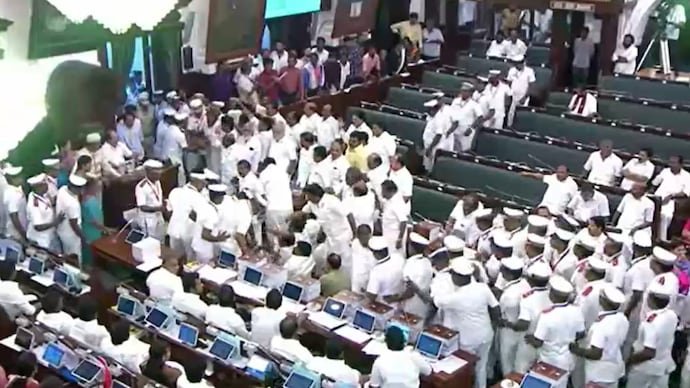
The Tamil Nadu Assembly descended into chaos on Tuesday after DMK MLAs protested Chief Minister C. Joseph Vijay’s references to corruption allegations against the previous DMK government, eventually prompting Speaker JCD Prabhakar to order Assembly marshals to evict the protesting legislators.
The confrontation began shortly after proceedings started, when DMK Whip EV Velu demanded that portions of Vijay’s speech delivered on Monday be removed from the official Assembly records.
The dispute centred on Vijay’s use of an Enforcement Directorate (ED) document to level allegations against the earlier DMK administration. He had claimed that contractors were allegedly required to provide between 7.5% and 10% of the value of certain contracts as “party funds” and linked the allegations to works under the Municipal Administration and Water Supply Department.
Vijay had also referred to the Sarkaria Commission report while attacking the DMK’s historical record on corruption.
The DMK objected strongly, arguing that those references were inappropriate under Assembly rules. When the Speaker rejected the demand to expunge the remarks, the disagreement escalated into a loud protest on the floor of the House.
Why the DMK demanded Vijay’s remarks be removed
The immediate trigger for Tuesday’s confrontation was Vijay’s speech from the previous day.
During his address, the Chief Minister launched a broad attack on the DMK’s record in government, using material from an ED document and historical references involving the Sarkaria Commission.
He also referred to allegations concerning the use of money collected from contractors as political funding.
The DMK argued that such references should not remain in the official legislative record and sought their expunging.
The demand was made by EV Velu at the start of Tuesday’s proceedings, turning what could have been a procedural question into a major political confrontation inside the Assembly.
The dispute also reflected a larger disagreement over whether allegations contained in investigative documents can be cited as political evidence in an Assembly speech when the underlying accusations have not necessarily been established through a final judicial finding.
Law Minister defends the Chief Minister
The ruling side rejected the DMK’s objections.
State Law Minister R Nirmal Kumar defended Vijay’s remarks, arguing that the Chief Minister had relied on material already available in the public domain.
He specifically defended Vijay’s references to the Sarkaria Commission report and documents associated with the Enforcement Directorate.
The minister also reiterated the corruption allegations that Vijay had raised against the earlier DMK administration.
The response hardened the disagreement because the DMK was seeking not merely a political rebuttal but removal of the disputed portions from the Assembly’s official record.
Speaker says Vijay cited information already in public domain
Speaker JCD Prabhakar rejected the DMK’s demand.
He said Vijay had not introduced secret or inaccessible material into the proceedings but had referred to information that was already in the public domain.
The Speaker specifically referred to Vijay’s mention of former Union minister Murasoli Maran and said the Chief Minister had relied on publicly available ED information.
Prabhakar also pointed out that Vijay had referred to the arrest of former Chief Minister M K Stalin under the Maintenance of Internal Security Act (MISA) and to earlier Assembly discussions involving the Sarkaria Commission.
On that basis, the Speaker concluded that there was no reason to expunge the remarks.
Speaker reminds DMK about Monday’s disruption
The Speaker also used the opportunity to criticise the DMK’s conduct during Vijay’s speech on Monday.
He told the protesting legislators that the Chief Minister had completed his address despite their attempts to disrupt the proceedings.
Prabhakar argued that the proceedings had remained within the rules and suggested that the events of the previous day had been seen across the country.
The remark further angered DMK members, who continued raising slogans rather than accepting the ruling from the Speaker.
The dispute consequently moved beyond the question of expunging remarks and became a test of the Assembly’s authority to maintain order when the opposition rejects a ruling from the chair.
DMK MLAs move toward the Speaker’s podium
When the demand to remove Vijay’s remarks was rejected, several DMK lawmakers gathered near the Speaker’s podium.
They continued raising slogans and insisted that the controversial portions of the Chief Minister’s speech be deleted from the official record.
The demonstration at the well of the House represented a significant escalation in the confrontation.
Instead of continuing the debate from their allocated seats, the legislators physically moved closer to the Speaker, prompting the chair to warn them that their behaviour was unacceptable.
The protest continued despite repeated instructions to return to their seats.
Leader of the House seeks action against DMK MLAs
Leader of the House KA Sengottaiyan then intervened and asked the Speaker to take action against the protesting DMK members under the Assembly’s rules.
He argued that the Speaker’s decision had already been delivered and that the legislators were continuing to create a disturbance despite that ruling.
Sengottaiyan requested that the protesting MLAs be removed from the chamber.
The request shifted the dispute from a question of parliamentary privilege and record-keeping to direct enforcement of legislative discipline.
Speaker gives the MLAs one final warning
Before ordering their removal, Speaker Prabhakar gave the protesting legislators another opportunity to return to their seats.
He said the members would have one minute to resume their places and offered to allow senior DMK leaders, including KN Nehru or EV Velu, to speak.
The offer suggested that the Speaker was willing to continue the discussion through normal legislative procedure if the protest ended.
The DMK lawmakers, however, continued their sloganeering and refused to comply.
That led the Speaker to issue stronger warnings.
Posters inside the Assembly add to the confrontation
The Speaker also accused the protesting MLAs of bringing posters into the House without permission.
He said the legislators were refusing to listen to his instructions and warned them that such conduct would not be allowed.
At one point, when a protesting MLA approached the Speaker’s chair, Prabhakar reportedly told him not to come closer and ordered him to leave.
As the confrontation continued, the possibility of removing the lawmakers from the chamber became increasingly likely.
Assembly marshals evict the DMK legislators
With the sloganeering continuing, Speaker JCD Prabhakar finally directed Assembly marshals to remove the protesting DMK MLAs from the House.
The legislators continued raising slogans while being escorted out of the Assembly hall.
The eviction brought the immediate confrontation inside the chamber to an end, but it did not resolve the underlying political dispute over Vijay’s corruption allegations.
Instead, the episode deepened the confrontation between the ruling administration and the DMK at a time when allegations involving the previous government are becoming an increasingly prominent part of Assembly Politics.
What Vijay alleged about “party funds”
At the centre of the dispute is one of the strongest allegations made by Vijay since taking office.
During his Monday speech, the Chief Minister cited an ED document while alleging that contractors working on government projects were made to pay between 7.5% and 10% of contract values as “party funds”.
He connected the allegation to works handled by the Municipal Administration and Water Supply Department.
Because the allegation concerns the use of government contracts to raise political funds, it has major implications if substantiated.
However, it is important to distinguish between an allegation cited from an investigative document and a finding established by a court.
The Assembly confrontation does not itself establish the truth of the corruption claims. The DMK disputes the allegations and objects to their inclusion in the official record.
Why the Sarkaria Commission reference angered the DMK
Vijay also invoked the Sarkaria Commission, a body whose historical inquiry into corruption allegations involving the then DMK government remains a politically sensitive part of Tamil Nadu’s history.
References to the commission carry significant political weight because they connect the present government to corruption controversies from an earlier period of state politics.
The DMK objected to Vijay’s use of the report, arguing that the references violated Assembly rules.
The Speaker disagreed, pointing to earlier legislative discussions and the fact that the historical material was already part of the public record.
The dispute therefore became partly about parliamentary procedure and partly about how historical allegations can be invoked in present-day political debate.
The ED document is now at the centre of the political fight
The controversy also highlights the increasingly important role of investigative agency material in political arguments.
Vijay used the ED document to support his allegations, while the DMK argued that the references should be expunged.
Investigative documents can contain allegations, witness statements, evidence summaries and investigative conclusions, but their presence in a government file does not automatically mean that every allegation has been finally proven.
This distinction is particularly important in a legislative chamber because statements made there become part of the public political record.
The question of how such material should be cited will likely remain contentious whenever governments use investigative agency documents to attack political opponents.
DMK says the remarks violate Assembly norms
EV Velu’s objection was based on the claim that the Chief Minister’s remarks were contrary to the rules governing Assembly proceedings.
The DMK wanted the disputed passages removed rather than simply rebutted through another speech.
Expunging a remark is a procedural mechanism by which words deemed unparliamentary or otherwise impermissible can be removed from the official legislative record.
That made the Speaker’s decision particularly important.
By refusing to delete Vijay’s remarks, the chair effectively allowed them to remain part of the formal record, setting the stage for the opposition’s continued protest.
Speaker rejects the DMK’s procedural argument
Prabhakar’s position was that Vijay had referred to information already available publicly.
He also argued that historical references to figures such as Murasoli Maran and former Chief Minister M K Stalin did not by themselves justify expunging the speech.
The Speaker pointed to previous Assembly discussions on the same historical matters.
His argument was therefore based on continuity: if similar material had already formed part of legislative debate, then its mention by the current Chief Minister did not automatically violate the House’s rules.
The DMK disagreed, and the failure to resolve that procedural question became the immediate cause of the protest.
The political backdrop is becoming increasingly confrontational
The Assembly clash is another sign of the increasingly competitive relationship between the ruling TVK government and the opposition DMK.
Vijay has sought to portray his administration as a break from the political practices of previous governments and has repeatedly emphasised Governance, law and order and corruption control.
The DMK, meanwhile, is attempting to hold the new government accountable for its performance while defending its own record in office.
That dynamic makes historical allegations politically useful to both sides.
The ruling party can use past controversies to challenge the DMK’s credibility, while the opposition can argue that the government is avoiding present-day questions by reopening old disputes.
Why the exchange over corruption is politically important
Corruption allegations have a particular political impact because they can influence voters’ perceptions of both individual politicians and entire parties.
For Vijay, citing official investigative material allows him to frame his attack as evidence-based rather than merely political rhetoric.
For the DMK, preventing disputed allegations from remaining in the legislative record is important because such statements can be repeatedly used in future political campaigns.
That is why the demand to expunge the remarks was more than a procedural technicality.
It was also a battle over the political narrative that will emerge from the Assembly session.
What happens when opposition protests disrupt Assembly proceedings?
Legislative assemblies have rules designed to ensure that members can debate while preserving the authority of the Speaker to maintain order.
Members can challenge government statements, demand clarifications, seek records to be corrected and raise points of order.
But once the Speaker rules on a procedural question, continuing a protest in the well or refusing repeated directions to return to one’s seat can trigger disciplinary action.
In the Tamil Nadu Assembly, that escalation ultimately resulted in the intervention of marshals.
The incident demonstrates how quickly a disagreement over the content of a speech can become a conflict over parliamentary discipline.
Why the eviction matters politically
The eviction is significant because it highlights the intensity of the confrontation between the government and the principal opposition party.
The DMK did not merely criticise Vijay’s accusations from outside the chamber. Its members chose to challenge the Speaker’s decision directly inside the House.
The government, in turn, insisted on enforcing the Speaker’s ruling.
The result was a highly visible clash that is likely to become part of the political narrative surrounding the current Assembly session.
For the ruling side, the episode can be presented as evidence that the government is standing firm against opposition disruption. For the DMK, the same episode can be portrayed as an attempt to silence its objections to serious allegations.
The role of the Speaker becomes crucial
Tuesday’s events also place the Speaker at the centre of the political controversy.
The Speaker’s responsibility is to maintain order and interpret the House’s rules while allowing both government and opposition members to participate in debate.
In politically polarised proceedings, every ruling by the chair can be scrutinised through a partisan lens.
Prabhakar’s refusal to expunge Vijay’s speech and subsequent order to remove the protesting legislators therefore carried immediate political consequences.
The Speaker’s role becomes particularly sensitive when the government’s majority and the opposition’s procedural rights come into direct conflict.
Why expunging remarks matters
Removing words from the Assembly record is not a trivial step.
Official legislative records can remain available long after an Assembly session ends and may be used by journalists, researchers and future political actors.
Expungement therefore determines whether controversial statements become part of the formal historical record of proceedings.
The DMK’s insistence on deleting Vijay’s remarks reflects the political significance attached to that record.
The Speaker’s refusal means the disputed statements remain in the proceedings, subject to the rules governing the official documentation of the session.
Vijay’s corruption attack goes beyond one Assembly speech
The Chief Minister’s intervention on Monday appears to be part of a broader effort to frame corruption as a defining issue in the political contest with the DMK.
By referring to both historical allegations and recent investigative material, Vijay connected the party’s past and present political controversies.
He also sought to portray his own government as committed to greater administrative integrity.
That framing is likely to remain an important part of the TVK’s political strategy as it seeks to consolidate support and challenge the DMK’s organisational strength.
The DMK’s response reveals its immediate strategy
The opposition’s reaction suggests that the party intends to challenge the government aggressively on both the substance and procedure of such allegations.
By demanding expungement, the DMK focused on the legitimacy of the Chief Minister’s references rather than simply responding to the corruption allegations themselves.
But the party can also use the controversy politically by arguing that unproven claims should not be used as substitutes for governance debates.
The clash over the records is therefore likely to continue alongside the substantive debate over corruption.
What the Assembly clash means for Tamil Nadu politics
The confrontation comes at an important stage in the development of the TVK government.
Vijay entered electoral politics with the promise of presenting a new political alternative, and his government now faces the difficult task of proving that it can translate that political movement into functioning administration.
The DMK, one of Tamil Nadu’s most established political organisations, remains a powerful opposition force with deep roots across the state.
The resulting political competition is likely to produce more aggressive exchanges in the Assembly as both sides attempt to define their records and attack the other’s credibility.
Historical corruption allegations are likely to remain one of the weapons in that contest.
What happens next in the Assembly?
The immediate dispute may subside once the evicted legislators return to subsequent proceedings, but the political argument over Vijay’s allegations is unlikely to disappear.
The DMK can continue challenging the accusations through Assembly debates, political statements and other legal or institutional avenues available to it.
The government, meanwhile, can continue citing investigative material and historical records in its attacks on the opposition, provided the remarks comply with the applicable rules and legal requirements.
The broader political contest will also determine whether these allegations become a sustained campaign issue or remain confined to the current Assembly session.
Key points from the Tamil Nadu Assembly uproar
| Issue | What happened |
|---|---|
| Chief Minister’s allegations | Vijay cited ED material and alleged contractors were made to contribute 7.5-10% of contract values as “party funds” |
| Historical reference | Vijay referred to the Sarkaria Commission and earlier political controversies |
| DMK demand | EV Velu sought expungement of the disputed portions of Vijay’s Monday speech |
| Law Minister’s response | R Nirmal Kumar defended the references as based on official and public information |
| Speaker’s ruling | JCD Prabhakar refused to expunge the remarks |
| DMK protest | MLAs raised slogans, moved toward the Speaker’s podium and continued the demonstration |
| Posters | The Speaker said the protesting legislators had brought posters without permission |
| Government demand | Leader of the House KA Sengottaiyan sought action against the protesting MLAs |
| Final action | Assembly marshals evicted the protesting DMK legislators |
Allegations remain allegations unless legally established
The political significance of Vijay’s speech should not be confused with legal proof.
The Chief Minister’s claims about alleged payments from contractors are based, according to the government’s account, on material from an ED document. The DMK has disputed the allegations and objected to their inclusion in the Assembly proceedings.
Whether the alleged corruption occurred and who, if anyone, is legally responsible are questions for the appropriate investigative and judicial processes.
The Assembly debate itself cannot determine guilt.
That distinction becomes especially important when serious corruption allegations are used in a highly partisan political Environment.
Vijay and the DMK are now locked in a battle over the record
Tuesday’s eviction demonstrates that the political fight between Vijay’s government and the DMK is extending beyond policy disagreements.
It is increasingly becoming a contest over which narrative of Tamil Nadu’s political history will dominate the public record.
Vijay is invoking ED material and decades-old allegations to challenge the DMK’s credibility. The DMK is fighting to ensure that what it considers inappropriate or unproven accusations do not remain unchallenged in the Assembly proceedings.
The Speaker’s decision has temporarily settled the procedural question in favour of the government, but the political argument remains wide open.
Why this Assembly clash could shape the next phase of Tamil Nadu politics
The confrontation over Vijay’s corruption charges comes at a time when Tamil Nadu’s political landscape is undergoing a significant realignment.
Vijay’s rise has introduced a new political force into a state historically dominated by the DMK and AIADMK, while the DMK is attempting to retain its organisational and electoral influence from the opposition benches.
Every major Assembly confrontation now serves two purposes: legislative debate and political messaging beyond the House.
Tuesday’s eviction fits squarely into that new environment.
The images of DMK MLAs being escorted out by marshals, the Speaker refusing to delete Vijay’s allegations and the government’s insistence on maintaining order are likely to be used by both sides to reinforce their competing political narratives.
The dispute is far from over
DMK MLAs were removed from the Tamil Nadu Assembly after refusing to accept the Speaker’s decision on Vijay’s controversial references to ED documents and corruption allegations involving the previous DMK regime.
The immediate trigger was EV Velu’s demand that Vijay’s remarks be expunged. The Speaker rejected that request, arguing that the Chief Minister had relied on information already in the public domain, including ED material, earlier Assembly discussions and the Sarkaria Commission report.
The DMK continued its protest, moved toward the Speaker’s podium and raised slogans. After warnings, including an order to return to their seats and a reference to posters brought into the House without permission, the Speaker directed Assembly marshals to remove the legislators.
The episode has now turned a disagreement over parliamentary records into a larger political confrontation over corruption, historical allegations and the conduct of the new TVK government.
For Vijay, the controversy provides another opportunity to attack the DMK’s past record. For the opposition, the fight is about challenging what it describes as inappropriate and disputed allegations being placed on the Assembly record.
The legal truth behind the corruption claims will ultimately depend on evidence and due process, not the volume of slogans inside the Assembly. Politically, however, Tuesday’s confrontation makes one thing clear: the battle between Vijay and the DMK is becoming increasingly intense, and the Tamil Nadu Assembly is likely to remain one of its main arenas.
For breaking news and live news updates, like us on Facebook or follow us on Twitter and Instagram. Read more on Latest India on thefoxdaily.com.



COMMENTS 0