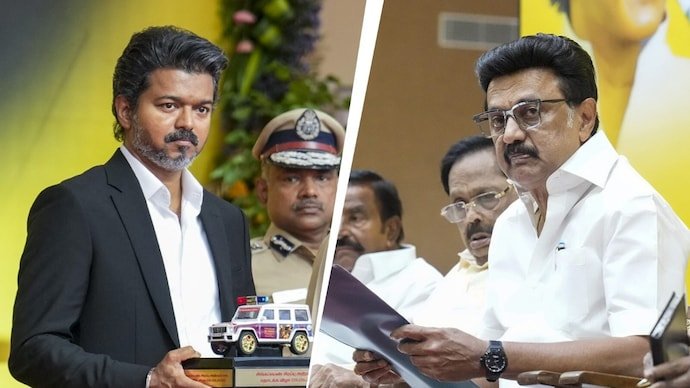
The Delimitation debate has returned to the centre of Tamil Nadu politics, with the ruling TVK government and the opposition DMK taking positions on an issue that could reshape the distribution of seats in the Lok Sabha.
DMK leader and Leader of the Opposition in the Tamil Nadu Assembly Udhayanidhi Stalin has said his party has opposed the proposed exercise from the beginning and will continue to do so. His clarification came amid reports that the DMK could consider supporting the Centre’s proposed delimitation framework if certain safeguards were incorporated.
At the same time, Tamil Nadu Chief Minister C. Joseph Vijay has called a meeting of the state’s Lok Sabha and Rajya Sabha MPs to discuss the proposed exercise and its possible consequences for the state.
The parallel developments are significant because delimitation is no longer only a constitutional or parliamentary question. In Tamil Nadu, it has become closely connected with concerns over political representation, population policy, Centre-state relations and the relative influence of southern states in national politics.
Udhayanidhi Stalin says DMK will continue opposing delimitation
Udhayanidhi Stalin said the DMK’s position on delimitation had not changed. Responding to speculation that the party may have softened its stand, he said the party had opposed the exercise from the outset and would continue to oppose it.
The clarification came after reports suggested that the DMK could potentially support a revised arrangement if several conditions were included in the proposed legislation.
According to the reported demands, the DMK wants safeguards that would prevent Tamil Nadu’s share of representation from being diluted. Among the conditions discussed are retaining the 1971 Census as the basis for determining representation for a specified period, ensuring a substantial increase in seats across states and providing a clear state-wise allocation of seats in the legislation.
The distinction matters. Opposing delimitation outright and demanding safeguards within a delimitation exercise are politically different positions. The latest statement from Udhayanidhi indicates that, at least publicly, the DMK wants to maintain a firm opposition to the proposed exercise rather than be seen as endorsing it.
Why delimitation has become such a major issue in Tamil Nadu
Delimitation refers to the redrawing of electoral constituencies and, where applicable, the redistribution of seats among states based on constitutional and legal provisions.
The central political controversy arises from the possibility of using population figures to determine the future distribution of Lok Sabha seats. Southern states argue that a population-based approach could reward states that experienced faster population growth while providing comparatively less political weight to states that made greater progress in population stabilisation.
Tamil Nadu and other southern states have historically invested heavily in Education, healthcare and family planning, contributing to slower population growth compared with several northern states.
The political concern is therefore not simply about the number of constituencies. It is about whether electoral representation should take population size into account without also recognising the consequences of decades of population-control policies.
What could happen to Tamil Nadu’s Lok Sabha representation?
Tamil Nadu currently has 39 seats in the Lok Sabha, accounting for roughly 7.2% of the House’s 543 elected seats.
A government proposal discussed earlier this year envisaged an approximately 50% increase in Lok Sabha seats across states. Under the illustrative figures released by the government, Tamil Nadu’s representation would rise from 39 to 59 seats.
| State | Current Lok Sabha seats | Illustrative seats after 50% increase |
|---|---|---|
| Tamil Nadu | 39 | 59 |
| Karnataka | 28 | 42 |
| Andhra Pradesh | 25 | 38 |
| Telangana | 17 | 26 |
| Kerala | 20 | 30 |
The figures are important because they illustrate the government’s argument that a uniform expansion could allow southern states to gain seats rather than lose them in absolute terms.
However, opponents of the proposed approach are concerned about the underlying principle of representation. Even if Tamil Nadu receives more MPs, the political balance between states could change if faster-growing states gain a larger share of the overall House.
That is why the debate cannot be reduced to whether Tamil Nadu will gain or lose individual seats. The more important question is how its share of national representation changes relative to other states.
Why the 1971 Census matters to southern states
The demand to retain the 1971 Census as the basis for seat allocation is rooted in the history of India‘s delimitation policy.
India previously froze the allocation of Lok Sabha seats among states to prevent states from being penalised for successfully controlling population growth. That political compromise allowed states to pursue population stabilisation policies without fearing an immediate reduction in their parliamentary influence.
Southern states now argue that abruptly shifting to a population-based formula could undermine that earlier incentive structure.
The issue has become particularly sensitive because population growth has not been uniform across India. States with large populations today could gain substantially more representation if seats are redistributed primarily according to population.
For Tamil Nadu, therefore, the Delimitation debate is also about whether the country’s electoral system should reward population size alone or balance population with other constitutional and political considerations.
Government says southern states will not be disadvantaged
The Centre has presented a different interpretation of the proposed changes. Government figures released during the earlier parliamentary debate showed that a uniform increase of around 50% in seats could actually leave the southern states’ combined share of Lok Sabha seats broadly stable or marginally higher.
The government’s illustrative calculation put the combined representation of the six southern states at about 24% of the current House and roughly the same proportion after the proposed expansion.
Tamil Nadu’s own share was projected to move from around 7.18% to approximately 7.23% under that model.
This is an important part of the political argument because it challenges the assumption that any expansion of the Lok Sabha would automatically reduce the South’s representation.
But the government’s calculation depends on the specific formula used. The political dispute is therefore likely to continue until the final legislative framework, allocation formula and state-wise seat numbers are settled.
Vijay seeks meeting with MPs across party lines
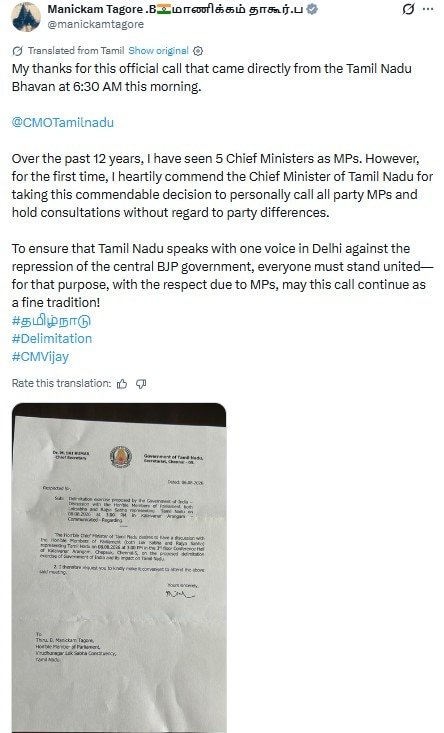
Against this backdrop, Chief Minister Vijay has called a meeting with Tamil Nadu’s MPs to discuss the delimitation proposal. The meeting is significant because it is intended to bring together representatives from different political parties at a time when state politics remains sharply divided.
Vijay has previously described the Centre’s proposed delimitation exercise as biased and opposed measures that he believes could weaken Tamil Nadu’s political voice.
The decision to consult MPs from across the political spectrum could allow Tamil Nadu to present a common position in Delhi, rather than having different parties advance competing arguments.
Congress MP Manickam Tagore welcomed the initiative, describing the decision to invite MPs from different parties for consultation as unusual and arguing that Tamil Nadu should speak with one voice on the issue.
Why an all-party approach could matter
Delimitation is one of those issues where state-level political rivalries can temporarily take a back seat to broader questions about federal representation.
Tamil Nadu’s political parties have disagreed sharply on many issues, but concerns about the consequences of population-based representation have previously produced cooperation among parties that normally compete against each other.
An all-party consultation could therefore strengthen the state’s negotiating position if the parties agree on a common set of demands.
However, reaching that consensus may be difficult. The DMK and Vijay’s TVK are now on opposite sides of the state’s political divide, and Udhayanidhi Stalin has emerged as the Leader of the Opposition after the 2026 Assembly election.
The meeting will therefore also be watched as an early test of how much cooperation is possible between the new government and the principal opposition party on an issue involving Tamil Nadu’s long-term representation in Parliament.
DMK’s position is also important for the wider opposition
The DMK’s position has attracted particular attention because of its parliamentary strength and its historical role in opposing population-based delimitation proposals that could affect southern representation.
Any indication that the party might support a revised delimitation bill would have implications beyond Tamil Nadu. It could influence the broader opposition strategy in Parliament and potentially affect efforts by opposition parties to maintain a common position.
That explains why reports of a possible DMK shift generated political attention even before the party publicly clarified its position.
Udhayanidhi’s statement removes some immediate uncertainty, although the details of the party’s demands remain relevant to understanding how it approaches the legislation.
Delimitation is about more than Lok Sabha seats
The debate also has implications for India’s federal political structure. Parliamentary representation affects how states participate in national decision-making, including debates over legislation, government formation and the allocation of political attention.
There is also a broader concern in southern states that parliamentary representation and fiscal federalism should not move in opposite directions. The fear is that a state could be recognised for having controlled population growth but later find that achievement reflected negatively in its political weight.
At the same time, advocates of delimitation argue that democratic representation should eventually reflect changes in population. The longer the allocation of seats remains disconnected from population changes, the greater the gap between the number of people represented by MPs in different states can become.
That creates the central tension in the debate: how should India balance equal representation of citizens with the need to preserve incentives for states that successfully controlled population growth?
What happens next?
The next stage of the controversy will depend on the government’s legislative strategy and the precise provisions ultimately placed before Parliament.
For Tamil Nadu, the immediate priority is likely to be building a common position among its MPs and political parties. Vijay’s meeting could provide a platform for that discussion, while the DMK’s clarification gives the opposition party a clear starting point.
The final political battle will not be decided simply by the headline number of Lok Sabha seats. It will depend on the formula used to distribute those seats, the safeguards offered to states, the treatment of historical population-control policies and the extent to which the proposed changes alter the balance of representation.
For now, the DMK says its opposition to the proposed delimitation framework remains intact. Vijay’s decision to bring MPs together shows that the Tamil Nadu government also intends to make the issue a collective state-level concern. With the Centre preparing to move ahead and political parties positioning themselves, the delimitation debate in Tamil Nadu is likely to remain a major issue in both state and national politics.
For breaking news and live news updates, like us on Facebook or follow us on Twitter and Instagram. Read more on Latest India on thefoxdaily.com.






COMMENTS 0