
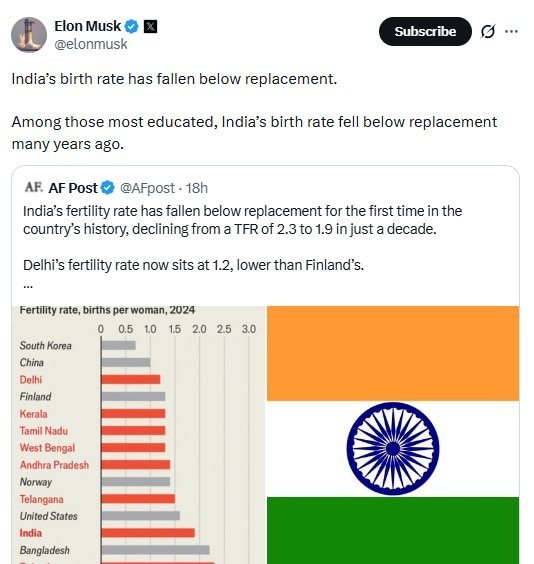
India has long been associated with rapid population growth. For decades, policymakers worried about managing a rising population, creating jobs for millions of young people, and ensuring adequate food, housing, healthcare, and Education. However, a major demographic shift is now underway. According to the latest fertility data, India’s Total Fertility Rate (TFR) has fallen to 1.9 children per woman, below the replacement level of 2.1.
The development attracted global attention after Elon Musk commented on the trend, noting that India’s birth rate has fallen below replacement levels and highlighting that fertility among the country’s most educated population had crossed that threshold years ago. While the remark sparked discussion on Social Media, it also brought attention to one of the most important long-term challenges facing not just India, but much of the world.
The key question is no longer whether India’s population is growing too quickly. Instead, policymakers, economists, and demographers are increasingly asking whether the country is entering a period of demographic slowdown that could reshape its economic and social future.
Understanding India’s Fertility Decline
The Total Fertility Rate measures the average number of children a woman is expected to have during her lifetime. A TFR of 2.1 is generally considered the replacement level, meaning each generation is large enough to replace itself without relying on immigration.
India’s latest fertility rate of 1.9 indicates that the country has moved below this threshold.
This does not mean India’s population will immediately begin shrinking. Due to its large young population, India will continue to add people for several years. However, it signals that long-term population growth is slowing and could eventually stabilize before entering decline later this century.
Such demographic transitions have already occurred across Europe, East Asia, and parts of North America.
What Is Driving India’s Falling Fertility Rate?
The decline is not the result of a single factor. Instead, it reflects profound economic, educational, and social transformations occurring across the country.
1. Rising Education Levels
Education remains one of the strongest predictors of fertility decline worldwide. As literacy rates improve and more people pursue higher education, family sizes typically become smaller.
Educated families often delay marriage, prioritize career development, and invest more resources in fewer children.
This observation aligns with Musk’s comment that fertility among India’s most educated groups dropped below replacement levels years ago.
2. Urbanisation
India is rapidly urbanising. Living in cities is significantly more expensive than living in rural areas.
Housing costs, education expenses, healthcare, transportation, and childcare place financial pressure on families. As a result, many urban couples opt for one or two children rather than larger families.
3. Women’s Workforce Participation
Increasing educational opportunities and career aspirations among women have transformed family planning decisions.
Many women today prioritize professional growth alongside family life, often leading to delayed childbirth and smaller family sizes.
4. Access to Healthcare and Family Planning
Improved healthcare services and wider access to contraception have allowed families greater control over reproductive decisions.
This has contributed significantly to declining fertility rates across developing economies.
India’s Demographic Journey: Then vs Now
India’s demographic story has changed dramatically over the past several decades.
| Period | Demographic Trend | Primary Concern |
|---|---|---|
| 1960s-1980s | Rapid population growth | Population explosion |
| 1990s-2000s | Gradual fertility decline | Economic development |
| 2010s | Approaching replacement level | Job creation and urbanisation |
| 2020s | Below replacement fertility | Ageing population risks |
| Future decades | Potential population stabilisation | Workforce sustainability |
This transition represents one of the most significant demographic shifts in modern Indian history.
The States Still Above Replacement Level
Although India’s national fertility rate has fallen below replacement level, the picture varies considerably across states.
According to recent demographic data, Bihar, Uttar Pradesh, Madhya Pradesh, Rajasthan, Chhattisgarh, and Jharkhand continue to record fertility rates above the replacement threshold.
These states generally have younger populations and higher birth rates compared to more urbanised and economically developed regions.
Meanwhile, many southern and western states have experienced fertility rates below replacement level for years.
This creates a demographic imbalance where population growth becomes concentrated in specific regions while others experience ageing populations.
Why Low Fertility Is Becoming a Global Concern
For much of the 20th century, governments worried about overpopulation. Today, many developed economies face the opposite problem.
Countries such as Japan, South Korea, Italy, Germany, and china are grappling with falling birth rates and ageing populations.
The challenge is straightforward: when fewer children are born, fewer workers eventually enter the labor force.
Meanwhile, growing numbers of elderly citizens require pensions, healthcare services, and social support.
This creates economic pressure on younger generations and government finances.
The Economic Impact of Falling Fertility
Population trends directly influence economic growth.
A growing workforce can increase productivity, expand consumer demand, and support innovation. Conversely, a shrinking workforce can slow economic expansion.
Several economic challenges may emerge if fertility remains below replacement levels for an extended period.
- Labor shortages in key industries.
- Higher dependency ratios.
- Increased pension obligations.
- Greater healthcare spending.
- Slower economic growth.
- Reduced tax revenues.
Many advanced economies are already struggling with these issues.
Can India Still Benefit from a Demographic Dividend?
Despite concerns about falling fertility, India continues to possess one of the world’s youngest populations.
This demographic advantage is often called the “demographic dividend.”
A large working-age population can generate faster economic growth if sufficient jobs, education, and skills training are available.
India’s challenge is therefore different from countries like Japan or South Korea.
The country still has an opportunity to convert its youthful population into long-term economic strength before ageing pressures become more pronounced.
Success will depend on employment generation, industrial expansion, technological innovation, and human capital development.
Birth Rate vs Fertility Rate: Why the Difference Matters
Public discussions often confuse birth rates and fertility rates, but they measure different things.
| Indicator | Definition | Purpose |
|---|---|---|
| Birth Rate | Number of births per 1,000 people annually | Measures annual population growth |
| Total Fertility Rate | Average children per woman over her lifetime | Measures long-term demographic trends |
Fertility rate is generally considered the more important measure when assessing a country’s long-term population trajectory.
The Insight Many People Miss
The debate is often framed as either population growth being good or bad. Reality is more complicated.
Extremely high fertility can strain resources, infrastructure, and public services. Extremely low fertility can create workforce shortages and economic stagnation.
The goal is not necessarily higher or lower population growth but demographic balance.
Countries that maintain a stable working-age population while supporting sustainable economic development tend to be better positioned for long-term prosperity.
India’s current fertility rate suggests it may be moving toward that balance, but managing the transition effectively will be critical.
What Elon Musk’s Warning Reflects
Elon Musk has repeatedly argued that population decline represents one of the biggest long-term risks facing modern societies.
His concerns extend beyond India and include countries across Europe, East Asia, and North America where fertility rates have remained below replacement levels for years.
While experts disagree on the severity of the threat, there is broad consensus that demographic trends significantly influence economic performance, social stability, and public finances.
The discussion triggered by Musk’s comments therefore reflects a larger global conversation about how societies adapt to changing population structures.
Future Outlook: A New Demographic Era for India
India’s fertility rate falling below replacement level marks a historic milestone. It signals that the country is entering a new phase of demographic transition characterized by smaller families, slower population growth, and eventually a more mature age structure.
In the short term, India still benefits from a large and youthful workforce. In the long term, however, policymakers will need to prepare for challenges associated with ageing populations, workforce dynamics, healthcare demands, and social Security systems.
The countries that successfully navigate these transitions are typically those that invest heavily in education, productivity, innovation, and workforce participation.
Conclusion
India’s fertility rate dropping to 1.9 children per woman represents more than a statistical milestone. It marks the beginning of a significant demographic transformation that will influence the country’s Economy, society, and development trajectory for decades.
Elon Musk’s remarks have brought global attention to a trend that demographers have been tracking for years. While India remains the world’s most populous nation, the era of rapid population growth is gradually giving way to one of demographic stabilization.
The real challenge ahead is not simply whether fewer children are being born. It is whether India can capitalize on its remaining demographic dividend, build a highly skilled workforce, and prepare for the realities of an ageing society. How effectively it manages this transition may become one of the defining factors in determining India’s economic and geopolitical position during the 21st century.
For breaking news and live news updates, like us on Facebook or follow us on Twitter and Instagram. Read more on Latest World on thefoxdaily.com.






COMMENTS 0