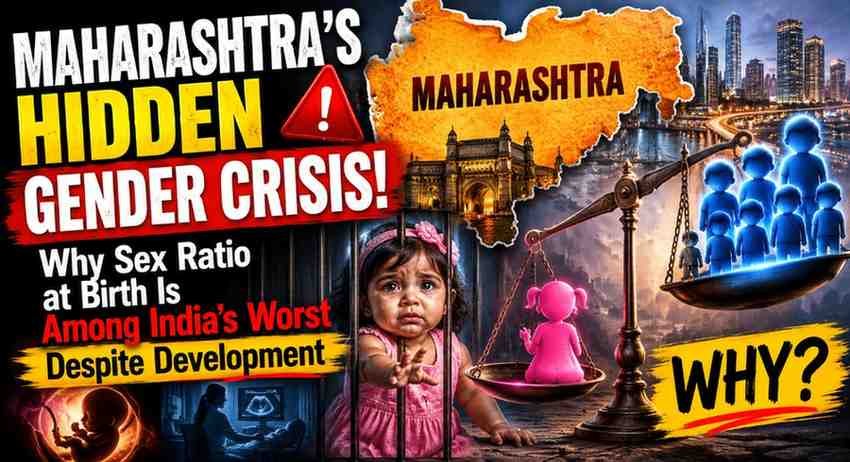
In most conversations about India‘s gender problem, certain states get named first Haryana with its deeply entrenched patriarchy, Bihar with its high fertility and son preference, Rajasthan with its history of early marriage. Maharashtra rarely makes that list. It is, after all, home to Mumbai, India’s financial capital, a state with one of the country’s highest rates of female literacy and urban employment, a mean female marriage age above the national average, and some of the lowest child marriage rates in the country. And yet, the latest data places Maharashtra firmly among the worst-performing major states in India on a single, damning metric: sex ratio at birth (SRB) the number of girls born for every 1,000 boys.
The numbers are stark. Maharashtra records approximately 899 girls per 1,000 boys at birth, placing it in the bottom five among all major states and Union Territories ranking only marginally ahead of Bihar (896), Haryana (885), Delhi (876), and Uttarakhand (872). For a state that routinely leads on economic and social development indicators, this is not just a statistical anomaly. It is a crisis hiding in plain sight, and the data demands an honest reckoning.
What makes Maharashtra’s performance particularly troubling and analytically interesting is that it breaks every expected correlation. The conventional wisdom in public health research holds that higher female education, later marriage, lower fertility, and greater economic participation all correlate positively with a healthier sex ratio at birth. Maharashtra scores well on nearly all these indicators.
The state’s mean age at marriage for women stands at 23.4 years, slightly above the national average of 23.1 years. Child marriage affects only one per cent of women in Maharashtra, against the national average of 2.1 per cent. The NFHS-5 (2019–21) survey recorded a sex ratio at birth of 913 girls per 1,000 boys already a decline from 924 in the previous NFHS-4 round of 2015–16. More recent Civil Registration System data has pushed that figure further downward.
If education and economic development were sufficient to correct gender bias at birth, Maharashtra should be near the top of the national ranking alongside Kerala (974) and Himachal Pradesh (956), both of which demonstrate that high SRB and high development can indeed coexist. The fact that Maharashtra sits alongside Haryana and Bihar instead tells us something important: wealth and education can coexist with deeply entrenched son preference when that preference is enabled by access to technology and weakly enforced law.
The Urban Scandal: Where Modernity and Misogyny Meet
Perhaps the most revealing and most disturbing finding in the Maharashtra data is the sharp rural-urban divide, which runs directly counter to the national pattern. Across India, urban areas record a healthier sex ratio at birth of 928 girls per 1,000 boys, compared to 914 in rural areas. The expectation is that cities, with their greater access to education, healthcare, and exposure to progressive ideas, will produce better gender outcomes.
In Maharashtra, the opposite is true. Rural Maharashtra recorded a sex ratio at birth of 910 girls per 1,000 boys a concerning figure, but one that pales alongside urban Maharashtra’s deeply troubling 885 girls per 1,000 boys. Maharashtra’s cities are performing worse on this metric than its villages.
This inversion points directly to one of the most uncomfortable truths in the gender data: access to ultrasound technology, combined with disposable income and weak PCPNDT enforcement, turns urban privilege into a tool for sex-selective abortion. Urban families in Maharashtra have the economic means to access private scanning facilities, the information to identify sex early in pregnancy, and critically the reduced family size aspirations that intensify the pressure to “ensure” at least one son. A family that intends to have only one or two children may calculate that it cannot afford to “risk” a daughter as the sole or first child.
This dynamic smaller desired family size combined with persistent son preference is what researchers call the “fertility-sex ratio paradox.” It is visible across India’s developed states, but Maharashtra’s data makes it exceptionally legible.
State-by-State: Where Maharashtra Stands
| State / UT | Sex Ratio at Birth (Girls per 1,000 Boys) | Development Category |
|---|---|---|
| Kerala | 974 | High development, high SRB |
| Himachal Pradesh | 956 | High development, high SRB |
| Chhattisgarh | 967 | Lower development, strong SRB |
| National Average | ~929 | — |
| Maharashtra | ~899 | High development, low SRB |
| Bihar | 896 | Low development, low SRB |
| Haryana | 885 | Middle development, low SRB |
| Delhi | 876 | High development, very low SRB |
| Uttarakhand | 872 | Middle development, very low SRB |
The table reveals two distinct pathways to a poor sex ratio at birth: the traditional route of low development and deep rural patriarchy (Bihar), and the emerging route of high development with urban son preference and technology access (Maharashtra, Delhi). Both produce roughly the same outcome for girl children they are not born.
The Law Is There. The Enforcement Is Not.
India has had the legal framework to address sex-selective abortion since 1994, when the Pre-Conception and Pre-Natal Diagnostic Techniques (PCPNDT) Act was passed, prohibiting the use of diagnostic technology to determine the sex of a foetus. The law has teeth it allows for imprisonment of violators, cancellation of clinic registrations, and prosecution of both service providers and those who seek sex determination.
In practice, those teeth are rarely used. Conviction rates under the PCPNDT Act remain startlingly low. The Ministry of Health has reported only a few hundred convictions against the backdrop of tens of thousands of registered ultrasound and genetic clinics across the country. State-level monitoring committees, which the Act mandates must meet quarterly, frequently fail to do so. In Maharashtra a state with one of India’s densest concentrations of private diagnostic clinics the scale of the enforcement gap is proportionally vast.
There is also a geographic arbitrage problem. When a district or state begins cracking down, patients and operators often shift activity across jurisdictions. Raids conducted in Haryana, for instance, have uncovered inter-state networks operating out of Uttar Pradesh and Rajasthan. In Maharashtra, with its sprawling urban-rural continuum and dense private healthcare ecosystem, monitoring and accountability are structurally harder to sustain than in geographically smaller or more administratively centralised states.
The Beti Bachao Beti Padhao (BBBP) campaign, launched in 2015 from Panipat, Haryana, was designed to complement PCPNDT enforcement with demand-side cultural change. The results nationally have been modest but real the sex ratio at birth improved from approximately 918 in 2014–15 to around 933 by 2022–23, a 15-point gain. But a Parliamentary Standing Committee on the Empowerment of Women found that more than half of the BBBP budget was spent on media and advertising rather than direct interventions that change household-level behaviour. Maharashtra’s continued slide in SRB despite being one of India’s better-resourced states suggests that advertising alone cannot move deeply held beliefs about the value of daughters.
The Missing Girls: What the Numbers Actually Mean
Sex ratio at birth statistics can feel abstract. What they represent is not abstract at all. Across India, the natural biological sex ratio at birth — the ratio that would prevail in the complete absence of gender-based interference is approximately 952 girls per 1,000 boys. Every point below that figure represents girls who were never allowed to be born.
A state recording 899 girls per 1,000 boys instead of the natural 952 is, in effect, “missing” approximately 53 girl births for every 1,000 male births. Scaled across Maharashtra’s millions of annual births, this translates into tens of thousands of girls per year who are absent from the demographic record not because of natural causes, but because of deliberate, technology-enabled elimination before birth.
These are the daughters who would have grown up to be doctors, engineers, farmers, teachers, mothers, voters, taxpayers. Their absence is not just a moral failure it is an economic one. Research consistently shows that societies with more balanced gender ratios at birth grow more productively, have lower rates of gender based violence, and produce better outcomes for subsequent generations of both boys and girls.
Why Chhattisgarh and Kerala Should Be Maharashtra’s Benchmark
Among the analytical insights that standard news coverage tends to miss is the lesson embedded in the high-performing outliers. Chhattisgarh, one of India’s less economically developed states, records a sex ratio at birth of 967 far above the national average and dramatically above Maharashtra. Kerala, with its legendary emphasis on female education and literacy, records 974. Himachal Pradesh manages 956.
What these states share is not uniformly high GDP or urbanisation Chhattisgarh is among India’s lower-income states. What they share is a combination of community-level social norms that do not systematically devalue daughters, coupled with functional local governance structures that enforce the law even at the primary healthcare level. In Kerala, decades of women’s education and participation in civic life have shifted the cultural calculus around daughters so fundamentally that son preference, while not absent, no longer manifests in birth statistics. In Chhattisgarh, tribal social structures in many regions have historically been more gender-egalitarian than the caste-dominant agrarian societies of north and west India.
For Maharashtra, the prescription is not simply more ultrasound raids, though those are necessary. It is a sustained investment in the social infrastructure women’s property rights, women’s economic independence, and a cultural environment in which daughters are genuinely valued that makes the demand for sex determination less acute in the first place.
The Data Gap That Makes Everything Worse
Any analysis of India’s sex ratio at birth must confront a measurement problem that is rarely acknowledged in mainstream coverage: Census 2021 has not been conducted. India is now operating on state-level sex ratio data that is, in places, over a decade old. The Sample Registration System provides annual estimates, and the Civil Registration System tracks registered births, but neither provides the granular district-level data that would allow policymakers to target interventions precisely.
This means that the true extent of Maharashtra’s sex ratio problem including which districts are driving the state average down, whether the Marathwada region shows different patterns from Vidarbha or the Konkan coast, and whether specific castes or income groups are disproportionately responsible is not fully known. Without that data, policy remains blunt where it needs to be surgical.
Conclusion: Development Is Not Destiny
Maharashtra’s sex ratio at birth crisis delivers an uncomfortable verdict on the theory that economic development, left to itself, corrects gender discrimination. It does not. Development raises incomes and expands access to technology — including the technology of sex-selective abortion. Without simultaneously investing in the social and legal infrastructure that makes daughters genuinely valued and sex determination genuinely risky, development can actually worsen birth sex ratios in the short and medium term.
The states that are getting this right Kerala, Himachal Pradesh, Chhattisgarh have all, in different ways, invested in something that transcends GDP: a social environment in which the birth of a daughter is not treated as a burden to be engineered away. Maharashtra, with its resources, its institutions, and its talent, is more than capable of joining that list. The question is whether its policymakers, communities, and families are willing to confront the truth that its own data is now telling loudly and without ambiguity.
India cannot build a developed nation on a foundation of missing daughters. Maharashtra, of all states, should know better.
For breaking news and live news updates, like us on Facebook or follow us on Twitter and Instagram. Read more on Latest Health on thefoxdaily.com.






COMMENTS 0