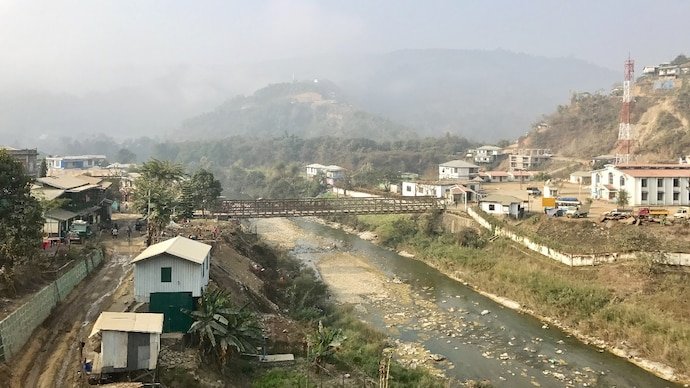
India and Myanmar are engaged in discussions to resolve long-pending undemarcated sections of their shared international border, with the Ministry of External Affairs (MEA) confirming that negotiations are underway. The issue has attracted widespread attention following reports that both countries are considering a limited territorial exchange in Manipur as part of efforts to complete the boundary demarcation process.
While the MEA has not confirmed that a land swap has been agreed upon, it has acknowledged that certain stretches of the border remain unsettled and are currently the subject of bilateral discussions. The reported proposal has also triggered opposition from civil society organisations in Manipur, which argue that any change affecting the state’s boundaries should not proceed without public consultation.
What Did the MEA Say?
During a press briefing in New Delhi, Ministry of External Affairs spokesperson Randhir Jaiswal addressed questions regarding reports of a possible territorial exchange between India and Myanmar.
He stated that some sections of the international border remain unresolved and confirmed that discussions regarding those areas are ongoing. However, he did not confirm reports that the two countries had reached any agreement to exchange territory.
The official response indicates that bilateral negotiations are continuing, but the government has not publicly announced any final decision regarding changes to the boundary.
Why Reports of a Territorial Exchange Emerged
The renewed attention follows a report published on July 17 by The Diplomat, which cited an official document stating that the Indian government was examining a proposal to complete the demarcation of the border between boundary pillars 65 and 68 along the Manipur-Myanmar frontier.
According to the report, the proposal involves the possible exchange of approximately 1.4 square miles of territory in order to settle one of the remaining undemarcated stretches of the international boundary.
The reported area lies in Manipur’s Chandel district near Myanmar’s Kabaw Valley in the Sagaing Region. The report further stated that the referenced official document was dated May 26, 2026, and anticipated completion of the demarcation exercise within approximately three months.
The Government of India has not officially confirmed these reported details.
Understanding the India-Myanmar Border
India and Myanmar share a 1,643-kilometre international border extending across four northeastern Indian states Arunachal Pradesh, Nagaland, Manipur and Mizoram before entering Myanmar’s Sagaing Region and Chin State.
The frontier passes through mountainous terrain, dense forests and remote communities, with several ethnic groups historically living on both sides of the border.
According to information from the Ministry of Home Affairs, approximately 1,472 kilometres of the boundary has already been demarcated using boundary pillars, while around 171 kilometres remain unresolved. These undemarcated portions are concentrated mainly in parts of Arunachal Pradesh and Manipur.
Why Is Border Demarcation Still Incomplete?
The present India-Myanmar boundary was established under a bilateral agreement signed in 1967. However, not every section of the frontier has been physically marked on the ground.
In 2018, the government informed Parliament that the remaining unresolved stretches would be addressed through an established bilateral boundary mechanism, including identifying and installing additional boundary pillars where necessary.
According to the available information, India has consistently maintained that it does not have a broader territorial dispute with Myanmar. Instead, the issue relates to a limited number of unresolved boundary pillars that still require final demarcation.
Why Might a Territorial Adjustment Be Considered?
According to The Diplomat, one reason being examined is the possibility of completing the demarcation process more efficiently so that India can proceed with plans to strengthen border management.
The report stated that resolving the remaining boundary uncertainties could facilitate construction of border fencing intended to address concerns relating to illegal Immigration, cross-border crime and the movement of insurgent groups.
These reported considerations have not been independently confirmed by the Government of India, although border management has been a stated policy priority in recent years.
Border Security Has Become a Major Policy Focus
In 2024, India announced its intention to fence the entire 1,643-kilometre international border with Myanmar.
The government also decided to discontinue the Free Movement Regime (FMR), which had been in operation since 2018. Under that arrangement, eligible tribal communities living near the border could Travel up to 16 kilometres into each other’s territory using border passes without requiring visas.
The decision reflected a broader effort to strengthen border regulation while addressing security and migration concerns in the region.
Which Areas Remain Most Sensitive?
Several stretches of the India-Myanmar border continue to require detailed demarcation.
According to the available information, the most sensitive sectors in Manipur include:
- Molcham sector between boundary pillars 64 and 68.
- Moreh sector between pillars 75 and 79.
- Choro Khunou sector between pillars 88 and 95.
The reported proposal relates specifically to the Molcham sector between pillars 65 and 68.
Reports of Bilateral Discussions
The Diplomat, citing an unnamed government official, reported that the issue was discussed during Myanmar leader Min Aung Hlaing’s visit to India last month.
According to the report, both governments considered options that included erecting auxiliary and new boundary pillars while examining an earlier Ministry of External Affairs proposal prepared in 2017 concerning border alignment in the sector.
Neither government has publicly confirmed these reported discussions.
Territorial Exchanges Are Not Without Precedent
Although any proposal involving territory is politically sensitive, India has previously resolved boundary issues with neighbouring countries through negotiated agreements.
One notable example is the 2015 Land Boundary Agreement between India and Bangladesh. Under that agreement, India transferred 111 enclaves to Bangladesh while receiving 51 Bangladeshi enclaves, resolving a boundary issue that had remained unsettled for more than four decades.
That agreement demonstrated that negotiated territorial settlements can be used to permanently resolve long-standing boundary complications when both countries reach mutual agreement.
Proposal Faces Opposition in Manipur
The reported proposal has generated strong reactions from sections of civil society in Manipur.
According to The Imphal Times, the Coordinating Committee on Manipur Integrity (COCOMI) warned the Union government against ceding any part of the state’s territory to Myanmar if the reported proposal were implemented.
The organisation stated that it would launch a strong public response should such a move proceed.
What Is COCOMI’s Position?
COCOMI is a joint platform of Meitei civil society organisations formed in 2019 during the Centre’s peace negotiations with Naga insurgent groups.
Following publication of the report regarding the proposed territorial exchange, the organisation argued that Manipur’s territorial integrity is non-negotiable.
According to reports, COCOMI maintained that the state’s present boundaries have historical significance and expressed concern that any further territorial reduction would be unacceptable.
The organisation also urged the Union government not to take any decision affecting Manipur’s boundaries without the consent of the people of the state.
Why the Issue Matters
The discussions involve more than the technical placement of boundary pillars. They touch upon National Security, border administration, local identity, constitutional governance and regional politics.
For the central government, completing the demarcation process could improve border management and reduce uncertainty along unresolved stretches.
For many residents and organisations in Manipur, however, even a limited territorial adjustment raises concerns about historical boundaries and state identity.
This explains why discussions over relatively small areas of land can generate significant political debate.
Timeline of Key Developments
| Year / Date | Development |
|---|---|
| 1967 | India and Myanmar defined the present international boundary through a bilateral agreement. |
| 2018 | The Government informed Parliament that unresolved stretches would be addressed through bilateral boundary mechanisms. |
| 2024 | India announced plans to fence the entire India-Myanmar border and discontinue the Free Movement Regime. |
| May 26, 2026 | According to The Diplomat, an official document examined a proposal concerning the border between pillars 65 and 68. |
| July 17, 2026 | The Diplomat reported that India was considering a possible territorial exchange to complete demarcation. |
| Recent | The MEA confirmed that discussions on unsettled border sectors with Myanmar are ongoing but did not confirm a land exchange. |
What Could Happen Next?
The next stage will likely depend on the outcome of bilateral discussions between India and Myanmar. At present, the government has confirmed only that negotiations over unresolved boundary sectors are continuing.
If the two countries eventually reach an agreement on demarcation, further official announcements would be expected before any boundary-related changes are implemented. At the same time, any proposal involving territorial adjustments is likely to face close political and public scrutiny, particularly in Manipur.
Broader Context
Resolving international boundaries often requires balancing historical agreements, local concerns, security priorities and diplomatic negotiations. While most of the India-Myanmar border has already been formally demarcated, the remaining unresolved sections continue to require careful bilateral engagement.
The current discussions highlight the complexity of border management in India’s Northeast, where geography, history and the interests of local communities intersect with national security and international Diplomacy. Whether the ongoing negotiations ultimately result in a final agreement remains uncertain, but the issue is likely to remain an important subject of policy and public debate in the months ahead.
For breaking news and live news updates, like us on Facebook or follow us on Twitter and Instagram. Read more on Latest India on thefoxdaily.com.






COMMENTS 0