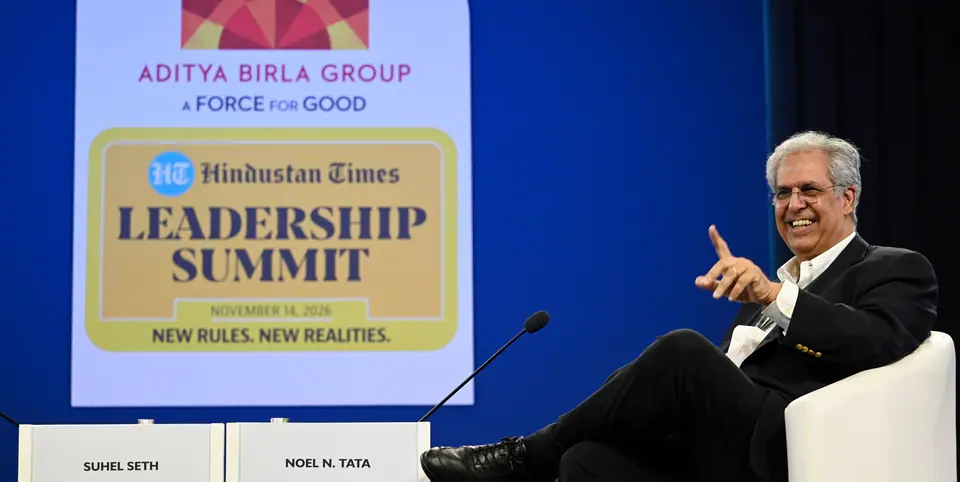
Tata Trusts chairman Noel Tata has said he does not question the Tata Group’s strategic direction but is concerned about whether the organisation has the discipline to execute its plans effectively. Speaking at the 24th Hindustan Times Leadership Summit, Tata emphasised that ambitious projects require careful implementation, financial discipline and a clear assessment of outcomes.
His remarks highlighted a distinction between deciding what the group should achieve and ensuring that its investments and projects deliver the intended results. He said the group’s core philosophy remained rooted in Philanthropy and nation-building, regardless of changes in leadership or personalities.
Tata also discussed the priorities of Tata Trusts, the importance of measuring the impact of charitable spending, plans to establish hospitals in underserved regions and the challenges of making difficult funding decisions.
Tata Group’s Direction Is Clear, but Execution Needs Discipline
Addressing questions about the Tata Group’s strategic priorities, Noel Tata said its overall direction had not changed. He described philanthropy and nation-building as central principles embedded in the group’s identity rather than priorities associated with any particular leader.
However, he said the organisation needed to examine how effectively it translated its ambitions into completed projects.
“I have not questioned the direction of what we’ve done. I question sometimes the delivery of what we’re doing,” Tata said at the summit.
He stressed that large projects, particularly those requiring substantial investment and long development periods, could succeed only when supported by consistent execution and disciplined capital allocation.
The challenge, according to Tata, is not simply identifying projects that align with the group’s ambitions. It is ensuring that resources are allocated carefully, implementation remains on track and the expected outcomes are achieved.
He questioned how projects with long gestation periods could succeed without execution discipline and argued that the group needed to maintain high standards while carrying out large-scale initiatives.
His comments placed operational performance at the centre of the discussion about the Tata Group’s future. Strategic ambition, he suggested, must be accompanied by the organisational processes and financial decisions required to turn plans into results.
Philanthropy and Nation-Building Remain Core Tata Trusts Priorities
Tata said the group’s commitment to philanthropy and nation-building was independent of changes in leadership. He described these principles as part of the organisation’s founding philosophy and said they continued to guide its work.
The Tata Trusts play a significant role in carrying forward this philanthropic legacy. Their work includes supporting communities, improving access to essential services and contributing to institutions that advance education, research and public welfare.
For Tata, the challenge is to ensure that these commitments produce meaningful improvements rather than being measured simply by the amount of money spent.
He said the Trusts needed to assess what their programmes actually achieved, particularly in underserved communities where social and economic challenges often overlap.
This approach also reflects a broader emphasis on connecting different development initiatives. Instead of treating nutrition, agriculture, water management and employment as separate interventions, Tata indicated that combining them in a single area could produce more substantial results.
Noel Tata Says Impact Matters More Than Expenditure
After taking over as chairman of Tata Trusts in October 2024 following the death of Ratan Tata, Noel Tata reviewed the organisation’s programmes in underserved areas.
The review reinforced his view that philanthropic work should be judged by its impact rather than the amount of money allocated to it.
“It wasn’t just, okay, I spent so many crores doing this. What did we actually achieve with that expenditure? What could be the maximum impact that we could arrive at?” he said.
The distinction is important because charitable spending does not automatically translate into lasting improvements. A programme may reach a large number of people or involve substantial funding, but its effectiveness depends on whether it addresses the underlying problems and creates measurable benefits.
Tata offered an example of an integrated development approach involving nutrition, water harvesting and agriculture in the same geographical area.
Such programmes could address several connected challenges faced by rural households. Better access to water can support agricultural activity, while improved farming conditions can contribute to food security and household income.
He also highlighted the importance of creating employment opportunities for women. When another member of a household begins earning, the additional income can improve the family’s overall financial position.
Tata said the increase in household income when a second person earns can make a significant difference to living conditions. His comments reflected an emphasis on programmes that generate economic opportunities alongside improvements in basic services.
Taking Over Tata Trusts Chairmanship Was a Humbling Experience
Tata described becoming chairman of Tata Trusts as a humbling experience, particularly after years of serving as a trustee.
He said the role gave him a deeper understanding of the scale of challenges faced by disadvantaged communities and the opportunities available to support them.
“One thing that struck me and gave me a lot of humility is the depth of the problems that some of our society have to face, and the enormous opportunity that existed to help the underserved,” he said.
The experience, he indicated, changed how he viewed the responsibilities associated with managing philanthropic resources. Addressing social challenges requires more than financial contributions; it demands an understanding of local needs, effective programme design and sustained implementation.
His remarks also underscored the responsibility of Tata Trusts as custodians of resources intended to serve public interests over the long term.
Tata Looks to the Founders’ Vision for Guidance
When discussing the principles guiding the Trusts, Tata said he returned to the founding documents of the organisation.
He pointed out that the founders could have transferred their wealth to family members but instead chose to dedicate shares and financial resources to the Trusts.
“They could have left their money to the family, to their cousins. Instead, they decided, no, we leave our shares and our money to these trusts,” he said.
He described that decision as a guiding principle for the organisation’s work today. The founders intended the Trusts to support institution-building in India, provide relief to communities facing hardship and advance learning.
Tata referred to institutions such as the Indian Institute of Science, the Tata Institute of Fundamental Research and the National Centre for Biological Sciences as examples of the institutional legacy associated with the founders’ vision.
These institutions represent a long-term approach to nation-building through scientific research, education and the development of knowledge. Tata’s remarks suggested that the Trusts should continue to evaluate their priorities against this broader purpose.
Tata Trusts Plan 40 to 50 Hospitals in Underserved Regions
One of the major initiatives outlined by Tata was a plan to establish 40 to 50 not-for-profit general-purpose hospitals in underserved parts of India.
The proposed hospitals are intended to improve access to healthcare in regions where communities may have limited access to medical facilities. Tata said the locations would be selected near reasonably sized cities rather than in extremely remote rural areas.
He explained that building hospitals in locations without sufficient supporting infrastructure could make it difficult to attract and retain qualified doctors.
“If you build hospitals in really, really rural areas, you won’t get doctors to come and work in those hospitals,” he said.
The location strategy reflects a practical consideration in healthcare planning. Hospitals need not only buildings and medical equipment but also qualified professionals, reliable infrastructure and the ability to maintain services over time.
Placing facilities near established urban centres could help them access medical staff while serving surrounding underserved populations.
The proposed network would focus on not-for-profit healthcare delivery. However, the long-term effectiveness of the initiative will depend on how the Trusts identify locations, recruit medical professionals, manage operating costs and maintain consistent standards of care.
₹9.5 Crore Treatment Case Highlights Difficult Philanthropic Choices
Tata also described a case involving a three-year-old girl with a rare disease to illustrate the difficult decisions philanthropic organisations sometimes face.
The child’s treatment required a single injection costing ₹9.5 crore. Tata said the amount was significantly higher than the ₹20 lakh to ₹30 lakh that the Trusts typically provide in an individual case.
The situation presented a difficult choice: whether to direct an exceptionally large amount towards one patient or distribute the available resources among hundreds of people who also needed assistance.
Rather than immediately committing the entire amount, the Trusts encouraged the girl’s father to raise funds through crowdfunding.
According to Tata, the father managed to collect ₹8.5 crore over five months. Tata also approached friends and requested contributions of ₹5 lakh each, while the Trusts agreed to cover the remaining amount.
The girl subsequently received the injection and has almost fully recovered, Tata said.
The case illustrated the balance between responding to an urgent individual need and maintaining the ability to support a much larger number of beneficiaries.
It also demonstrated how crowdfunding, personal contributions and institutional support can be combined to address an exceptionally expensive medical requirement.
For Tata, the example highlighted why philanthropic decisions require careful judgement. Organisations must consider the immediate needs of individuals while also ensuring that their resources remain available for broader public benefit.
Noel Tata Says Effective Philanthropy Requires Excellence
Reflecting on his transition from business leadership to heading Tata Trusts, Tata said the new responsibility required him to learn his role again.
He recalled spending four decades of his life finding ways to make money, but said managing philanthropic resources involved a different set of challenges.
“At first I thought this is very easy. It sometimes is depressing… you realise you need excellence to make money, you also need excellence to spend money,” he said.
His observation captured a central theme of his remarks at the summit: financial resources alone cannot guarantee successful outcomes. Whether the objective is building a business, establishing a hospital or improving conditions in underserved communities, results depend on the quality of planning and execution.
For the Tata Group, that means maintaining discipline in large projects and ensuring that capital is used effectively. For Tata Trusts, it means measuring the real-world impact of programmes, supporting institutions and making difficult choices about limited resources.
Execution and Measurable Results Will Shape Tata Trusts’ Priorities
Noel Tata’s comments at the 24th Hindustan Times Leadership Summit outlined a consistent approach to both business and philanthropy. He reaffirmed the Tata Group’s established priorities while emphasising that their success depends on disciplined implementation.
His remarks also indicated that Tata Trusts would place greater attention on outcomes, integrated development initiatives and access to essential services. The proposed hospital network and the focus on household income and community development reflect the scale of the organisation’s ambitions.
The broader message was that long-term goals need more than financial commitments or institutional legacy. They require careful planning, accountability and the ability to demonstrate that resources are producing meaningful results.
As Tata continues in his role, the balance between preserving the founders’ vision and improving the execution of programmes is likely to remain central to his leadership approach.
For breaking news and live news updates, like us on Facebook or follow us on Twitter and Instagram. Read more on Latest India on thefoxdaily.com.





COMMENTS 0