The Tata Group’s latest leadership dispute has brought an old question back to the centre of corporate India: who ultimately controls one of the country’s most influential business conglomerates—the board of its holding company, its largest shareholders, or the executives responsible for running its businesses?
In September 2026, the debate has resurfaced after Tata Sons reappointed N chandrasekaran as executive chairman for another five-year term, despite opposition from Noel Tata, chairman of Tata Trusts. The dispute also involves the group’s approach to Reserve Bank of India (RBI) listing requirements and disagreements over the interpretation of Tata Sons’ Articles of Association.
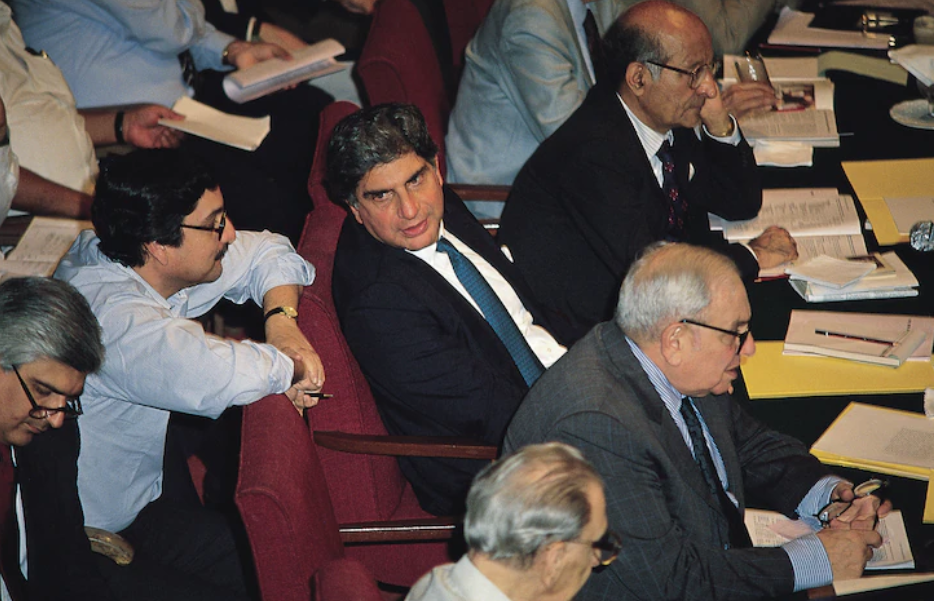
The confrontation has drawn comparisons with the early 1990s, when Ratan Tata, newly appointed chairman of Tata Sons, faced resistance from powerful executives who had built substantial authority within individual Tata companies.
That earlier struggle, particularly the confrontation with Tata Steel chief Russi Mody, became a defining episode in the evolution of the Tata Group. It was not simply a disagreement between two prominent personalities. It raised fundamental questions about succession, managerial independence, corporate governance and the authority of the group’s central leadership.
Three decades later, the circumstances are different, but the underlying issue remains relevant: how should authority be distributed between Tata Sons, its shareholders, its board and the leaders of its operating companies?
Ratan Tata Inherited a Conglomerate, Not an Automatically Unified Empire
When Ratan Tata succeeded JRD Tata as chairman of Tata Sons in 1991, he took charge of a business group with a long history, powerful institutions and experienced leaders. Yet becoming chairman of the holding company did not automatically mean that every major operating company would immediately follow his direction.
Under JRD Tata, the group had developed a structure in which individual companies enjoyed considerable autonomy. Their leaders often had long careers, strong relationships with employees and considerable influence over business decisions.
Among the most prominent executives were:
- Russi Mody: The influential leader of Tata Iron and Steel Company, now Tata Steel.
- Darbari Seth: A major figure in Tata Chemicals and Tata Tea.
- Ajit Kerkar: The executive associated with the growth of Indian Hotels and the Taj hospitality business.
These executives had helped build important businesses within the group. Their authority was rooted not merely in their job titles, but also in years of experience, institutional knowledge and relationships inside their respective companies.
For Ratan Tata, the challenge was to establish a more coordinated group structure without disregarding the contributions of the people who had built its businesses.
The question was therefore larger than who occupied the chairman’s office. It concerned the balance between individual-company autonomy and the strategic authority of Tata Sons.
Why the Early 1990s Became a Turning Point
Ratan Tata’s appointment coincided with a period of major economic change in India. The country was beginning to move away from a heavily regulated economic framework towards greater liberalisation and competition.
For large Indian businesses, the changing environment created new demands. Companies increasingly needed to consider investment, technology, efficiency, international competition and opportunities beyond their traditional markets.
A conglomerate operating through powerful but relatively independent companies faced an important organisational question: could it coordinate its resources and strategy effectively while allowing each business to respond to its own market?
Greater coordination could help the group establish common priorities and make decisions across businesses. However, it could also create tension with executives accustomed to substantial independence.
Ratan Tata’s effort to strengthen central oversight therefore represented a change in the group’s operating philosophy. The objective was not simply to replace a few senior executives. It was to establish a clearer relationship between the holding company and the businesses under its umbrella.
Russi Mody: The Central Figure in Tata’s First Major Leadership Test
Russi Mody was one of the most prominent figures in the Tata Group when Ratan Tata became chairman. He had spent decades at Tata Iron and Steel Company and was closely associated with the company’s identity.
His standing made the disagreement with Ratan Tata particularly consequential. Mody was not an inexperienced executive whose authority depended only on a recent appointment. He had a long record within the business and enjoyed a strong reputation among many employees.
The conflict became especially significant around succession and the future leadership of Tata Steel.
Mody had sought to elevate his adopted son, Aditya Kashyap, within TISCO. That issue became part of a broader disagreement over how leadership should be selected and who would exercise authority over the company’s future.
At stake was a principle with implications beyond one executive’s career: should a powerful company chief have substantial influence over succession, or should those decisions be guided more directly by the group’s central leadership and corporate governance arrangements?
The dispute revealed the difficulty of changing leadership in a conglomerate where individual executives had built substantial power over many years.
The 1992 TISCO AGM and the Change in Leadership
The succession struggle reached an important point at Tata Iron and Steel Company’s 1992 annual general meeting. Mody stepped down as managing director, and Jamshed J Irani was appointed to the position.
According to the historical account cited by India Today, the atmosphere at the meeting appeared conciliatory, even though the preceding struggle had exposed serious divisions within the group.
The change in managing director was significant because it demonstrated that leadership at a major Tata company could be altered despite the influence of a long-serving executive.
However, Mody’s departure from the managing director’s position did not immediately end the broader confrontation. The following year, he left TISCO altogether.
In a 1993 interview with India Today Magazine, Mody discussed his disagreement with Ratan Tata. He said his criticism concerned management and the company’s performance rather than simply personal likes or dislikes.
He also acknowledged that the TISCO board had the authority to remove him. His comments illustrated the difference between disagreeing with a decision and disputing the formal authority through which that decision was made.
Mody’s exit became one of the clearest symbols of the transition underway at Tata Sons. It showed that the group’s central leadership was prepared to change the management of a major company when it believed the existing arrangement needed to change.
Ratan Tata’s Retirement Policy: Turning a Leadership Principle into a Formal Rule
The changes at Tata Steel were part of a broader effort. In 1992, Ratan Tata introduced a retirement policy establishing age limits for senior executives and directors.
The policy mattered because it provided a formal mechanism for leadership transitions. Rather than relying entirely on individual negotiations or the personal influence of senior executives, the group could apply a defined retirement framework.
According to the historical account, the policy contributed to the departure of several prominent figures from leadership positions, including Mody, Darbari Seth and Ajit Kerkar. Their exits, however, occurred under different circumstances and should not be treated as identical events.
Mody left TISCO in 1993. Seth retired from leadership positions in 1994. Kerkar left Indian Hotels in 1997 amid a separate governance controversy.
The broader significance was organisational. A formal policy could reduce the ability of any individual executive to retain a leadership position indefinitely simply because of personal influence or a long record of service.
It also made succession a matter of institutional rules rather than solely a question of individual relationships.
Why formal rules can change corporate power
In a large organisation, informal authority can become deeply embedded. A leader may influence hiring, succession, business strategy and relationships with employees, suppliers and other stakeholders.
Formal governance rules can establish limits on that authority. They can make leadership changes more predictable and clarify which institutions are responsible for appointments and oversight.
But formal rules are not a substitute for sound judgment. Their effectiveness depends on how consistently they are applied, whether they are understood by stakeholders and whether the process is viewed as legitimate.
That distinction is important when comparing Ratan Tata’s period with the current dispute. A rule can clarify authority, but disagreements over who has the right to interpret or apply it can still create conflict.
Darbari Seth and Ajit Kerkar: Two Other Centres of Influence
Russi Mody was the most visible figure in Ratan Tata’s early confrontation with the old guard, but the challenge to central authority extended beyond Tata Steel.
Darbari Seth had played a major role in building Tata Chemicals and expanding Tata Tea. His experience and influence made him an important figure within the group.
Questions surrounding succession and the possibility of continued family influence within Tata Chemicals became part of the broader debate over how leadership should be organised. Ratan Tata’s approach sought to prevent individual businesses from developing enduring power centres that operated independently of the group’s central governance.
Ajit Kerkar’s position at Indian Hotels presented a different situation. He had helped build the company and the Taj hospitality business into a substantial enterprise. His leadership was associated with considerable operational autonomy.
Kerkar’s eventual departure followed a separate governance controversy. It should therefore not be presented as a direct replica of Mody’s dispute. Nevertheless, his exit formed part of the wider change in the relationship between individual company leaders and Tata Sons.
Together, these cases illustrated that Ratan Tata’s consolidation of authority involved several businesses, different circumstances and multiple mechanisms of leadership change.
The Bombay House Blitz: How Authority Became More Centralised
Ratan Tata’s consolidation of power did not happen through one dramatic boardroom event. It developed through a combination of retirement rules, board appointments, succession decisions and a gradual strengthening of Tata Sons’ role.
The Tata Steel confrontation mattered because it was highly visible. Mody represented an established model in which a powerful company chief could exercise considerable independence. His departure demonstrated that the group’s central leadership could intervene in the management of a major operating company.
That message had implications across the conglomerate.
As Tata Sons strengthened its influence, the group moved towards a more integrated structure. Individual companies continued to operate in their own markets, but the holding company had a stronger role in shaping broader priorities and coordinating strategic decisions.
This distinction is essential: centralisation does not necessarily mean that every operating decision must be made at headquarters. It means that the organisation establishes clearer authority over matters that affect the group as a whole.
For a conglomerate with businesses in different industries, the balance between central direction and local management remains a continuing governance challenge.
From Bombay House to Global Expansion
The organisational changes associated with Ratan Tata’s leadership became more visible over the following two decades, as Tata companies pursued international expansion and the group developed a more unified identity.
Major acquisitions included Tetley, Corus and Jaguar Land Rover. These transactions helped make the Tata Group a more internationally recognised conglomerate and expanded its presence across industries and markets.
The group’s growth cannot be attributed entirely to the leadership confrontations of the 1990s. Acquisitions, operating performance, market conditions, financing, management decisions and the capabilities of individual businesses all played roles.
Nevertheless, a more coordinated group structure could support the pursuit of large strategic initiatives. A holding company with clearer authority and stronger oversight may be better positioned to align major decisions across businesses, although the outcomes of individual investments still depend on execution and market conditions.
The broader transformation was therefore both organisational and strategic. Tata Sons developed a more influential coordinating role, while the group’s companies pursued opportunities that extended well beyond their traditional domestic markets.
Why the Current Tata Sons Dispute Is Different
The 2026 confrontation between N Chandrasekaran and Noel Tata resembles the earlier period in one important respect: it concerns the distribution of authority within the Tata Group.
However, the institutional circumstances are substantially different.
Ratan Tata’s early challenge involved establishing the authority of a newly appointed chairman over powerful executives who led operating companies. The current dispute centres on Tata Sons, its board, its shareholders and the governance arrangements connecting those institutions.
Chandrasekaran’s reappointment for another five-year term was backed by the Tata Sons board. Noel Tata, who chairs Tata Trusts, opposed the move. Tata Trusts subsequently described the reappointment as a “legal nullity,” arguing that the company’s Articles of Association require the support of its nominee directors.
The disagreement also concerns steps towards complying with RBI listing requirements. That adds a regulatory dimension to the governance debate.
These are competing positions reported in the current dispute, not a final legal determination. The interpretation of the Articles of Association and the effect of the relevant governance provisions are central questions that should be distinguished from either side’s public claims.
Tata Trusts’ Shareholding and the Question of Shareholder Authority
Tata Trusts is the largest shareholder of Tata Sons, with a reported holding of approximately 66%. Its position gives the trusts substantial influence over the holding company.
Yet ownership and board authority are not necessarily interchangeable. Shareholders exercise rights through the company’s legal and governance framework, while directors have responsibilities associated with their board positions.
The current dispute highlights the practical importance of understanding those distinctions.
When a major shareholder opposes a board decision, several questions arise:
- What powers do shareholders have under the company’s Articles of Association?
- What authority does the board have to appoint or reappoint executive leadership?
- Do nominee directors have specific consent or approval rights?
- How should the company proceed when its major stakeholders disagree?
- What regulatory requirements apply to the company’s ownership and listing status?
The answers depend on the relevant legal documents, applicable law and the facts of the particular decision. A shareholder’s size alone does not resolve every governance question.
For Tata Sons, the challenge is to establish a process that can withstand scrutiny from shareholders, directors and regulators while allowing the company to continue functioning.
The Boardroom Question: Can a Decision Be Valid Without Consensus?
One of the most important issues in the current dispute is the relationship between board decision-making and consensus among nominee directors.
India Today’s report says Tata Trusts argues that the Articles of Association require the support of its nominee directors for Chandrasekaran’s reappointment. The board, meanwhile, has approved the decision.
The disagreement raises a broader corporate governance question: when a company’s governance documents provide special rights or procedures, how should those provisions interact with the board’s general decision-making authority?
Proxy advisory firm IiAS has criticised the board’s approach, arguing that it undermined shareholder supremacy and proceeded without consensus between the two Tata Trusts nominees. Those statements are the advisory firm’s assessment, not a judicial finding.
Corporate lawyer Nitin Potdar has also criticised the approach, raising concerns about stakeholder responsibilities and potential reputational consequences. These views should likewise be understood as attributed commentary.
The dispute illustrates why a board’s ability to approve a resolution is not the only question stakeholders may ask. They may also examine whether the process followed the company’s governing documents, whether relevant rights were respected and whether the decision has sufficient institutional support.
Why the AGM and Regulatory Timetable Matter
The current leadership dispute has been complicated by uncertainty around Tata Sons’ annual general meeting.
The meeting was expected on August 18, 2026, but was deferred after the Sir Ratan Tata Trust (SRTT) could not convene to decide on a joint representative with the Sir Dorabji Tata Trust (SDTT). The report says insufficient members were present.
Tata Sons’ Articles of Association reportedly require at least one representative jointly nominated by SDTT and SRTT at an AGM or general meeting.
This procedural issue has consequences beyond scheduling. If the relevant representation arrangements remain unresolved, the company’s ability to conduct its meeting could be affected.
The report also says the corporate affairs ministry granted Tata Sons a three-month extension, requiring the meeting to be held before November 18, 2026.
That deadline gives the company a defined period in which to address the outstanding governance and meeting-related issues. However, the report does not establish a confirmed new AGM date.
The SRTT Dispute Adds Another Layer of Complexity
The disagreement is also connected to regulatory restrictions affecting SRTT.
According to the report, Maharashtra’s charity commissioner prohibited SRTT from undertaking business on May 15, 2026, following a complaint by Tata Trusts vice-chairman Venu Srinivasan, who is also a Tata Sons director. The complaint concerned the number of permanent trustees exceeding the applicable rules.
On September 1, the commissioner ordered that permanent trustees could not exceed one-quarter of the total number of trustees. Three of SRTT’s five trustees are permanent, according to the report.
Tata Trusts has argued that the appointments of Noel Tata, Jimmy Tata and Jehangir HC Jehangir as permanent trustees predated the effective date of the relevant rule. It maintains that the amendment should operate prospectively rather than invalidate earlier appointments.
These are reported positions in an ongoing regulatory dispute. The final implications depend on the applicable orders and any subsequent legal or administrative developments.
The situation shows how a dispute about the composition of a charitable trust can have wider consequences for the governance of a major business group when the trust is also a significant shareholder.
What the Two Leadership Battles Have in Common
The Ratan Tata–Russi Mody confrontation and the current Chandrasekaran–Noel Tata dispute are not identical. One involved the authority of a group chairman over powerful operating-company executives; the other concerns the relationship between a holding company’s board, its major shareholder and its governance documents.
Still, several themes connect them.
1. Authority must be clearly defined
In the 1990s, Ratan Tata sought to strengthen Tata Sons’ role in a group where company chiefs had considerable autonomy. Today, the dispute concerns the precise division of authority among Tata Sons, its board and Tata Trusts.
2. Succession is an institutional issue
Leadership transitions can expose disagreements about who has the right to appoint, approve or remove senior executives. Clear succession procedures can reduce uncertainty, but only when stakeholders understand and respect them.
3. Governance rules matter most when stakeholders disagree
Policies and Articles of Association may appear technical during stable periods. Their importance becomes much more visible when powerful stakeholders take opposing positions.
4. Institutional legitimacy matters alongside formal power
A decision may have significant operational consequences even while stakeholders contest its process. The ability to explain the basis for a decision and demonstrate compliance with governance requirements can influence confidence in the institution.
What the Current Dispute Could Mean for the Tata Group
The immediate question is how Tata Sons will resolve the disagreement surrounding Chandrasekaran’s reappointment, the AGM and the relevant governance provisions.
The longer-term implications extend beyond one chairman’s tenure.
First, the outcome could clarify how the board’s authority interacts with the rights of Tata Trusts and its nominee directors. That clarity would matter for future leadership decisions.
Second, the dispute could influence how the group handles regulatory requirements connected to Tata Sons’ status and the RBI’s listing framework. The precise consequences will depend on the applicable rules and decisions taken by the company and regulators.
Third, the process could shape how investors, employees and other stakeholders understand the relationship between ownership and management within the group.
Finally, the episode may affect how future leadership transitions are organised. A clearly documented and accepted process could help reduce uncertainty when the next major succession decision arises.
These are potential implications, not established outcomes. The available report does not confirm how the dispute will be resolved or what final governance arrangements will emerge.
Conclusion: Bombay House Is Again Facing a Question of Control
Ratan Tata’s confrontation with Russi Mody and the old guard marked a significant change in the Tata Group’s internal structure. Through retirement policies, leadership changes and stronger central oversight, Ratan Tata helped establish a more coordinated relationship between Tata Sons and its operating companies.
The transformation unfolded over time and involved different executives, businesses and circumstances. It cannot be reduced to a single boardroom victory, nor can the group’s later international expansion be attributed to one leadership dispute alone.
Today’s disagreement between Chandrasekaran and Noel Tata is a different kind of contest. It centres on the relationship between the board, the controlling trusts, governance documents and regulatory obligations.
The historical comparison is useful because it highlights a recurring challenge in large, closely connected business groups: authority must be exercised through institutions that stakeholders recognise as legitimate.
Three decades ago, the central question was whether the chairman of Tata Sons could bring powerful operating companies under stronger group-wide oversight. In 2026, the question is how the authority of Tata Sons’ board should operate alongside the rights and responsibilities of its major shareholders.
The resolution of the current dispute may therefore matter not only for who leads Tata Sons, but also for how the Tata Group defines, distributes and exercises corporate power in the years ahead.
For breaking news and live news updates, like us on Facebook or follow us on Twitter and Instagram. Read more on Latest Business on thefoxdaily.com.





COMMENTS 0