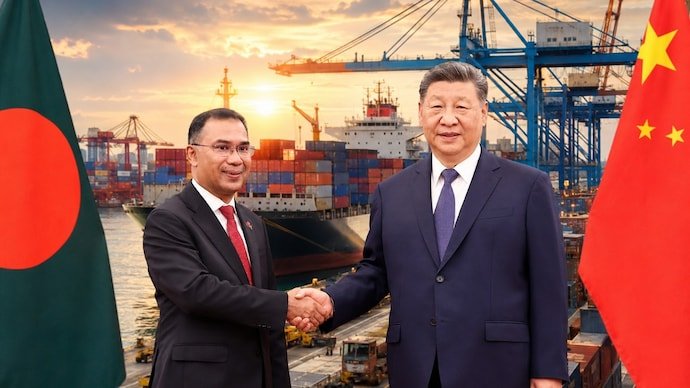
China is once again reshaping the strategic map of South Asia. After investing tens of billions of dollars in the China-Pakistan Economic Corridor (CPEC), Beijing has now proposed another major connectivity project this time on India‘s eastern flank.
The proposed China-Myanmar–Bangladesh Economic Corridor aims to connect China’s southwestern Yunnan province with Bangladesh via Myanmar through an integrated network of highways, railways, ports, and logistics hubs. Although still at the proposal stage, the initiative reflects China’s long-term strategy of expanding its economic influence and reducing dependence on vulnerable maritime routes.
For Bangladesh, the corridor promises increased trade, infrastructure investment, and stronger links with East Asian markets. For China, it represents another opportunity to strengthen its Belt and Road ambitions. For India, however, the proposal introduces fresh strategic considerations involving regional security, maritime influence, and geopolitical competition.
What Is the Proposed China-Myanmar-Bangladesh Economic Corridor?
The proposed corridor would establish a multimodal transport network connecting:
- Kunming in China’s Yunnan Province.
- Mandalay in central Myanmar.
- Yangon and Kyaukphyu along Myanmar’s coast.
- Bangladesh’s Chattogram (Chittagong).
- Cox’s Bazar and other economic zones.
The project is expected to include highways, railway lines, logistics parks, industrial corridors, special economic zones, and port modernization projects designed to facilitate regional trade.
Unlike the earlier Bangladesh-China-India-Myanmar (BCIM) initiative, the new proposal excludes India entirely, reflecting changing geopolitical realities in South Asia.
Primary Search Intent: Understanding China’s Strategic Corridor
The primary search intent behind this topic is informational. Readers want to understand what the new corridor is, why China is proposing it now, and how it could affect regional Geopolitics, trade, and India’s security.
Related semantic keywords naturally associated with this subject include:
- China-Bangladesh Economic Corridor
- China Myanmar corridor
- Bay of Bengal strategy
- Belt and Road Initiative
- China Pakistan Economic Corridor
- BCIM Corridor
- Yunnan connectivity
- Indian Ocean strategy
- Myanmar civil war
- India-China strategic competition
How the Proposal Emerged
The proposal gained momentum during Bangladeshi Prime Minister Tarique Rahman’s visit to Beijing, where Chinese President Xi Jinping expressed support for expanding bilateral connectivity.
Bangladeshi officials described the corridor as a purely economic initiative focused on:
- Increasing bilateral trade.
- Improving transportation infrastructure.
- Modernizing seaports.
- Enhancing regional logistics.
- Creating new industrial opportunities.
The discussions also extended beyond transport, covering artificial intelligence, healthcare cooperation, education, and defense dialogue mechanisms.
China’s Long-Term Strategic Vision
The proposed corridor fits into China’s broader strategy of developing multiple land and maritime trade routes under its Belt and Road Initiative (BRI).
For Beijing, connectivity projects serve several strategic objectives:
- Diversifying international trade routes.
- Reducing transportation costs.
- Expanding overseas infrastructure investments.
- Increasing economic influence across Asia.
- Strengthening access to the Indian Ocean.
China has increasingly invested in ports, railways, highways, industrial parks, and energy infrastructure throughout Asia, Africa, and Europe as part of this long-term vision.
Why Access to the Bay of Bengal Matters
The Bay of Bengal has emerged as one of the world’s most strategically important maritime regions.
It serves as:
- A gateway to Southeast Asia.
- A major shipping corridor.
- An energy transportation route.
- A growing manufacturing hub.
- A key component of Indo-Pacific geopolitics.
Greater access to Bangladesh’s ports could provide China with expanded commercial opportunities while complementing its existing investments across the Indian Ocean region.
From BCIM to a Three-Nation Corridor
The latest proposal represents a significant shift from the earlier BCIM Economic Corridor.
The original BCIM concept envisioned cooperation among:
- Bangladesh
- China
- India
- Myanmar
Although discussions continued for years, the initiative gradually lost momentum as strategic differences widened.
India remained cautious about joining projects associated with the Belt and Road Initiative, particularly because another flagship BRI project the China-Pakistan Economic Corridor passes through territory claimed by India.
The new proposal effectively bypasses India altogether.
Comparison: CPEC vs Proposed China-Bangladesh-Myanmar Corridor
| Feature | China-Pakistan Economic Corridor (CPEC) | China-Myanmar-Bangladesh Corridor |
|---|---|---|
| Primary Route | China to Pakistan | China to Bangladesh via Myanmar |
| Maritime Access | Arabian Sea | Bay of Bengal |
| Status | Operational with ongoing expansion | Proposal stage |
| Main Challenge | Security concerns in Pakistan | Myanmar civil conflict |
| Strategic Importance | Western access route | Eastern connectivity route |
Myanmar: The Project’s Biggest Obstacle
While the proposal appears ambitious on paper, Myanmar remains its most significant challenge.
The country continues to experience:
- Internal armed conflict.
- Political instability.
- Territorial fragmentation.
- Infrastructure disruption.
- Security risks for foreign investments.
Several regions that would likely host portions of the proposed corridor have experienced prolonged instability, making construction and long-term operation highly uncertain.
Without sustained political stability, even well-funded infrastructure projects face considerable implementation risks.
Bangladesh’s Economic Perspective
For Bangladesh, the proposal offers several potential economic advantages.
Possible benefits include:
- Higher foreign investment.
- Improved transportation infrastructure.
- Expanded export opportunities.
- Modernized ports.
- Greater regional connectivity.
- Employment generation.
Infrastructure development around Chattogram and Mongla ports could strengthen Bangladesh’s role as a regional logistics hub connecting South Asia with Southeast Asia.
Why India Is Watching Closely
Although the corridor remains only a proposal, Indian policymakers are likely to monitor its evolution carefully.
Several strategic considerations explain New Delhi’s interest.
1. China’s Expanding Regional Presence
The project would extend China’s infrastructure footprint closer to India’s eastern neighborhood.
2. Maritime Competition
Greater Chinese commercial activity around the Bay of Bengal could influence regional shipping, logistics, and maritime infrastructure development.
3. Strategic Connectivity
China continues to build alternative trade routes that reduce dependence on traditional maritime chokepoints.
4. Regional Influence
Infrastructure financing often strengthens long-term diplomatic and economic partnerships.
The Strait of Malacca Factor
One strategic motivation frequently discussed by analysts is China’s desire to reduce reliance on the Strait of Malacca.
A substantial share of China’s energy imports and international trade passes through this narrow maritime passage.
Alternative land corridors connecting China to the Indian Ocean could:
- Improve supply chain resilience.
- Diversify transport options.
- Reduce transit times for certain cargo.
- Enhance strategic flexibility.
Although the proposed Bangladesh corridor would not eliminate dependence on maritime trade, it could complement China’s broader network of international transport routes.
Infrastructure Diplomacy in South Asia
Infrastructure investment has become one of the defining features of modern geopolitical competition.
Countries increasingly compete not only through military capabilities but also through:
- Port construction.
- Railway financing.
- Energy projects.
- Digital infrastructure.
- Industrial parks.
- Cross-border logistics.
China has emerged as one of the world’s largest overseas infrastructure investors, particularly across developing economies.
Potential Economic Impact if the Corridor Materializes
If successfully completed, the corridor could produce several long-term economic effects:
- Reduced transportation costs.
- Higher regional trade volumes.
- Growth in manufacturing investment.
- Expansion of logistics services.
- Improved supply chain integration.
- Increased tourism connectivity.
However, realizing these benefits depends heavily on political stability, financing, and sustained regional cooperation.
The Missing Piece: Security
Large-scale infrastructure projects require predictable security environments.
Even the most economically attractive corridors struggle when confronted by:
- Armed conflict.
- Political uncertainty.
- Border instability.
- Supply chain disruptions.
- Investment risks.
Myanmar’s current security environment remains the principal uncertainty surrounding the proposal.
A Unique Perspective Often Overlooked
Much of the discussion surrounding the proposed corridor focuses on geopolitics. Equally important, however, is the evolving nature of regional economic competition.
Rather than viewing infrastructure solely as transportation projects, countries increasingly see corridors as comprehensive economic ecosystems that combine ports, industrial zones, digital infrastructure, manufacturing clusters, logistics services, and investment platforms.
Whichever nation succeeds in building the most efficient regional trade networks over the coming decades is likely to gain significant economic and diplomatic advantages beyond simple freight movement.
The proposed China-Myanmar-Bangladesh Economic Corridor is not merely about constructing roads or railways. It reflects the growing importance of infrastructure as a strategic instrument of economic influence, regional integration, and geopolitical competition across the Indo-Pacific.
Future Outlook
The China-Myanmar-Bangladesh Economic Corridor remains in its conceptual phase, and substantial political, financial, and security challenges lie ahead before construction could begin. Myanmar’s internal conflict remains the single largest obstacle to implementation, while financing, environmental approvals, and regional Diplomacy will also influence the project’s future.
For Bangladesh, the proposal presents opportunities to expand trade and modernize infrastructure. For China, it represents another step in diversifying trade routes and strengthening connectivity under its broader regional strategy. For India, the proposal reinforces the need to closely monitor evolving infrastructure developments in its neighborhood while continuing to strengthen its own regional connectivity initiatives and partnerships across the Bay of Bengal and the wider Indo-Pacific. Whether the corridor ultimately materializes or not, it signals that strategic competition through infrastructure investment will remain a defining feature of South Asia’s geopolitical landscape for years to come.
For breaking news and live news updates, like us on Facebook or follow us on Twitter and Instagram. Read more on Latest World on thefoxdaily.com.






COMMENTS 0