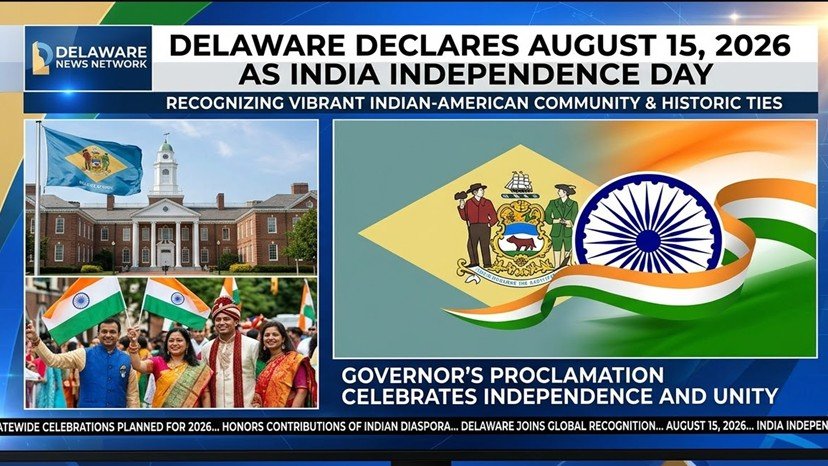
Delaware has proclaimed August 15, 2026, as India Day, becoming the latest US state to formally recognise India’s Independence Day and the contributions of its Indian-American community. The proclamation places Delaware alongside states including New York and New Jersey, where similar recognition has been announced ahead of India’s 80th Independence Day.
The move is more than a ceremonial reference to a national holiday. State-level proclamations provide an opportunity to recognise the cultural heritage of communities that have become part of the social and economic fabric of the United States. In Delaware, the proclamation specifically points to the work, leadership and service of residents of Indian heritage and their role in strengthening communities across the state.
For Indian Americans, August 15 has long been an occasion to celebrate the history and cultural traditions of India while also reflecting on their connection to the country where they live. The 2026 observance carries added significance because it marks eight decades since India became independent in 1947.
What Delaware’s India Day proclamation says
The proclamation signed by Delaware Governor Matt Meyer emphasises the diversity of cultures and traditions represented throughout the state. It specifically recognises the growing Indian-American community and its contribution to Delaware.
The document describes Delaware as a state strengthened by the many cultures represented among its residents. It highlights how Delawareans of Indian heritage have contributed through their professional work, leadership and community service.
The proclamation also connects the contributions of Indian Americans with the wider idea of opportunity across generations. Rather than treating cultural heritage as something separate from public life, it recognises Indian-American residents as contributors to the state’s broader development.
Another important element is its recognition of India’s diversity. The proclamation refers to the country’s many languages, traditions, faiths and customs and notes how generations of Indian Americans have carried aspects of that heritage into their lives in the United States.
That combination of heritage and community participation is central to the meaning of India Day in Delaware. The observance gives residents an opportunity to celebrate India’s independence while also recognising the people who maintain cultural connections between India and American communities.
Why August 15, 2026, is especially significant
India celebrates Independence Day on August 15 every year. In 2026, the date marks the country’s 80th Independence Day, commemorating independence from British rule on August 15, 1947.
The anniversary provides a particularly visible moment for Indian communities outside India to celebrate their heritage. For the Indian diaspora, Independence Day is not limited to events in India. Flag-hoisting ceremonies, cultural programmes, community gatherings and public celebrations take place in cities across the United States.
The 2026 milestone also gives state proclamations greater symbolic importance. Recognising August 15 as India Day or India Independence Day allows state governments to acknowledge both the historical significance of India’s independence and the presence of Indian-American communities within their states.
India’s Independence Day is distinct from Republic Day, which is celebrated on January 26. Independence Day commemorates the end of British rule, while Republic Day marks the adoption of India’s Constitution and the country becoming a republic in 1950.
Delaware joins New York and New Jersey
Delaware’s proclamation follows similar recognition in other parts of the United States.
New York and New Jersey have also recognised August 15, 2026, as India Independence Day. New York’s state legislature separately adopted a resolution calling on Governor Kathy Hochul to proclaim the date in recognition of India’s independence and the importance of Indian heritage within the state.
The developments in the northeastern United States are particularly notable because the region has long been home to substantial Indian-American communities. Indian-origin residents participate across a wide range of professions, businesses, educational institutions and community organisations.
Delaware’s decision adds another state-level recognition to the growing public visibility of India’s Independence Day in the United States. The proclamations are not federal declarations and do not create a new national holiday. Instead, they are official state recognitions of a particular day and its cultural significance.
That distinction matters. A proclamation generally serves a commemorative and symbolic purpose rather than changing the legal status of an existing holiday. In Delaware, the proclamation provides formal recognition while encouraging residents to observe India Day and acknowledge the contributions of Indian Americans.
How Indian Americans celebrate Independence Day in the US
India’s Independence Day has developed into a major annual cultural occasion for Indian-American communities across the United States.
Celebrations can include flag-hoisting ceremonies, community gatherings, cultural performances, parades, food festivals and programmes focused on Indian history and heritage. Indian diplomatic missions and community organisations also organise events around the August 15 observance.
In Washington, the Indian Embassy is traditionally a focal point for official Independence Day celebrations. Indian consulates and the Permanent Mission of India to the United Nations in New York also participate in commemorative activities.
Community celebrations extend well beyond diplomatic institutions. Indian-American organisations, temples, cultural associations, student groups and local community leaders frequently use the occasion to bring different generations together.
For older members of the diaspora, such events can provide a connection to the country of their birth or family heritage. For younger Indian Americans who may have grown up in the United States, they can offer an opportunity to learn about Indian history, languages, traditions and the significance of independence.
Why state proclamations matter to the Indian-American community
A state proclamation does not change foreign policy or establish a new federal holiday. Its importance is primarily civic and cultural.
When a governor formally recognises a community’s heritage, the announcement can help bring that community’s history and contributions into the broader public conversation. It also signals that cultural identity and civic participation can exist together.
That message is particularly relevant for Indian Americans, whose community identity often spans multiple generations and cultures. Families may maintain Indian languages, festivals, food traditions and religious or cultural practices while simultaneously participating fully in American public, professional and civic life.
Delaware’s proclamation reflects this dual connection. It celebrates India’s independence while focusing heavily on the contribution of Delaware residents of Indian heritage.
The wording also points to an important generational element. Indian-American communities are not defined solely by recent immigrants. They include people born in the United States as well as families with roots in India extending across several generations. Cultural observances therefore become a way of passing heritage from parents and grandparents to younger Americans.
India Day is also a story about local communities
The significance of the Delaware proclamation goes beyond India-US relations at the national level. State proclamations are fundamentally about local communities.
Governors recognise days and causes that have meaning for residents within their states. In this case, the focus is on Indian-American residents who contribute to Delaware through work, leadership, service and community involvement.
That makes the observance relevant even to people who are not of Indian origin. Cultural celebrations can provide opportunities for wider communities to learn about the history and traditions of their neighbours.
The proclamation’s emphasis on India’s diversity is also significant. Indian Culture cannot be reduced to a single language, religion, cuisine or regional tradition. India is home to a vast range of linguistic, religious and cultural identities, many of which are represented within the Indian-American population.
Community events in the United States often reflect that diversity, bringing together people with roots in different Indian states and regions.
India’s Independence Day and the wider India-US relationship
The India Day observances also carry a broader people-to-people dimension. Government-to-government relations receive considerable attention in discussions about India and the United States, but relationships between the two countries are also shaped by students, families, professionals, entrepreneurs, researchers and community organisations.
Indian Americans are part of that broader connection. Their personal and family links to India create cultural and social relationships that exist alongside official diplomatic ties.
State-level recognition can therefore be viewed as a local expression of those connections. A proclamation in Delaware is not itself a foreign-policy decision, but it acknowledges the cultural relationship created by residents who maintain ties with India while contributing to American communities.
This distinction helps explain why India Day celebrations can attract attention from both community organisations and public officials. They provide a setting where cultural heritage, local civic participation and international connections intersect.
How India’s 80th Independence Day will be observed
India’s Independence Day in 2026 falls on Saturday, August 15. In India, the central national ceremony traditionally takes place at the Red Fort in New Delhi, where the prime minister raises the national flag and delivers the Independence Day address.
Indian communities overseas mark the occasion differently, reflecting local customs and the laws and traditions of their host countries. In the United States, celebrations often combine formal ceremonies with cultural programmes and community events.
Public displays can also make the occasion visible beyond Indian-American communities. In previous years, well-known landmarks in different American cities have been illuminated in the colours associated with the Indian tricolour, while public ceremonies and parades have drawn large crowds.
These events give Indian Americans an opportunity to celebrate publicly while also introducing elements of Indian culture to neighbours and visitors.
What Delaware’s recognition means for 2026
The immediate significance of Delaware’s proclamation is clear: August 15, 2026, will be formally recognised as India Day in the state, with residents encouraged to celebrate India’s independence and recognise the contributions of the Indian-American community.
The larger significance lies in the way the observance connects national history with local civic life. India’s independence was achieved thousands of miles from Delaware, but the people and traditions associated with that history are now part of communities throughout the United States.
For Indian Americans in Delaware, the proclamation provides an official acknowledgement of that presence. For the wider public, it offers another opportunity to understand the history and cultural diversity of one of the United States’ established immigrant communities.
What happens next
The next stage will be the actual observance of August 15, when Indian diplomatic missions, community organisations and Indian-American residents across the United States mark the 80th Independence Day.
Delaware’s proclamation is expected to form part of that wider calendar of celebrations. New York and New Jersey will also observe the date following their respective proclamations, adding to the visibility of India’s Independence Day across the United States.
The longer-term significance will depend less on the proclamation itself than on the community activity surrounding it. Cultural programmes, youth participation and local engagement can determine whether such observances remain annual ceremonies or become lasting opportunities for cross-cultural understanding.
For now, Delaware’s decision represents a formal recognition of a community whose cultural heritage has become part of the state’s identity. As India prepares to celebrate 80 years of independence, the observance in Delaware and other US states will highlight a connection that is both international in origin and deeply local in practice.
August 15, 2026, will therefore carry two messages for Indian Americans in the United States: a celebration of India’s historic independence and a recognition of the generations of people who have carried Indian heritage into American communities.
For breaking news and live news updates, like us on Facebook or follow us on Twitter and Instagram. Read more on Latest World on thefoxdaily.com.






COMMENTS 0