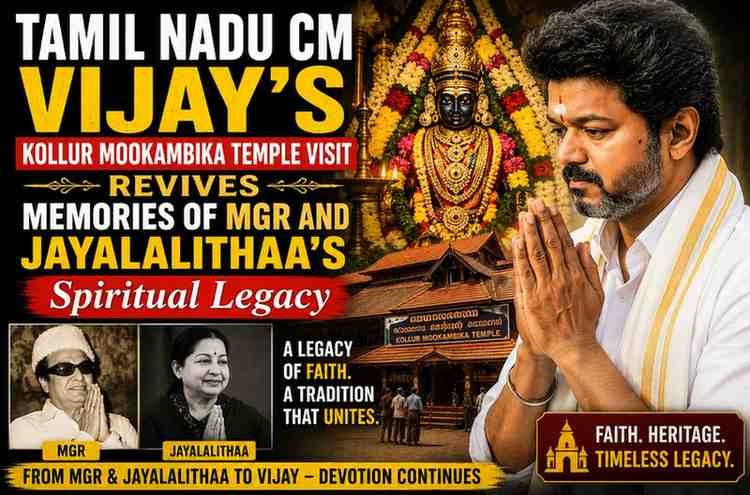
The recent visit of Tamil Nadu Chief Minister Vijay to the revered Kollur Mookambika temple has stirred nostalgia in political circles and among devotees alike. The temple, located in Karnataka’s Udupi district, has long been a spiritual destination for several South Indian political leaders.
In particular, the visit has revived memories of former Tamil Nadu Chief Ministers M.G. Ramachandran (MGR) and J. Jayalalithaa, both of whom were known for their repeated pilgrimages to the shrine during their political careers.
These visits were often seen not just as personal acts of devotion but also as moments that reinforced their public image as leaders deeply rooted in faith and cultural tradition.
MGR and Kollur: A Longstanding Spiritual Connection
MGR’s association with the Mookambika temple was both consistent and well-documented. According to a July 12, 1985 report, he had visited the temple at least seven times by that point in his career.
Even in the final years of his life, MGR continued to undertake journeys to Kollur for darshan, underscoring the importance of the shrine in his personal spiritual life.
In January 1987, he made another visit to the temple, a testament to his enduring devotion despite declining health conditions at the time.
Jayalalithaa’s Visits and Political Symbolism
Jayalalithaa, MGR’s political protégé and successor in Tamil Nadu politics, also maintained a strong spiritual connection with temples, including Kollur Mookambika.
Her visits were often interpreted through multiple lenses personal faith, cultural identity, and political messaging. In Tamil Nadu politics, where leadership imagery plays a crucial role, such pilgrimages often carried symbolic weight.
For supporters, these visits reinforced a sense of continuity between devotion and governance.
Why Kollur Mookambika Temple Attracts Political Leaders
The Kollur Mookambika temple is dedicated to Goddess Mookambika, a form of the divine feminine representing wisdom, strength, and creativity. It is considered one of the most powerful Shakti shrines in South India.
Over the years, it has attracted devotees from various walks of life, including artists, film personalities, and political leaders seeking spiritual grounding.
The temple’s reputation as a site for blessings related to leadership and success has contributed to its popularity among those in public life.
Comparison: Devotional Visits as Personal Faith vs Political Symbolism
| Personal Faith Perspective | Political Symbolism Perspective |
|---|---|
| Spiritual seeking and inner peace | Public image and cultural connection |
| Private devotion without media attention | Visible acts reinforcing leadership identity |
| Faith-based motivation | Strategic cultural messaging |
| Personal rituals and beliefs | Symbolic continuity with tradition |
An Insight Competitors Often Miss: Pilgrimages Shape Political Memory in South India
In South Indian political culture, temple visits by leaders often become part of long-term public memory. Unlike routine political activities, such moments are emotionally resonant and culturally embedded.
They contribute to a leader’s image not just as a policymaker, but as a culturally grounded figure connected to tradition and spirituality.
This blending of faith and politics is a recurring feature in Tamil Nadu’s leadership history, particularly among mass leaders who cultivated strong emotional connections with the public.
The Role of Religion in Political Identity
In Tamil Nadu, where cinema, culture, and politics often intersect, religious symbolism has historically played a nuanced role.
Leaders like MGR and Jayalalithaa carefully balanced rationalist political traditions with visible expressions of personal devotion. This duality helped them connect with diverse voter bases.
Temple visits, therefore, were not isolated acts but part of a broader cultural language of leadership.
Public Perception and Media Narratives
Media coverage of such visits often amplifies their significance, turning personal religious acts into public narratives.
These narratives contribute to political mythology, where leaders are remembered not only for governance but also for symbolic gestures that resonate with cultural identity.
Over time, these moments become reference points in political storytelling.
Why Mookambika Temple Remains Politically Significant
The Mookambika temple’s reputation extends beyond regional devotion. It is often associated with blessings for education, leadership, and success in public life.
This symbolic association has made it a recurring destination for individuals seeking spiritual affirmation during critical phases of their careers.
Its cultural prominence ensures that visits by political leaders are often interpreted through a broader societal lens.
Prediction: Continued Blending of Devotion and Political Image-Making
As political communication becomes increasingly visual and media-driven, symbolic acts such as temple visits are likely to remain significant.
Future trends may include:
- More visible cultural and religious engagements by leaders.
- Increased media amplification of personal spiritual moments.
- Stronger linkage between identity politics and cultural symbolism.
- Continued referencing of historical leaders like MGR and Jayalalithaa in public narratives.
This suggests that cultural memory will continue to shape political perception in the region.
Conclusion
Tamil Nadu Chief Minister Vijay’s visit to the Kollur Mookambika temple has rekindled memories of earlier leaders like MGR and Jayalalithaa, whose repeated pilgrimages became part of their enduring public image.
While rooted in personal devotion, such visits often carry deeper cultural and political meaning in South India, where spirituality and leadership narratives frequently intersect.
Ultimately, these journeys reflect more than faith they become part of the evolving story of political identity and public memory.
For breaking news and live news updates, like us on Facebook or follow us on Twitter and Instagram. Read more on Latest Entertainment on thefoxdaily.com.






COMMENTS 0