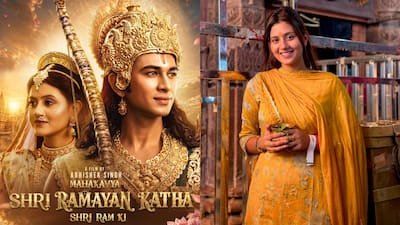
Anjali Arora’s portrayal of Mata Sita in Mahakavya Shri Ramayan Katha has become a major talking point ahead of the film’s theatrical release on September 25, 2026. The film’s trailer has opened a wider discussion about casting, the representation of revered characters from the Ramayana and the creative responsibility involved in bringing a culturally significant epic to contemporary cinema.
Directed by Abhishek Singh, the film features Dev Sharma, Anjali Arora, Sheel Verma, Rajniesh Duggal and Nirbhay Wadhwa. Its trailer covers several recognisable episodes from the Ramayana, including the wedding of Ram and Sita, their exile, Sita’s abduction and the early preparations connected with the construction of Ram Setu.
While the film’s subject has generated curiosity, the response to the trailer has been sharply divided. Some viewers have questioned whether Arora is suited to portray Sita, while others have focused on the film’s visual effects and overall presentation. The intensity of the reaction illustrates the unique challenge faced by filmmakers adapting stories that carry enormous cultural and religious significance.
Why Anjali Arora’s casting as Sita has become controversial
Anjali Arora rose to widespread internet recognition after appearing in the viral Kacha Badam trend. Her subsequent social media visibility and entertainment appearances have made her a familiar digital personality.
Her casting as Sita represents a very different kind of screen responsibility. Sita is one of the most recognisable figures in Indian epic literature and religious tradition, and portrayals of the character are often viewed through expectations formed by generations of devotional storytelling, television adaptations, theatre and literature.
That difference between Arora’s established public image and the cultural expectations surrounding Sita appears to be one of the reasons the casting has attracted scrutiny.
However, criticism of casting is ultimately a matter of audience response rather than proof that a performance is inadequate before the film has been released. A trailer provides only a limited glimpse of a completed character arc, and viewers will be able to assess the full performance only after the film reaches cinemas.
What happens in the Mahakavya Shri Ramayan Katha trailer?
The trailer introduces viewers to several major chapters associated with the Ramayana. It includes the relationship between Ram and Sita, their marriage, the period of exile and Sita’s abduction.
The footage also moves towards the larger conflict that follows Sita’s abduction, including the preparations associated with Ram Setu. This suggests that the film intends to cover a substantial portion of the epic rather than focusing on a single episode.
For filmmakers, condensing an expansive epic into a feature film presents an obvious storytelling challenge. The Ramayana contains numerous characters, locations, relationships, philosophical ideas and narrative turns. Decisions about what to include and what to omit can significantly shape how audiences interpret an adaptation.
Social media criticism has focused on both casting and VFX
The reaction to the trailer has not been limited to Anjali Arora’s casting. Several viewers have also criticised the film’s visual effects, with comments questioning the quality and execution of the VFX shown in the trailer.
Some reactions have been blunt, while others have used humour or comparisons with previous mythological films. One social media user questioned the casting of Arora as Sita, while another sarcastically expressed appreciation for Adipurush in comparison.
Other comments criticised what viewers perceived as weak visual effects. One commenter even jokingly suggested that the combination of music and the film’s setting made it appear as though the story involved time travel.
These comments should be understood as social media reactions rather than independent assessments of the completed film. Trailer footage can differ considerably from the final theatrical presentation, and online comments are not a substitute for a critical review.
Why visual effects matter so much in a Ramayana adaptation
Visual effects are particularly important when filmmakers attempt to recreate an epic world involving divine characters, ancient kingdoms, forests, large-scale battles and legendary events.
Modern audiences have also become accustomed to increasingly sophisticated digital filmmaking. Large-scale Indian productions have invested heavily in computer-generated imagery, virtual production and post-production technology, raising expectations for mythological cinema.
That creates a difficult benchmark for smaller or differently positioned productions. Viewers are no longer evaluating only whether a scene communicates the story. They are also examining whether the visual world feels convincing enough to support the mythology.
For Mahakavya Shri Ramayan Katha, the trailer’s reception indicates that VFX will be an important part of how audiences judge the film. If the effects are perceived as distracting, they can make it harder for viewers to emotionally engage with the narrative.
The bigger challenge: portraying revered characters for modern audiences
There is a fundamental difference between adapting an ordinary fictional story and adapting a narrative that millions of people regard as sacred or culturally foundational.
With the Ramayana, viewers may already have strong mental images of Ram, Sita, Lakshman, Hanuman and other characters. Those images have been shaped by family traditions, religious art, television serials, theatre, regional retellings and previous films.
As a result, a new adaptation does not begin with a blank canvas.
Every major creative decision—casting, costumes, dialogue, music, production design and visual effects—can be compared with an audience member’s existing understanding of the story.
This makes casting particularly sensitive. A filmmaker may select an actor based on screen presence, interpretation or a specific creative vision, but audiences may evaluate that choice against a much larger cultural memory.
Does controversy automatically mean the film will fail?
No. Strong criticism before release does not necessarily predict a film’s eventual box-office performance or critical reception.
Indian cinema has repeatedly demonstrated that trailers can generate intense debate while the finished film receives a different response. Conversely, a widely praised trailer can create expectations that the completed movie struggles to satisfy.
For Mahakavya Shri Ramayan Katha, the decisive factors will ultimately include the storytelling, performances, screenplay, music, visual execution and the film’s ability to establish an emotional connection with its audience.
The current backlash does, however, create a higher level of scrutiny. Viewers who already have reservations may watch the film more closely, while curiosity generated by the controversy could also encourage more people to see it.
Social media has changed the economics of trailer controversy
One important difference between today’s film environment and the traditional publicity cycle is the speed at which audience reactions spread.
A trailer can generate thousands of opinions within hours. Memes, criticism, praise and comparisons can become part of the public narrative before most viewers have seen the movie.
This creates both opportunities and risks for filmmakers. Controversy can increase awareness, but it can also establish a negative perception that becomes difficult to change.
In the case of Mahakavya Shri Ramayan Katha, the discussion has already moved beyond the trailer itself to broader questions about who should portray revered characters and how mythological stories should be presented on screen.
Why the timing is significant for Ramayana films
The film is arriving during a period of renewed interest in cinematic adaptations of the Ramayana.
Ranbir Kapoor and Sai Pallavi are also preparing to bring their interpretation of the epic to the big screen around Diwali. Their project has attracted considerable attention because of its scale and high-profile cast and filmmaking team.
The simultaneous presence of multiple Ramayana-inspired productions means audiences are likely to compare them, even when their creative approaches differ.
For Mahakavya Shri Ramayan Katha, this makes its own identity especially important. It will need to establish why its interpretation deserves attention rather than being judged solely against a larger production.
Mahakavya Shri Ramayan Katha versus big-budget mythological cinema
| Factor | Mahakavya Shri Ramayan Katha | Large-scale Ramayana adaptations |
|---|---|---|
| Primary challenge | Winning audience confidence through casting, storytelling and presentation | Meeting expectations created by large budgets and extensive promotion |
| Audience expectations | Authentic and emotionally convincing interpretation | Epic scale combined with technical spectacle |
| Current conversation | Casting and trailer VFX have drawn criticism | Scale, cast, VFX and interpretation attract scrutiny |
| Key opportunity | Build an identity through storytelling and performances | Use technological scale to create a large cinematic experience |
The comparison highlights an important point: a Ramayana film does not necessarily need to compete only on budget. A strong screenplay, convincing performances and emotional clarity can also distinguish a production.
The FIR demand: criticism versus legal claims
Among the reactions to the trailer, one social media user called for an FIR against those involved in the film. Such comments represent an individual reaction and should not be treated as evidence that a criminal case has been filed or that the filmmakers have committed an offence.
Strong criticism of casting or creative choices is different from an established legal finding. Unless authorities announce an investigation or a court determines otherwise, online demands for legal action remain comments made by individual users.
This distinction is especially important when reporting on social media controversies. Viral comments can quickly become headlines themselves, but their existence does not establish the truth of the allegation behind them.
What the filmmakers need to prove with the full film
The trailer has already created one major challenge: the finished film will have to overcome the first impressions generated online.
The most effective way to do that will be through the film itself. If the performances are emotionally convincing, the screenplay gives the characters depth and the visual world supports the story, the conversation could change after release.
For Anjali Arora in particular, the role represents an opportunity to move the discussion beyond her social media identity. Playing a culturally significant character places her under unusual scrutiny, but it also gives her the chance to demonstrate a different aspect of her performance abilities.
The audience will ultimately decide whether that transition works.
What audiences should watch for after the trailer controversy
- Anjali Arora’s performance: Whether she establishes Sita as a complete character rather than relying only on visual presentation.
- Dev Sharma’s portrayal of Ram: Whether the central relationship between Ram and Sita creates emotional credibility.
- Visual effects: Whether the theatrical version improves upon the concerns raised by viewers about the trailer.
- Screenplay: How effectively the film condenses the expansive Ramayana into a feature-length narrative.
- Music and sound: Whether the soundtrack complements the period and emotional world of the story.
- Cultural sensitivity: Whether the adaptation treats its source material with sufficient care while maintaining a cinematic identity.
Release date and cast of Mahakavya Shri Ramayan Katha
Mahakavya Shri Ramayan Katha is scheduled to release on September 25, 2026. The film is directed by Abhishek Singh and features Dev Sharma, Anjali Arora, Sheel Verma, Rajniesh Duggal and Nirbhay Wadhwa.
Its release will provide the first opportunity for audiences to judge the complete performances, storytelling and technical execution rather than relying on a short trailer.
Conclusion: The real verdict will come after the trailer ends
Anjali Arora’s casting as Sita in Mahakavya Shri Ramayan Katha has triggered strong social media reactions, with criticism directed at both her suitability for the role and the visual effects shown in the trailer. Some comments have gone as far as demanding legal action, although such online statements should not be confused with any confirmed legal proceedings.
The controversy highlights a much larger challenge facing filmmakers who adapt the Ramayana. These are stories that arrive with enormous cultural memory and deeply established audience expectations. A new film must therefore satisfy both cinematic demands and the emotional relationship viewers already have with its characters.
For Mahakavya Shri Ramayan Katha, the September 25 release will be the real test. The trailer has created debate, but the film will ultimately be judged on its performances, storytelling, visual execution and ability to present a familiar epic with conviction.
For Anjali Arora, the role of Sita could become an important turning point in her screen career. Whether audiences accept that transformation will depend not on her previous viral fame, but on what she brings to the character when the complete story reaches theatres.
For breaking news and live news updates, like us on Facebook or follow us on Twitter and Instagram. Read more on Latest Entertainment on thefoxdaily.com.

COMMENTS 0