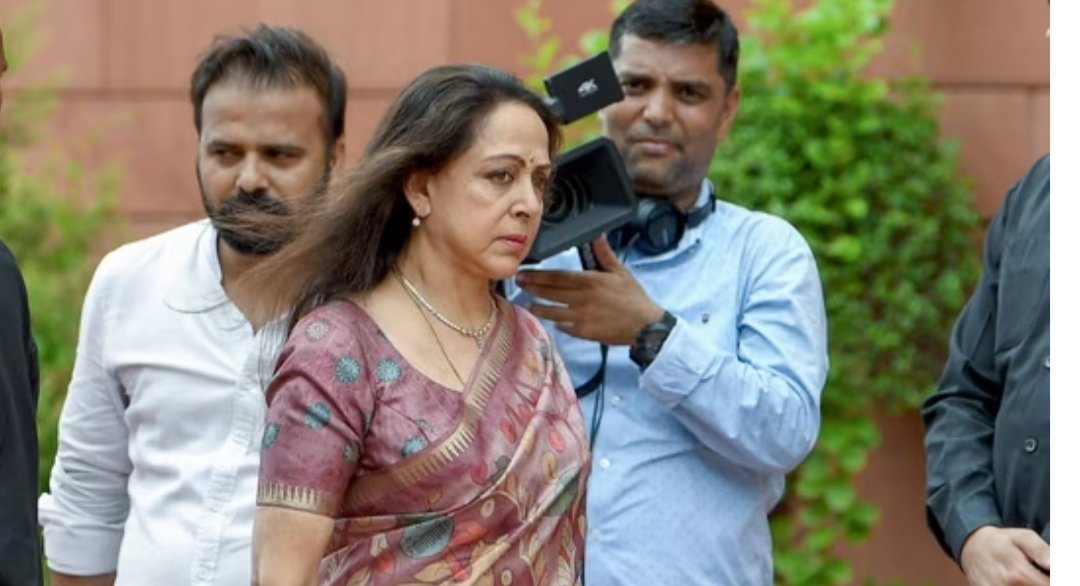
The ongoing CJP protest in Delhi has taken a new turn after BJP MP and veteran actor Hema Malini publicly questioned the effectiveness of street demonstrations. Her statement—that protests “won’t achieve anything” and that issues should instead be resolved through dialogue—has ignited a wider national conversation about the role of protests, youth participation, and democratic engagement in India.
As thousands gathered near Parliament Street demanding accountability over alleged examination irregularities and broader education reforms, Malini’s remarks introduced a contrasting perspective: should change come from protest or policy discussions?
This debate is not just political—it reflects deeper questions about governance, public participation, and the evolving voice of India’s youth.
What Hema Malini Said—and Why It Matters
Speaking to the media after attending the first day of the Monsoon Session of Parliament, Hema Malini emphasized the importance of structured dialogue over public demonstrations.
Her key points included:
- Issues should be resolved through constructive discussion
- Street protests may not lead to meaningful outcomes
- Youth should be guided responsibly rather than influenced emotionally
- The government has already taken steps to support the education system
She also refrained from commenting on demands for the resignation of the Education Minister, signaling a cautious political stance amid escalating tensions.
Understanding the CJP Protest Movement
The Cockroach Janata Party (CJP) protest has emerged as a significant student-led movement focused on education reforms and accountability. At its core, the protest reflects frustration among students over alleged irregularities in competitive examinations and broader systemic concerns.
Key Demands Driving the Protest
- Transparency in examination processes
- Accountability from educational authorities
- Policy reforms to prevent future discrepancies
- Greater student representation in decision-making
The movement has gained traction nationwide, with Delhi becoming its central stage as protesters attempt to bring their concerns directly to policymakers.
Protest vs Dialogue: A Long-Standing Debate
Hema Malini’s comments have reignited a classic democratic debate: Is protest an effective tool for change, or should dialogue always take precedence?
| Approach | Advantages | Limitations |
|---|---|---|
| Protest | Draws attention quickly, mobilizes masses | Can lead to disruption, may lack structured outcomes |
| Dialogue | Encourages policy-level solutions | Often slow, may not gain public visibility |
In reality, both approaches often work together. Protests can create urgency, while dialogue translates that urgency into actionable policy.
The Role of Youth in Modern Movements
One of the most striking aspects of the CJP protest is the active involvement of students. Young people are no longer passive stakeholders—they are becoming key drivers of change.
Why Youth-Led Movements Are Rising
- Increased awareness: Access to information through digital platforms
- Higher stakes: Education directly impacts career opportunities
- Collective identity: Shared concerns create strong community bonds
However, Malini’s concern about students being “misguided” reflects a broader anxiety about how youth engagement is shaped and directed.
Celebrity Voices: Divided Opinions
The CJP protest has seen participation from several public figures, each bringing their own perspective.
Supporters of the Protest
- Actors and activists who joined demonstrations on the ground
- Public figures amplifying the issue on social media
Advocates for Dialogue
- Leaders like Hema Malini emphasizing structured discussions
- Voices urging calm and policy-based solutions
This divide highlights how even influential voices differ on the best path forward.
Real-World Impact: What Happens Next?
Amid the protests, a delegation from CJP has already met with Union Health Minister JP Nadda, signaling that dialogue is indeed taking place alongside demonstrations.
This dual approach suggests that:
- Protests are creating pressure and visibility
- Government meetings are opening channels for negotiation
The outcome will likely depend on how effectively these two forces interact.
A Unique Insight: The “Visibility vs Viability” Equation
One of the most overlooked aspects of movements like the CJP protest is what can be called the “visibility vs viability” equation.
- Visibility: Protests ensure the issue cannot be ignored
- Viability: Dialogue ensures solutions can actually be implemented
Without visibility, issues remain buried. Without viability, they remain unresolved. The challenge lies in balancing both.
Comparison: India’s Protest Culture Then and Now
| Aspect | Earlier Movements | Current Movements |
|---|---|---|
| Communication | Traditional media | Social media-driven |
| Participation | Localized groups | Nationwide engagement |
| Speed | Gradual momentum | Rapid mobilization |
| Impact | Policy influence over time | Immediate public attention |
This evolution explains why modern protests feel more intense—and more visible—than ever before.
Prediction: A Hybrid Model of Change
Looking ahead, India may move toward a hybrid model where protest and dialogue coexist more strategically.
This could involve:
- Structured platforms for student-government interaction
- Greater transparency in policy discussions
- More responsible use of public demonstrations
Such a model would address concerns raised by both protesters and leaders like Hema Malini.
Conclusion: A Debate That Reflects Democracy Itself
The CJP protest and Hema Malini’s response are not isolated events—they are part of a larger conversation about how democracy functions in practice.
Protests represent the voice of the people. Dialogue represents the mechanism of governance. Neither can fully replace the other.
As India navigates this complex landscape, one thing is clear: the future of change will depend not on choosing between protest and dialogue, but on integrating both effectively.
And in that balance lies the true strength of a लोकतांत्रिक society.
For breaking news and live news updates, like us on Facebook or follow us on Twitter and Instagram. Read more on Latest Entertainment on thefoxdaily.com.






COMMENTS 0