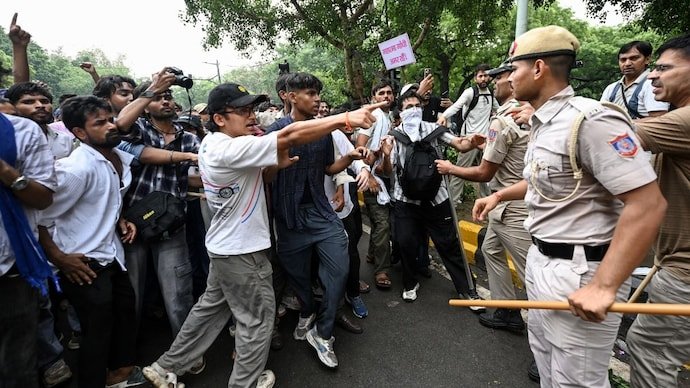
At Delhi’s historic Jantar Mantar, the sound of slogans is only one part of the story. Equally striking are the quieter scenes: volunteers distributing water in the July heat, strangers handing out meals, young people collecting litter, and countless smartphones documenting every speech, conversation, and moment in real time. These images reflect a protest that extends far beyond a single examination dispute.
While the demonstrations were initially driven by concerns surrounding the National Eligibility cum Entrance Test (NEET) and demands for greater accountability in India‘s examination system, conversations among participants reveal a much wider range of grievances. For many attendees, the protest has become a platform to express concerns about educational uncertainty, employment opportunities, public accountability, environmental challenges, and the relationship between citizens and institutions.
The gathering illustrates how a specific policy issue can evolve into a broader civic movement when people feel that existing systems are not adequately addressing their concerns. Whether or not the immediate demands are met, the demonstrations highlight growing expectations among young Indians for transparency, responsiveness, and institutional trust.
Why the Protest Began
The immediate focus of the demonstrations is the demand for accountability in India’s competitive examination system. Students and supporters have called for action over concerns relating to examination administration, fairness, and institutional responsibility.
The protest has also included calls for greater transparency in handling examination-related issues, quicker responses from authorities, and stronger safeguards to protect the integrity of future Competitive Exams.
For many students, competitive examinations determine access to higher Education and future career opportunities. Any disruption—whether through administrative delays, alleged irregularities, or uncertainty—can affect years of academic preparation and financial Investment by families.
Beyond NEET: A Wider Conversation
Although the demonstrations center on education, conversations among protesters reveal that many participants view the issue as part of broader social and economic challenges.
Common themes expressed by attendees include:
- Concerns about examination transparency.
- Employment opportunities for graduates.
- Rising cost of education and coaching.
- Demand for greater government accountability.
- Environmental concerns such as air pollution.
- The desire for institutions to communicate more openly with citizens.
Rather than viewing these issues independently, many participants describe them as interconnected challenges that influence their confidence about the future.
Jantar Mantar: India’s Historic Protest Ground
Jantar Mantar has long served as one of India’s best-known locations for peaceful public demonstrations. Situated in central Delhi near Parliament and major government institutions, it has hosted numerous movements involving students, farmers, workers, civil society organizations, and various public interest campaigns.
Its significance lies not only in its location but also in its symbolic role as a place where citizens assemble to voice concerns within a democratic framework.
The latest demonstrations continue this tradition while reflecting how modern forms of communication have reshaped public participation.
The Volunteers Behind the Movement
One of the defining characteristics of the gathering has been the large number of volunteers supporting the protest’s daily functioning.
Visitors have observed volunteers:
- Distributing drinking water.
- Serving meals to protesters.
- Cleaning public spaces.
- Managing queues.
- Providing basic logistical support.
These efforts highlight how civic participation often extends beyond speeches and demonstrations, relying instead on thousands of individuals contributing in practical ways to sustain peaceful public gatherings.
How Social Media Has Changed Modern Protests
Unlike many earlier protest movements that depended heavily on television or newspapers for visibility, today’s demonstrations unfold simultaneously online.
Smartphones have become essential tools for participants. Livestreams, short-form videos, photographs, and independent interviews circulate instantly across multiple social media platforms, allowing protesters to document events from their own perspectives.
This shift has fundamentally changed how public movements communicate with wider audiences.
Instead of relying solely on traditional media coverage, participants increasingly create and distribute their own content, enabling faster information sharing while also encouraging broader public discussion.
Digital Storytelling Has Become Part of Civic Participation
Throughout the demonstrations, individuals record speeches, interview fellow protesters, document volunteer activities, and share updates online.
For many young participants, documenting events is no longer separate from participating—it has become an integral part of civic engagement.
This reflects a broader trend visible around the world, where digital platforms increasingly shape how public opinion forms and how social movements gain momentum.
The Pressure of Competitive Examinations
India’s highly competitive entrance examinations influence the educational and professional aspirations of millions of students every year.
Preparing for these exams often requires years of study, coaching, relocation, and significant financial investment by families.
Consequently, any uncertainty surrounding examinations can have consequences extending beyond academics, affecting mental well-being, financial stability, and career planning.
Many students therefore see examination integrity not simply as an administrative issue but as a matter closely linked to opportunity and fairness.
Why Trust in Institutions Matters
One recurring theme among participants is the importance of institutional trust.
Public confidence depends not only on effective systems but also on transparent communication when challenges arise.
When citizens believe that authorities respond promptly, explain decisions clearly, and address concerns openly, confidence in public institutions generally strengthens.
Conversely, prolonged uncertainty or perceived lack of accountability can contribute to frustration and reduce public trust, particularly among younger generations preparing for important career milestones.
The Economic Dimension
Education and employment remain closely connected.
Many graduates today face increasingly competitive job markets, making entrance examinations even more significant as gateways to higher education and professional opportunities.
Families frequently invest substantial resources in coaching, accommodation, study materials, and examination fees over several years.
As a result, concerns regarding examination administration often carry broader financial implications for households across the country.
Comparison: Traditional vs Modern Protest Movements
| Traditional Demonstrations | Modern Digital-Era Demonstrations |
|---|---|
| Television and newspapers shaped public awareness. | Participants share updates directly through social media. |
| Limited real-time public interaction. | Continuous livestreams and instant audience engagement. |
| Professional journalists primarily documented events. | Citizens create and distribute their own content. |
| Information spread gradually. | Developments circulate globally within minutes. |
Why This Protest Resonates Beyond Delhi
Although centered in the national capital, the issues discussed at Jantar Mantar resonate with students and families across India.
Competitive examinations affect candidates from urban centers as well as smaller towns and rural communities. Many Travel long distances to examination centers and invest years preparing for a limited number of seats.
Because of this shared experience, developments related to educational policy often attract nationwide attention.
The Role of Peaceful Public Assembly
Peaceful public demonstrations remain an important feature of democratic societies, providing citizens with opportunities to collectively express opinions, raise concerns, and seek policy changes.
Such gatherings also create spaces where people from diverse professional, educational, and regional backgrounds engage in dialogue about common challenges.
The diversity visible at Jantar Mantar—from students and professionals to parents and retirees—illustrates how specific issues can bring together individuals with different experiences but similar aspirations for institutional improvement.
Expert Insight: The Shift from Individual Complaints to Collective Identity
One notable aspect of the demonstrations is how individual concerns appear to have merged into a broader collective identity.
Participants may arrive because of one specific issue, such as examination administration, yet discussions frequently expand to include employment, governance, environmental quality, public services, and civic participation.
This pattern is common in large public movements, where a single triggering event becomes a focal point for wider conversations already present within society.
Understanding this broader context helps explain why movements sometimes continue even after the original issue receives official attention.
What Authorities and Institutions Can Learn
The events at Jantar Mantar underline several broader lessons for public institutions:
- Timely communication helps reduce uncertainty.
- Transparency strengthens public confidence.
- Clear accountability encourages institutional trust.
- Constructive engagement with stakeholders can reduce tensions.
- Listening to public concerns early often prevents larger disputes.
Regardless of differing political perspectives, effective communication remains essential in maintaining confidence in public systems.
Future Outlook
The immediate future will likely depend on how authorities respond to the specific demands related to examination administration and accountability. However, the broader conversation emerging from Jantar Mantar suggests that many participants seek more than solutions to one examination cycle.
They are calling for stronger institutions, greater transparency, and increased public trust across multiple areas of governance.
As digital platforms continue to amplify civic participation, similar movements are likely to become increasingly decentralized, allowing citizens from across the country to engage in national conversations regardless of their physical location.
Conclusion
The demonstrations at Jantar Mantar illustrate how a protest rooted in examination concerns has evolved into a wider discussion about opportunity, accountability, and public trust. While education remains at the center of the movement, many participants describe broader concerns involving employment, institutional responsiveness, environmental challenges, and democratic engagement.
The defining feature of the gathering may ultimately be less about the slogans themselves and more about the determination of thousands of individuals to tell their own stories through volunteerism, peaceful participation, and digital communication. Whether through speeches, community support, or livestreams shared across social media, the central message remains consistent: people want their concerns to be acknowledged, addressed, and heard.
For breaking news and live news updates, like us on Facebook or follow us on Twitter and Instagram. Read more on Latest India on thefoxdaily.com.






COMMENTS 0