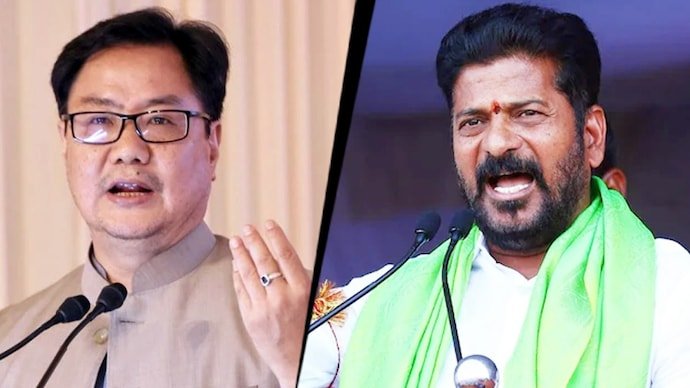
The debate over India‘s North-South political balance has once again moved to the center of national discourse after Union Minister Kiren Rijiju strongly criticized Telangana Chief Minister Revanth Reddy for remarks suggesting that southern states are being politically sidelined by the Centre.
What began as a political exchange over representation quickly evolved into a larger discussion about Federalism, parliamentary seats, economic contributions, population growth, and the future of India’s democratic structure. The Controversy reflects growing concerns among several southern states that future political changes could alter the balance of power within Parliament.
While the immediate trigger was a disagreement over regional representation, the deeper issue involves how India manages political equality, demographic changes, economic contributions, and federal cooperation in one of the world’s most diverse democracies.
What Sparked the Latest Controversy?
The controversy began after Telangana Chief Minister Revanth Reddy alleged that southern states were not receiving fair political representation and warned against what he described as an increasing imbalance favoring northern India.
Reddy argued that southern states contribute significantly to the national economy while facing concerns that future political developments could reduce their influence in Parliament.
His remarks included criticism of the BJP-led central government and broader concerns about the direction of federal policymaking.
Union Minister Kiren Rijiju responded sharply, accusing Reddy of attempting to create divisions based on geography and regional identity. Rijiju emphasized that India remains a united nation and that leadership positions are already represented by individuals from different regions of the country.
The exchange quickly gained national attention because it touched on a politically sensitive subject that has surfaced repeatedly over the past decade.
Why the North-South Debate Is Becoming More Prominent
The current debate is not simply about political rhetoric. It reflects broader structural questions about how India balances representation among states with vastly different population growth rates, economic performance, and development indicators.
Southern states such as Telangana, Tamil Nadu, Karnataka, Kerala, and Andhra Pradesh have historically recorded lower population growth rates compared to several northern states.
At the same time, many southern states have achieved higher literacy rates, stronger healthcare outcomes, lower fertility rates, and greater industrial development.
This has created concerns that states which successfully implemented population control measures could face reduced political influence if parliamentary representation becomes more closely tied to population figures.
The issue has therefore evolved into a debate about whether Governance success should inadvertently lead to reduced political leverage.
Understanding Delimitation and Why It Matters
The central issue driving much of the discussion is Delimitation.
Delimitation is the process of redrawing parliamentary and legislative constituency boundaries based on population changes recorded in the census. The objective is to ensure that elected representatives serve roughly equal numbers of citizens.
In principle, delimitation strengthens democratic representation. However, in a country as large and diverse as India, the process also creates complex political consequences.
If parliamentary seats are allocated primarily according to population growth, states that have experienced faster population increases could gain additional representation, while states with slower growth may see their relative influence decline.
This possibility has become a major concern among several southern states.
| Issue | Concern Raised by Southern States | Counter Argument |
|---|---|---|
| Population-Based Representation | May reduce relative political influence | Democracy requires representation based on population |
| Tax Contributions | High contributors deserve stronger voice | National development requires redistribution |
| Federal Balance | Regional interests could be weakened | National unity requires equal citizenship |
| Future Delimitation | Parliamentary influence may shift northward | Population changes must be reflected democratically |
Rijiju’s Response and the Politics of National Unity
Kiren Rijiju’s response focused on rejecting the idea that India’s leadership structure is dominated by any particular region.
By highlighting that the President, Prime Minister, and Vice President come from different parts of the country, Rijiju sought to counter claims that national institutions favor one geographical region over another.
His argument reflects a broader political narrative emphasizing national unity over regional distinctions.
Supporters of this view argue that constitutional offices and democratic institutions represent the entire nation rather than specific states or regions. They contend that framing issues in terms of North versus South risks creating unnecessary divisions within the country.
The debate therefore extends beyond numbers and representation into questions of national identity and political messaging.
The Economic Argument Behind Southern States’ Concerns
One of the most frequently cited points in the North-South debate involves taxation and economic contribution.
Several southern states contribute significantly to India’s GDP, exports, services sector, manufacturing output, and tax revenues. Political leaders from these states have often argued that fiscal contributions should be considered when discussing representation and resource allocation.
The argument is based on the perception that economically productive states should not lose influence despite achieving development goals and population stabilization.
However, supporters of India’s existing federal framework point out that fiscal redistribution is a fundamental feature of most modern federations.
Wealthier regions often contribute more resources that help support development in less-developed areas, creating a more balanced national economy over time.
This tension between economic contribution and political representation lies at the heart of the current debate.
How Population Trends Are Reshaping Indian Politics
The controversy also highlights a broader demographic transformation underway across India.
Over the past several decades, southern states have generally experienced lower fertility rates and slower population growth compared with some northern states.
This demographic divergence has produced important social and economic benefits, including improved healthcare outcomes, greater female Education, and stronger workforce participation in many regions.
However, it has also created political challenges because democratic systems traditionally allocate representation based on population size rather than development indicators.
As India’s population distribution continues to evolve, policymakers will increasingly face difficult questions about balancing demographic realities with concerns about regional equity.
The Constitutional Challenge Facing Policymakers
The delimitation debate presents one of the most complex constitutional questions India may face in the coming years.
On one hand, democratic principles suggest that representation should reflect population. Citizens should ideally have equal voting power regardless of where they live.
On the other hand, many argue that states which successfully implemented national development goals should not be politically disadvantaged for doing so.
Finding a solution that satisfies both principles will likely require extensive consultation among states, constitutional experts, political parties, and policymakers.
The challenge is not merely technical. It involves balancing democracy, federalism, development, and national cohesion simultaneously.
The HYDRAA-Hitler Controversy Adds Another Political Flashpoint
The event generated additional controversy when Revanth Reddy reportedly linked Telangana’s anti-encroachment agency HYDRAA to Adolf Hitler during a public discussion.
The comments immediately attracted criticism from opposition parties and historians.
Experts noted that there is no widely accepted historical evidence connecting Hitler’s inner circle or Nazi organizations to a group known as “Hydra” in the manner described.
The controversy shifted attention away from policy issues and toward questions regarding historical accuracy and political communication.
Opposition parties used the remarks to criticize the Telangana Chief Minister, while supporters argued that the comments were being interpreted out of context.
Regardless of intent, the episode further intensified an already contentious Political Debate.
How Other Federations Handle Similar Challenges
India is not the only democracy grappling with questions of representation and regional balance.
Countries such as the United States, Germany, Australia, and Canada have developed mechanisms to balance population-based representation with regional interests.
Many federations maintain one legislative chamber based primarily on population and another designed to protect regional representation.
These systems attempt to prevent either highly populated or less populated regions from dominating national decision-making.
India’s ongoing debate may eventually involve examining international models while adapting solutions to its unique constitutional and demographic circumstances.
The Political Implications Ahead of Future Elections
The North-South debate is likely to remain politically significant because it intersects with several major electoral issues.
- Federal relations between states and the Centre
- Parliamentary representation
- Fiscal transfers and taxation
- Regional development priorities
- Population policy outcomes
- Constitutional reforms
Political parties across India are expected to continue using these issues to mobilize support and shape public opinion.
As discussions around future delimitation gain momentum, regional concerns could become increasingly influential in national politics.
The Bigger Question: Can India Balance Representation and Federal Equity?
The most important question emerging from this controversy is not whether one side is entirely right or wrong.
Rather, it is whether India can successfully balance two legitimate democratic principles:
- Equal representation based on population.
- Protection of regional interests within a diverse federal system.
Both principles are essential to the long-term health of the world’s largest democracy.
The challenge for policymakers will be finding solutions that strengthen national unity while addressing genuine concerns about representation and fairness.
This is likely to become one of the most consequential constitutional and political debates of the coming decade.
Conclusion: More Than a Political War of Words
The exchange between Revanth Reddy and Kiren Rijiju is about far more than a disagreement between two political leaders. It reflects deeper questions about India’s future political structure, demographic transformation, federal balance, and democratic representation.
While Rijiju emphasized national unity and rejected regional divisions, Reddy’s comments highlighted concerns that have been voiced by several southern leaders regarding delimitation and political influence.
As India continues to evolve economically and demographically, debates over representation, taxation, and federalism are likely to become even more important. The challenge will be ensuring that these discussions remain constructive and focused on strengthening democratic institutions rather than deepening regional divides.
Ultimately, the success of India’s federal system will depend on its ability to accommodate diverse regional interests while preserving the shared national identity that binds the country together.
For breaking news and live news updates, like us on Facebook or follow us on Twitter and Instagram. Read more on Latest India on thefoxdaily.com.





COMMENTS 0