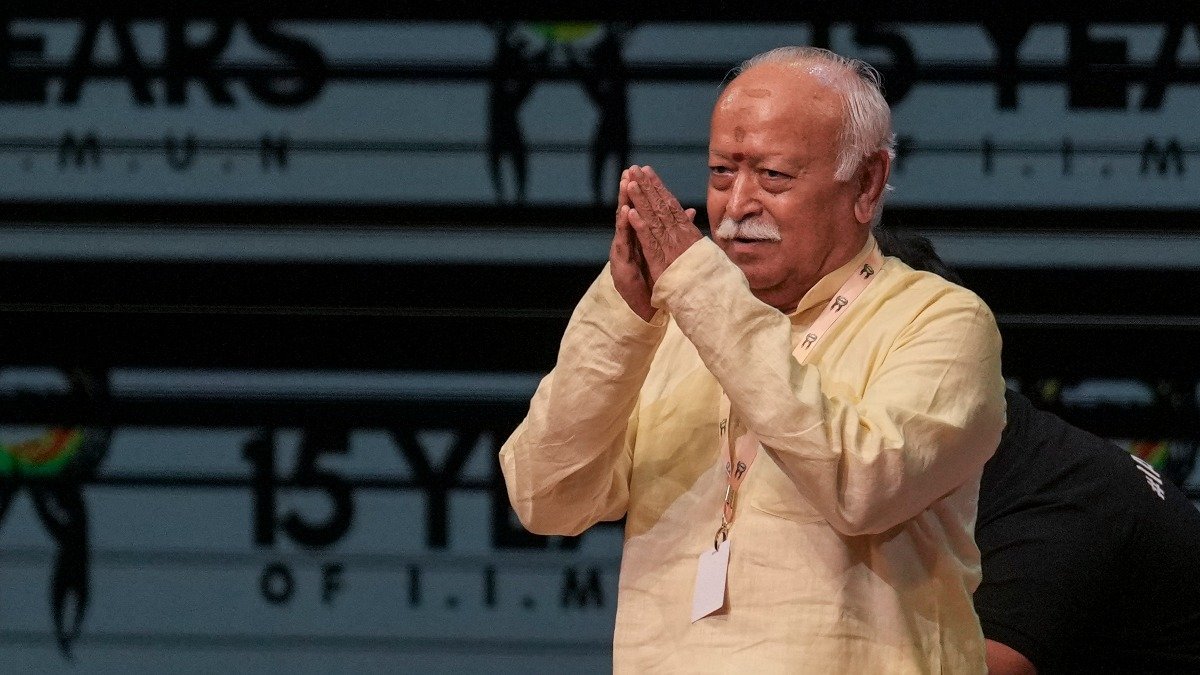
Rashtriya Swayamsevak Sangh (RSS) chief Mohan Bhagwat has said that Indians should unequivocally support the government and the armed forces during conflicts involving countries such as China and Pakistan, but argued that political and military disputes should not permanently sever people-to-people relationships. Speaking at a Gen Z-led event in Mumbai on Thursday, Bhagwat said that while National Security must remain the top priority during periods of conflict, dialogue should resume once hostilities end because “humanity is one.”
His remarks come at a time when India‘s relations with both Pakistan and China continue to be shaped by security concerns, border tensions and terrorism-related issues. Bhagwat’s comments also closely echo observations made earlier this year by senior RSS leader Dattatreya Hosabale, who advocated keeping channels of civilian engagement open despite strained diplomatic ties.
Bhagwat’s Message: Support the Nation During Conflict
Responding to a question on whether civilian engagement with Pakistan and China should continue during times of conflict, Bhagwat made it clear that there should be no ambiguity when national security is involved.
He said citizens should stand firmly behind the decisions taken by the elected government and the country’s armed forces during military confrontations.
“In times of conflict, we have to go with whatever our government and military do,” Bhagwat said.
The statement reinforces the RSS chief’s position that national unity becomes paramount during periods of war or heightened security threats, regardless of differing political opinions.
Dialogue Should Return After Conflicts End
While advocating complete support for the government during conflict, Bhagwat also argued that military confrontations should not permanently define relations between societies.
Referring to India’s historical and civilisational connections with neighbouring countries, he said those relationships may be paused during hostilities but should not be abandoned indefinitely.
“You have given two examples, Pakistan and China. People in China say that for 2,000 years Bharat has given us values. Pakistan was part of Bharat not more than 100 years ago. These should not be forgotten. These ties cannot be severed. They can be put on hold till the conflict is there,” he said.
Bhagwat added that lasting hostility cannot provide a sustainable path to peace.
“Sometimes, after the resolution of conflict, we have to take up the thread from where we left it and continue. So permanent enmity, permanent hatred is not the solution,” he said.
Why the Remarks Matter
The RSS is one of India’s most influential socio-cultural organisations, and statements by its leadership often attract significant political attention. Bhagwat’s remarks are notable because they seek to balance two positions that are often viewed separately: unwavering support for national security during conflict and the importance of rebuilding dialogue after hostilities end.
The comments do not advocate reducing India’s security posture during conflicts. Instead, they distinguish between immediate responses to national security challenges and long-term efforts aimed at maintaining regional stability through communication once conditions permit.
This distinction reflects a broader debate in India’s Foreign Policy discourse over how countries should manage relationships with neighbours that are simultaneously strategic competitors and important regional stakeholders.
Political Borders and People’s Relationships
Bhagwat suggested that tensions between nations are often driven more by political realities than by the attitudes of ordinary citizens.
“It is not that Pakistanis are wholeheartedly enemies of Indians. Nor are Indians like that. States, politics and international borders are realities of life,” he said.
He reiterated that supporting the country’s defence efforts during conflict and seeking peace afterward are not contradictory positions.
“During conflict, we are with our government and we are with our military. But we know that sometimes it has to cease, and we have to be one, because humanity is one,” Bhagwat said.
The remarks underline his view that geopolitical disputes should not permanently erase historical and cultural links between societies.
“Dialogue, Not Domination”
During his interaction, Bhagwat also described what he called India’s broader civilisational approach to International Relations.
According to him, India’s historical outlook has emphasized dialogue, coexistence and harmony rather than territorial expansion or domination.
“Bharat’s solution is not conquering or obliterating others. It is a harmonious and assimilating process that requires dialogue,” he said.
He further stated:
“We are not looking to conquer any other country. We are looking to unite.”
These remarks were presented in the context of discussing India’s long-term approach toward international engagement rather than specific diplomatic negotiations.
Bhagwat Draws a Clear Distinction Between Conflict and Terrorism
While advocating renewed dialogue after conventional conflicts, Bhagwat emphasized that terrorism should be viewed differently.
He argued that terrorism is not merely a series of isolated violent incidents but involves an underlying ideological and strategic framework.
“Terrorism is not only terrorism by radical groups. There is a whole philosophy behind it. There is a policy behind it – ‘a thousand cuts’. It is a hidden war, and we have to treat it accordingly,” he said.
According to Bhagwat, this distinction explains why military conflicts may eventually transition into diplomatic engagement, whereas terrorism requires a separate and sustained security response.
How the Remarks Compare With Earlier RSS Statements
Bhagwat’s comments closely resemble observations made by RSS General Secretary Dattatreya Hosabale in May.
Hosabale had argued that repeated terror attacks including the 2008 Mumbai attacks, the 2019 Pulwama attack and the Pahalgam terror attack last year demonstrated the need for India to place national security at the centre of its policy approach.
At the same time, he maintained that communication channels should not be closed permanently. He suggested that engagement through trade, visas, sports, academia and civil society could continue to serve as long-term bridges between the two countries.
Those remarks generated mixed political reactions. The congress questioned the timing of the proposal and asked what had changed after the Pahalgam terror attack to justify renewed calls for dialogue with Pakistan.
Support From Former Army Chief
Following Hosabale’s remarks, former Army chief General Manoj Mukund Naravane broadly supported the idea that maintaining people-to-people engagement could help prevent bilateral relations from deteriorating further.
However, he also stressed that India’s commitment to peace should never be interpreted as an unwillingness to use military force when required to respond to Pakistan-sponsored terrorism.
Taken together, these statements highlight an approach that seeks to combine robust national security measures with the possibility of restoring civilian engagement under appropriate circumstances.
Historical Context Behind the Debate
India’s relations with Pakistan have long been shaped by security concerns, cross-border terrorism and periodic military tensions. Diplomatic engagement has often fluctuated depending on developments in bilateral relations and the broader regional security environment.
Similarly, India and China share extensive historical and cultural connections but have also experienced periods of military standoffs and strategic competition. As a result, discussions about balancing national security with diplomatic engagement remain an important aspect of India’s foreign policy debate.
Bhagwat’s remarks fit into this broader conversation by distinguishing between temporary responses to conflict and the longer-term objective of maintaining channels for dialogue when circumstances permit.
What Bhagwat’s Remarks Mean
Confirmed fact: Bhagwat called for unconditional support for the government and armed forces during conflicts involving Pakistan and China while advocating renewed dialogue after hostilities end.
Reasoned analysis: His comments suggest an effort to reconcile strong national security priorities with the belief that permanent hostility is unlikely to produce lasting peace. Rather than presenting these positions as contradictory, he framed them as complementary stages in managing international relationships.
The remarks also reinforce a distinction between conventional interstate conflicts and terrorism, with Bhagwat arguing that each requires a different policy response.
What Could Happen Next
Bhagwat’s statements are part of an ongoing public discussion rather than a government policy announcement. Whether dialogue with neighbouring countries expands in the future will depend on developments in regional security, diplomatic engagement and the policies adopted by the Government of India.
For now, his comments contribute to a continuing debate on how India should balance national security, historical relationships and long-term regional stability. They also underscore a theme that has emerged repeatedly in recent RSS statements: unwavering support for the nation during periods of conflict, coupled with the belief that dialogue remains essential once conditions allow for it.
For breaking news and live news updates, like us on Facebook or follow us on Twitter and Instagram. Read more on Latest India on thefoxdaily.com.





COMMENTS 0