A growing collection of videos on Chinese Social Media platforms is presenting India through images of garbage, slums, poverty, pollution and social stereotypes. Some use real footage recorded in Bangladesh and falsely label it as India, while others rely on artificial intelligence to create imaginary scenes of Indian life. Despite questions about their accuracy, these videos are attracting millions of views and generating a distorted picture of the country for online audiences.
An investigation by India Today found recurring anti-India narratives across Chinese video platforms Bilibili and Youku. The videos repeatedly portray India as an unhygienic, unsafe and unliveable country, often using sensational headlines and misleading visual material to reinforce negative impressions. The investigation also raises questions about the commercial incentives behind such content and its possible connection to broader online influence campaigns.
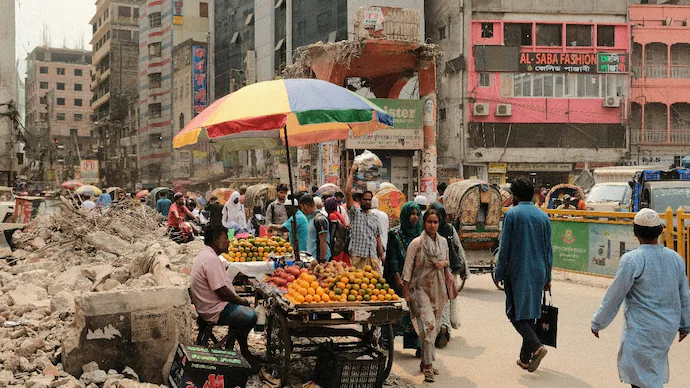
One particularly revealing example involved a Chinese woman livestreaming from Tekpara, a low-income neighbourhood in Dhaka, Bangladesh. She described the location to viewers as New Delhi, claiming that its homes were extremely dirty and that hygiene and law-and-order conditions were poor. The surroundings, including tin-roofed houses, were presented as evidence of India’s living conditions, even though the footage was being recorded outside India.
The findings highlight how social media content can turn poverty and urban hardship into a product for online consumption, while misleading viewers about the country being shown. They also raise concerns about the growing use of fabricated and misrepresented visuals in cross-border information campaigns.
Chinese Creator Films a Dhaka Neighbourhood and Presents It as Delhi
The investigation began with a report about Chinese nationals filming in Tekpara, a low-income neighbourhood in Dhaka. According to Bangladeshi newspaper Prothom Alo, Chinese visitors had been recording videos in the area for months, sometimes working from morning until night and occasionally entering people’s homes.
In one livestream, a Chinese woman stood beside a canal and told viewers that she was in New Delhi. She described the surrounding homes as dirty and unhygienic and criticised the area’s law-and-order situation. However, the location was identified as Tekpara in Bangladesh, not the Indian capital.
The distinction is important because the footage was not simply showing a poor neighbourhood. It was being presented as evidence of conditions in another country. Viewers unfamiliar with the location could easily accept the description as genuine, particularly when the video was accompanied by commentary that reinforced the misleading claim.
The incident raised a broader question: was this an isolated case of misleading content, or part of a much larger pattern of videos portraying India negatively?
India Today’s open-source intelligence investigation examined Chinese video platforms to understand how frequently similar narratives appeared. The findings suggested that the Dhaka livestream was not an isolated example. Instead, it reflected a wider collection of content built around sensationalised depictions of India.
India Today’s Investigation Finds Five Recurring Anti-India Narratives
India Today’s OSINT team searched Bilibili and Youku using India-related keywords and found hundreds of videos. Researchers examined approximately a dozen of them closely and identified five recurring themes that dominated the content.
- Poverty and slums: Videos portray India’s poorest neighbourhoods as representative of the entire country.
- An unliveable India: Content exaggerates pollution, sanitation problems and environmental conditions to suggest that Indian cities are unsuitable for human life.
- Caste and garbage: Videos connect caste-based inequality and waste to sweeping claims about Indian society.
- Indian men as predators: Some videos use sensational stereotypes to portray Indian men as sexually threatening or dangerous.
- Being Indian as a punchline: Content uses humour, ridicule and exaggerated scenarios to turn Indian identity into a source of mockery.
These themes share a common approach: they select particular problems or stereotypes and present them as if they define the experience of living in India. Instead of providing a balanced picture, they rely on emotionally charged material designed to attract attention and encourage viewers to engage with the content.
The repeated use of similar narratives also makes the videos more significant than individual examples of online criticism. When different uploads repeatedly focus on the same negative themes, they can create an impression that the portrayal is comprehensive, even when the material is selective, misleading or entirely fabricated.
Millions of Views for Videos Portraying India as a Garbage Dump
One of the most widely viewed examples identified by the investigation is a video titled “Home on a garbage mountain”. Its headline claims that 3.5 million Indian Dalits spend their lives on 800 million tonnes of garbage.
The video had accumulated approximately 1.4 million views and more than 6,000 comments. Its title combines caste identity, poverty and environmental degradation into a sensational claim designed to attract attention.
India faces genuine challenges involving waste management, sanitation and social inequality. However, presenting an enormous population group through a single extreme image does not provide an accurate account of the country’s social conditions. The framing risks reducing complex issues to a stereotype that viewers may mistake for a complete description of India.
Another video uploaded in late October warns that New Delhi could become so polluted that even mosquitoes would disappear. The headline uses an exaggerated prediction to present the capital as an environment incapable of supporting life.
A separate video promises to reveal “The secret no one dares to reveal”. Its subject is a slum near the Taj Mahal, and the video has received around 56,000 views.
These examples demonstrate how familiar locations and real social problems can be repackaged into sensational online stories. The presence of a slum near a famous monument becomes a supposed revelation about the country, while pollution concerns are turned into dramatic predictions about the future.
AI-Generated Video Imagines the Experience of Being Born in India
One of the more striking examples identified by the investigation is titled “Born in India: A life experience”. It invites viewers to imagine how terrible it would be to be born and grow up in India.
Unlike videos that use footage from real locations, this production is entirely AI-generated. It depicts a distressed boy holding the Indian flag and presents an imagined childhood as though it represents the experience of growing up in the country.
The boy is not a real child, and the life shown in the video is not an actual personal experience. Nevertheless, the content is presented in a format that encourages viewers to interpret the fictional scenes as a representation of Indian life.
The video had attracted approximately 163,700 views, according to India Today’s investigation.
AI-generated material creates a particular challenge for online audiences because it can produce convincing images without requiring access to real people or locations. A creator can construct a fictional scene, attach a national identity to it and distribute it as an apparent documentary or personal account.
When viewers do not recognise that the images are synthetic, the distinction between factual reporting and fabricated storytelling becomes difficult to identify. In this case, the emotional presentation of a fictional child is used to reinforce a negative narrative about an entire country.
Seven Anti-India Videos Cross 2.06 Million Views on Bilibili
The reach of the content is one of the most important findings in the investigation. Seven anti-India videos tracked on Bilibili had collectively crossed 2.06 million views by November 11, 2026.
One video titled “Indian pervert”, which portrays Indian men as predators, had alone accumulated approximately 388,000 views. The figure illustrates how content built around national stereotypes can attract a substantial audience on video-sharing platforms.
The investigation also identified older videos on Youku, some of which had been online for four or five years. Their titles include claims such as “1,400 people sharing one toilet”, continuing the focus on extreme depictions of poverty and sanitation.
The presence of older uploads suggests that this type of content is not limited to a short-lived online trend. Negative portrayals of India have appeared on these platforms over an extended period, with different videos repeatedly drawing on similar subjects.
However, view counts alone do not establish who produced the videos, whether their distribution was coordinated or whether they were promoted through organised campaigns. They do show that such material has reached a sizeable audience and that its recurring themes deserve closer examination.
Chinese Social Media and India’s Image: A Pattern Seen Before
The investigation’s findings also connect with earlier research into online narratives about India. Studies by the Australian Strategic Policy Institute and Doublethink Lab examined information campaigns involving Manipur and India’s northeastern region.
The organisations found that much of the narrative material had first appeared on Chinese social media platforms before reaching Indian online audiences. This finding suggests that content circulating within one country’s digital ecosystem can later influence conversations and perceptions elsewhere.
The research is significant because misleading narratives do not always remain confined to the platforms where they originate. Videos, screenshots, short clips and translated claims can be shared across different social networks, where they may reach audiences with little knowledge of the original context.
In the case of India’s northeastern region, the research examined how narratives concerning Manipur and the wider region travelled through online information networks. The findings drew attention to the role of Chinese social media platforms in the early circulation of some of the material.
It does not mean that every critical video about India is part of a coordinated operation. However, the research provides a reason to examine how narratives are created, amplified and transferred between digital platforms.
Rafale Mockery During the May 2025 India-Pakistan Conflict
Another example cited in the investigation emerged during the May 2025 India-Pakistan conflict. Chinese influencers circulated a viral video mocking India’s Rafale fighter jets.
The video became an example of how humour, edited visuals and online memes can be used during a period of military tension to influence public perceptions. Instead of relying on conventional political messaging, such content uses entertainment-style formats that can spread quickly through social media.
The Asia Research Institute at the National University of Singapore described the episode as “a textbook example of memetic warfare”. The term refers to the use of memes, jokes, viral images and other internet-native content to influence how audiences interpret political or military events.
Memetic warfare can be difficult to assess because the content often appears to be ordinary online humour. A video mocking military equipment may be shared as a joke, but its repeated circulation during a conflict can also contribute to a broader narrative about a country’s military capabilities.
The Rafale episode and the more recent anti-India videos share an important feature: both use digital content formats to shape perceptions beyond traditional news reporting.
Who Is Behind the Anti-India Videos? The Evidence Remains Inconclusive
One of the most important questions raised by the investigation is whether the videos are connected to the Chinese government or state-backed information operations.
At present, there is no public proof establishing that the Chinese state directly commissioned, funded or coordinated the videos examined by India Today. The investigation identifies recurring themes and examples of misleading content, but it does not establish the identity of all creators or demonstrate a direct government role.
That distinction matters. A video may promote a misleading national stereotype without being part of a government campaign. Individual creators can produce such material for advertising revenue, audience growth, attention or other commercial reasons.
At the same time, the operating environment of Chinese social media platforms raises questions about what content is allowed to remain visible and gain large audiences.
Bilibili, Youku and Douyin operate within China‘s tightly regulated internet environment. Freedom House, a US-based organisation that monitors political rights and civil liberties, gave China a score of 9 out of 100 in its 2026 assessment of internet freedom.
The broader context is that online platforms in China operate under extensive government controls. Content that authorities consider politically sensitive can face restrictions or removal. This environment makes the continued visibility of particular narratives a subject of scrutiny, although it does not, by itself, prove that the government supports or directs every video.
Why the ‘Dirty India’ Narrative Can Become a Profitable Online Business
Negative and sensational content can attract attention because it provokes strong emotional reactions. Images of extreme poverty, polluted streets, overcrowded housing and social conflict can encourage viewers to click, comment and share.
For creators, these reactions may translate into larger audiences and potential commercial returns. A video with a dramatic headline can compete for attention more effectively than a detailed explanation of India’s economic, social or environmental conditions.
The format also makes production relatively straightforward. A creator can film a poor neighbourhood, attach a misleading location label and build a narrative around the footage. In other cases, AI tools can generate fictional scenes without the need to visit a location or record real events.
This creates an incentive to select the most shocking images rather than provide a representative account. A video showing one slum may be presented as evidence of conditions across an entire city or country. A fictional AI-generated scene may be packaged as a real-life experience. The more extreme the claim, the greater its potential to attract curiosity and engagement.
However, the available investigation does not establish the earnings of the creators or prove that every video was produced for financial gain. The commercial explanation is a possible incentive behind the content, not proof of a common funding arrangement or organised network.
India’s Foreign Ministry Responds to Distorted Online Portrayals
India’s Ministry of External Affairs has responded to the issue of videos presenting distorted images of the country. Ministry spokesperson Randhir Jaiswal described such efforts as unfortunate and criticised the spread of false narratives.
Jaiswal said, “Such efforts to present a distorted picture of any country are unfortunate.”
He also warned that “peddling of false narratives only undermines the credibility of the actors involved and those behind them.”
The ministry has urged the authorities concerned to take appropriate action against those responsible.
The response reflects India’s concern about how misleading content can affect its international image. Digital platforms allow videos created in one country to reach audiences elsewhere almost instantly, making it difficult for governments and news organisations to correct false claims after they have spread.
However, addressing such content requires distinguishing between legitimate criticism, misleading presentation and deliberately fabricated material. India’s problems involving pollution, sanitation, poverty and discrimination are real subjects of public debate. The concern arises when selective footage or fictional material is presented as a complete and factual picture of the country.
India’s Real Challenges and the Problem With Selective Representation
India is a country of more than 1.4 billion people, with enormous differences in income, infrastructure, geography and living conditions. It faces serious challenges involving urban sanitation, air pollution, waste management, poverty and caste-based discrimination.
These problems deserve public attention and effective policy responses. Reporting on them is not inherently anti-India, and criticism of government performance or social conditions is an important part of public discussion.
The problem begins when a narrow selection of extreme images is used to represent the entire country. A slum in Dhaka falsely labelled as Delhi, an AI-generated child presented as a real Indian experience, or a single neighbourhood portrayed as proof of national conditions does not amount to reliable reporting.
India’s development story also includes achievements that are absent from these videos. The country has developed a major digital payments ecosystem, expanded its space programme and achieved a successful lunar landing through the Chandrayaan-3 mission. It is also a large democracy with a diverse population and a rapidly changing economy.
None of these achievements erases the country’s social and economic challenges. Equally, those challenges do not justify presenting India through a collection of misleading images and fabricated stories.
How Viewers Can Identify Misleading Videos About India
The spread of misleading content makes basic verification increasingly important. Viewers should be cautious when a video makes sweeping claims about a country using only a few dramatic images or emotionally charged statements.
- Check the location: Search for landmarks, street signs and other geographical clues before accepting a video’s claimed location.
- Look for the original footage: A video may have been recorded in another country or reused from an older upload.
- Watch for AI-generated visuals: Unnatural facial movements, inconsistent details and synthetic scenes can indicate that the material is not genuine.
- Question extreme headlines: Claims about millions of people or entire cities should be checked against reliable reporting and available evidence.
- Compare multiple sources: A claim supported by only one anonymous video deserves additional scrutiny.
- Separate criticism from misinformation: Real problems should be acknowledged, but false locations and fabricated experiences should not be treated as evidence.
These steps cannot identify every misleading video, but they can help viewers avoid accepting dramatic online content without checking its origin and context.
The Bigger Concern: When a Country Becomes an Online Stereotype
The India Today investigation points to a wider problem in the global digital information environment. Social media platforms reward attention, and content creators can exploit national stereotypes to attract viewers. When misleading footage, AI-generated scenes and sensational headlines repeatedly reinforce the same message, they can gradually shape how audiences perceive a country.
The videos identified on Bilibili and Youku show how India’s poorest neighbourhoods, environmental challenges and social inequalities can be turned into a simplified online identity. The Dhaka livestream adds another layer to the problem by demonstrating how footage from one country can be presented as evidence about another.
There is not yet public evidence proving that the videos are directed by the Chinese state. But their reach, repeated themes and connection with earlier research into cross-border online narratives make the issue worthy of continued scrutiny.
India’s image should not be defined by selective footage, fabricated AI characters or misleading descriptions of locations. The country’s challenges deserve honest reporting, just as its achievements deserve recognition. The central issue is not whether negative stories about India should exist, but whether audiences are being shown real events in their proper context.
When the worst frame is repeatedly presented as the whole picture, the result is not simply criticism. It is a distorted narrative that can travel far beyond the place where the original footage was recorded.
For breaking news and live news updates, like us on Facebook or follow us on Twitter and Instagram. Read more on Latest World on thefoxdaily.com.






COMMENTS 0