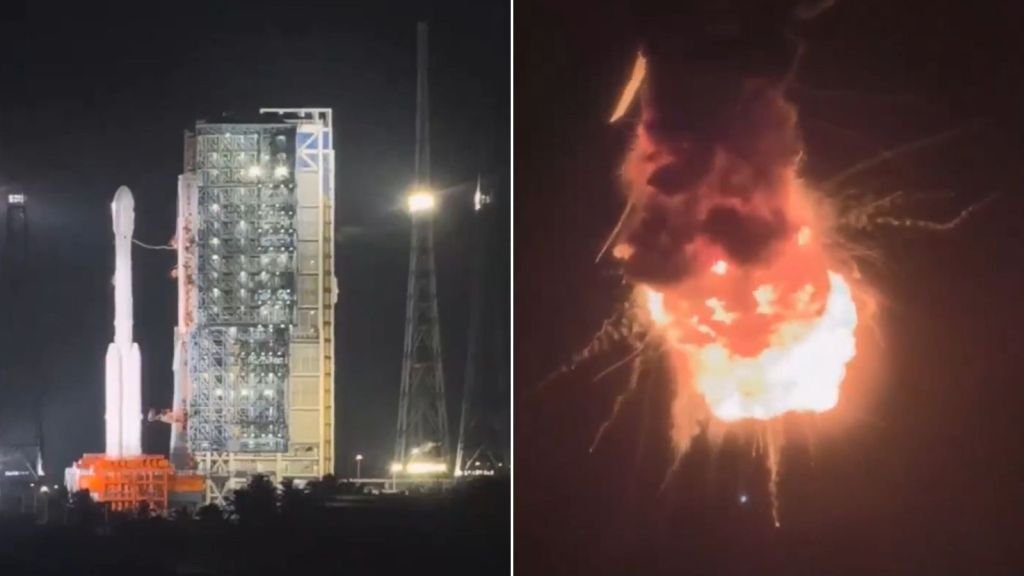
A Long March 7A rocket carrying the ChinaSat-4B communication satellite exploded roughly 85 seconds after launch from China’s Wenchang Space Launch Site, destroying both the rocket and satellite.
A Chinese rocket carrying a communication satellite exploded shortly after liftoff on Monday night, turning what initially appeared to be a successful launch into a failed Space mission.
The Long March 7A rocket, carrying the ChinaSat-4B satellite, blasted off from the Wenchang Space Launch Site on China‘s Hainan island. However, the rocket developed an in-flight anomaly during its first-stage flight and erupted into a large fireball approximately 85 seconds after liftoff.
Videos shared on Social Media showed the rocket rising normally before suddenly bursting into flames high above the launch site.
WATCH: Long March 7A explodes shortly after launch
Footage circulating online showed the rocket’s initial ascent before the vehicle appeared to break apart and turn into a fireball.
The explosion occurred before the rocket could reach orbit, resulting in the loss of both the launch vehicle and the ChinaSat-4B satellite.
The Long March 7A is a medium-lift launch vehicle designed primarily for missions involving higher orbits. Monday’s incident occurred during what was the rocket’s 18th flight, according to the information provided.
Rocket launched at 8:02 pm local time
China’s state-run Xinhua news agency reported that the rocket lifted off at 8:02 pm local time from the Wenchang Space Launch Site.
The mission was subsequently declared unsuccessful.
The exact cause of the failure was not immediately clear. Authorities are investigating the in-flight anomaly that caused the rocket to explode during its ascent.
What happened to the ChinaSat-4B satellite?
The ChinaSat-4B satellite was being carried into orbit aboard the Long March 7A when the failure occurred.
Because the rocket exploded during the first stage of flight, the satellite was unable to complete its mission. The satellite was destroyed along with the launch vehicle.
ChinaSat-4B was intended to be placed into orbit as part of China’s satellite communications programme, but the failed launch prevented the spacecraft from reaching its planned destination.
Long March 7A suffers second failure
The incident is notable because it reportedly occurred during the rocket’s 18th flight and represented only its second failure.
The Long March 7A is part of China’s Long March family of launch vehicles, which are used for a range of satellite and space missions.
The rocket’s previous successful flights had established a record that made Monday’s failure particularly significant for China’s launch programme.
Videos capture the explosion
Several videos of the incident quickly appeared on social media.
The footage showed the rocket successfully leaving the launch pad before the vehicle was engulfed in a bright fireball roughly 85 seconds later.
The visuals provide a clear indication that the failure occurred during the rocket’s ascent rather than during preparations for launch.
However, the videos alone do not establish what caused the anomaly. A technical Investigation will be required to determine whether the failure originated in the rocket’s propulsion system, structural components, guidance systems or another part of the vehicle.
Investigation into failure underway
The cause of the explosion remains under investigation.
The initial information indicates that the rocket developed an in-flight anomaly during its first-stage flight. Further details about the precise technical failure were not immediately available.
Launch failures can result from a range of complex technical problems, but no specific cause should be assumed until investigators release their findings.
For China’s space programme, determining the source of the failure will be important before the Long March 7A returns to flight.
China continues a busy launch programme
The failed Long March 7A mission comes as China continues to expand its space activities and conduct regular launches from its various spaceports.
The Wenchang Space Launch Site on Hainan has become an important facility for China’s space programme, particularly for larger launch vehicles and missions requiring modern launch Infrastructure.
Monday’s failure therefore represents a setback for the specific mission and launch vehicle, while the broader Chinese space programme continues to operate a large number of missions.
What happens next?
The immediate focus will be on the investigation into the Long March 7A failure.
Investigators will examine data from the launch and available footage to determine what caused the vehicle to develop an anomaly approximately 85 seconds after liftoff.
The failure destroyed the ChinaSat-4B satellite and ended the mission before the spacecraft could reach orbit.
Until the investigation establishes the cause, the exact technical reason for the explosion remains unknown.
Key facts about the failed launch
- Rocket: Long March 7A
- Satellite: ChinaSat-4B
- Launch site: Wenchang Space Launch Site, Hainan, China
- Launch time: 8:02 pm local time
- Failure: In-flight anomaly followed by explosion
- Time after liftoff: Approximately 85 seconds
- Result: Rocket and satellite destroyed
- Flight number: 18th Long March 7A mission
- Investigation: Cause of failure remains under investigation
The dramatic videos of the Long March 7A exploding roughly 85 seconds after liftoff have highlighted the risks involved in space launches. While the mission ended in failure, investigators will now focus on identifying the technical problem behind the anomaly and determining what it means for future Long March 7A missions.
For breaking news and live news updates, like us on Facebook or follow us on Twitter and Instagram. Read more on Latest World on thefoxdaily.com.






COMMENTS 0