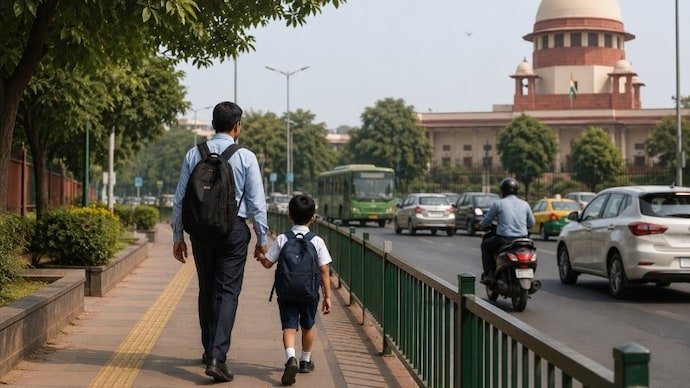
For decades, India‘s roads have largely been designed around vehicles. Pedestrians despite forming one of the largest groups of road users have often been forced to navigate broken sidewalks, encroachments, traffic congestion, and unsafe crossings. In a historic judgment, the Supreme Court has now sought to change that reality by declaring that the right to walk on safe and demarcated footpaths is a fundamental right protected under Articles 19 and 21 of the Constitution.
The ruling is far more than a legal observation. It fundamentally reshapes the relationship between citizens, governments, and public Infrastructure by establishing that pedestrians are not secondary road users. Instead, their right to safe movement takes precedence over the convenience enjoyed by motorized vehicles.
The judgment has the potential to influence Urban Planning, municipal Governance, road design standards, public safety policies, and future legislation across India.
What the Supreme Court Ruled
The Supreme Court held that wherever a road exists, authorities have an enforceable obligation to provide and maintain safe footpaths for pedestrians.
The Bench observed that walking is not merely a mode of transport but a constitutional freedom connected to personal liberty, dignity, health, and access to public spaces.
According to the Court, the right to walk safely on demarcated footpaths derives protection from:
- Article 19 – Freedom of movement.
- Article 21 – Right to life and personal liberty.
- Constitutional principles promoting equal access to public spaces.
The judgment explicitly states that the fundamental right of pedestrians overrides the privilege enjoyed by motorized vehicles on public roads.
This marks a significant shift in legal thinking, recognizing that roads are public spaces meant for people first and vehicles second.
The Case That Triggered the Landmark Judgment
The ruling emerged from a tragic case involving the death of a five-year-old child WHO was struck by a tanker while walking to school with his father.
The accident occurred in an area where neither a footpath nor a pedestrian crossing existed.
While examining compensation issues related to the accident, the Court expanded its focus to the broader question of pedestrian safety across India.
The judges concluded that the absence of safe walking infrastructure contributes directly to preventable accidents and fatalities.
The Court not only enhanced compensation to the victim’s family but also converted the matter into a broader proceeding examining pedestrian rights nationwide.
Why This Judgment Is Historic
India has long witnessed a transportation imbalance where road infrastructure investments have largely favored automobiles.
Flyovers, expressways, elevated corridors, and wider roads have often received priority, while pedestrian infrastructure has remained inadequate.
The Supreme Court described this situation as a “civilisational problem,” emphasizing that urban development has prioritized machines over human movement.
The ruling is historic because it transforms pedestrian infrastructure from a policy preference into a constitutional obligation.
For the first time, citizens have a clear legal basis to demand safe footpaths from authorities.
Understanding Articles 19 and 21 in the Context of Walking
The Court’s reasoning is rooted in two of the Constitution’s most important provisions.
Article 19: Freedom of Movement
Citizens have the constitutional freedom to move freely throughout India. Walking represents the most basic and universal form of movement.
If public roads become inaccessible or unsafe for pedestrians, this freedom becomes severely restricted.
Article 21: Right to Life and Dignity
The Supreme Court has consistently interpreted Article 21 broadly over the years.
The right to life includes:
- Safety.
- Dignity.
- Health.
- Access to public spaces.
- A quality living environment.
The Court effectively concluded that forcing citizens to walk amidst dangerous traffic conditions undermines these constitutional protections.
Who Is Responsible for Implementing the Judgment?
The Court identified multiple public authorities as duty-bearers responsible for pedestrian infrastructure.
- Urban Development Authorities.
- Municipal Corporations.
- Municipal Councils.
- Municipalities.
- Panchayats.
- Road development agencies.
These bodies are now expected to ensure that roads include safe walking infrastructure wherever feasible.
The judgment also opens the possibility for legal action if authorities fail to meet these obligations.
The State of Pedestrian Infrastructure in India
India’s urban centers have expanded rapidly over the past three decades, but pedestrian infrastructure has not always kept pace.
Common challenges include:
- Missing footpaths.
- Broken sidewalks.
- Encroachments.
- Poor lighting.
- Unsafe crossings.
- Lack of accessibility for persons with disabilities.
In many cities, pedestrians are forced to walk directly on roads alongside fast-moving traffic.
This situation disproportionately affects children, senior citizens, women, and persons with disabilities.
Why Pedestrian Safety Matters More Than Ever
Walking remains one of the most common forms of mobility in India.
Even people who use cars, buses, metros, or motorcycles spend part of their journey walking.
Safe footpaths support:
- School access.
- Public transport connectivity.
- Local commerce.
- Tourism.
- Public health.
- Environmental sustainability.
Without pedestrian infrastructure, entire sections of society face mobility barriers.
Comparison: Vehicle-Centric Cities vs Pedestrian-Friendly Cities
| Vehicle-Centric Planning | Pedestrian-Friendly Planning |
|---|---|
| Wider roads for cars | Dedicated footpaths and crossings |
| Higher accident risks | Improved public safety |
| Traffic-focused development | Human-centered development |
| Limited accessibility | Inclusive mobility for all |
| Greater pollution dependence | Encourages sustainable travel |
| Reduced street activity | Vibrant local economies |
The Economic Benefits of Better Footpaths
Pedestrian infrastructure is often viewed solely as a safety measure, but it also generates significant economic benefits.
Well-designed walkable areas typically lead to:
- Higher retail activity.
- Increased property values.
- Greater tourism appeal.
- Reduced healthcare costs.
- Improved public transport usage.
Businesses frequently benefit when customers can comfortably access commercial areas on foot.
Many successful global cities have discovered that prioritizing pedestrians often boosts local economic activity rather than restricting it.
The Public Health Connection
The judgment indirectly supports broader public health objectives.
Walking is among the simplest and most accessible forms of physical activity.
Regular walking can contribute to:
- Better cardiovascular health.
- Reduced obesity rates.
- Improved mental well-being.
- Lower healthcare burdens.
- Healthier urban populations.
When cities become more walkable, residents are more likely to incorporate physical activity into their daily routines.
An Important Insight Often Missed: Footpaths Are Social Infrastructure
Much of the discussion around footpaths focuses on transportation and safety. However, footpaths also serve a broader social purpose.
They are among the most democratic public spaces in a city.
Unlike private vehicles, footpaths are accessible regardless of income, age, gender, or social status.
A safe sidewalk allows:
- Children to walk to school.
- Senior citizens to remain independent.
- People with disabilities to participate in public life.
- Small businesses to attract customers.
- Communities to interact socially.
Viewed this way, pedestrian infrastructure is not merely a transportation asset it is a tool for social inclusion.
Could This Lead to New Laws?
Recognizing the absence of a dedicated legal framework governing pedestrian rights, the Supreme Court recommended consideration of new legislation.
The Court directed that the judgment be forwarded to relevant ministries and the law Commission.
Future legislation could potentially define:
- Pedestrian rights.
- Government obligations.
- Design standards.
- Accessibility requirements.
- Enforcement mechanisms.
- Penalties for non-compliance.
If enacted, such laws could establish uniform standards across the country.
Challenges Ahead
Despite the landmark nature of the ruling, implementation will not be simple.
Many Indian cities face:
- Space constraints.
- Encroachment issues.
- Funding limitations.
- Rapid urban growth.
- Fragmented governance structures.
Authorities will need to balance competing demands while ensuring compliance with constitutional obligations.
Long-term success will depend on sustained planning, investment, and political commitment.
Future Outlook
The Supreme Court’s ruling could become one of the most influential urban governance judgments in recent years. By elevating pedestrian rights to constitutional status, the Court has created a legal foundation for a more inclusive and human-centered approach to city planning.
In the coming years, municipalities may face increasing pressure to redesign roads, expand pedestrian infrastructure, improve accessibility, and integrate walking into transportation strategies.
Citizens, advocacy groups, and urban planners are also likely to use this judgment as a basis for demanding safer and more accessible public spaces.
Conclusion
The Supreme Court’s declaration that walking on safe and demarcated footpaths is a fundamental right marks a transformative moment in India’s urban development journey. By placing pedestrians ahead of motorized convenience, the Court has recognized walking as an essential constitutional freedom connected to dignity, safety, and equal access to public spaces.
The judgment not only provides legal protection for millions of pedestrians but also challenges governments to rethink how roads are designed and maintained. If effectively implemented, it could lead to safer streets, healthier communities, more inclusive cities, and a fundamental shift toward people-first urban planning across India.
For breaking news and live news updates, like us on Facebook or follow us on Twitter and Instagram. Read more on Latest India on thefoxdaily.com.






COMMENTS 0