The C Joseph Vijay-led Tamil Nadu government has withdrawn an order that sought to prevent students and young people from participating in protests associated with the Cockroach Janta Party (CJP) and Left organisations, following criticism from political groups and civil society voices.
The directive was issued on August 14 to the school Education and higher education departments and was marked as a “most immediate” communication. It called for coordinated steps to prevent students and youth from being drawn into protests and agitations linked to the Left and the CJP. The government subsequently withdrew the communication on Wednesday.
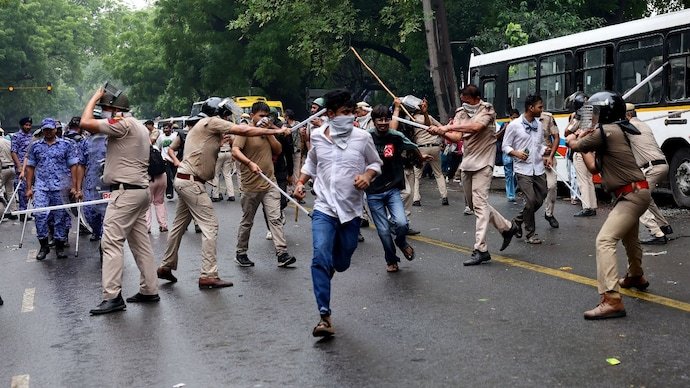
The reversal has brought the question of student participation in political demonstrations back into focus. The controversy is particularly significant because the CJP has recently emerged from a major student mobilisation in Delhi, while Tamil Nadu itself has a long history of student involvement in education-related political movements.
The episode also highlights the difficult balance governments face when trying to protect students from disruptive political activity while respecting their ability to express opinions, organise and participate in peaceful democratic action.
Why did the Vijay government withdraw the order?
The immediate trigger was the backlash over the language and scope of the directive.
According to the now-withdrawn communication, government departments were asked to coordinate measures aimed at preventing students and youth from “succumbing to the urge” to participate in protests and agitations organised by Left parties and the CJP.
Schools and colleges were also directed to submit an action-taken report by August 20, indicating that the government initially intended the instructions to be implemented through educational institutions rather than leaving the matter as a general advisory.
The CJP criticised the directive, with its national co-convener Saurav Das describing it as unconstitutional and calling the government’s approach illogical and irrational.
The BJP, however, defended the government’s position. BJP leader Vinoj P Selvam described the CJP and Left organisations as “agents of chaos”, framing the issue as one of preventing disruption rather than restricting political expression.
With the directive now withdrawn, the immediate administrative restriction has disappeared. But the dispute has raised a broader question about how far governments can go in discouraging political mobilisation among students.
What did the withdrawn Tamil Nadu order seek to do?
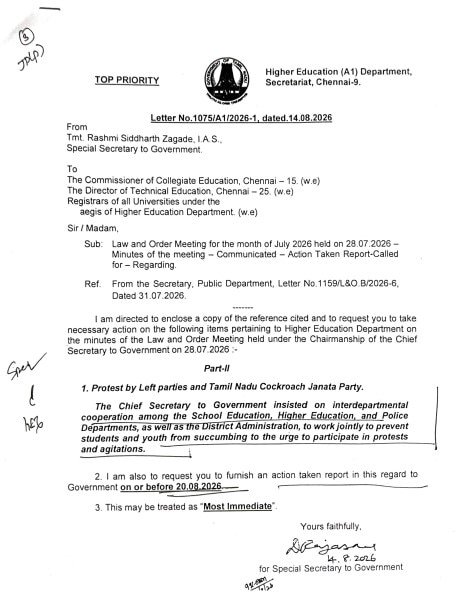
The controversy centres on the government’s attempt to coordinate action across school and higher-education departments.
The directive specifically referred to students and youth taking part in protests associated with Left parties and the CJP. Its wording suggested that educational institutions were expected to play a role in preventing participation.
The instruction also carried a deadline for reporting action taken by schools and colleges. That made the order more than a general warning: it created an administrative expectation that institutions would respond to the government’s direction.
Critics therefore viewed the communication as an attempt to restrict students’ participation in political demonstrations. Supporters of the order argued that educational institutions should not become recruitment grounds for political mobilisation.
The withdrawal means the government has effectively stepped back from that particular administrative approach, at least for now.
The CJP’s growing influence after the Jantar Mantar protests
The controversy cannot be separated from the CJP’s rapid rise during the student protests in Delhi.
The organisation became nationally prominent after spearheading a prolonged agitation at Jantar Mantar over alleged examination irregularities and the handling of student concerns. The movement eventually became a major political issue in the capital.
Union Education Minister Dharmendra Pradhan resigned on July 25 amid the protests. The CJP subsequently called off its Jantar Mantar agitation after the resignation and government assurances concerning some of its other demands. :contentReference[oaicite:0]{index=0}
The scale and visibility of that mobilisation helped transform the CJP from an online youth movement into a national political pressure group.
Its campaign has since expanded beyond the original education dispute. The organisation has been pushing issues involving government schools, student rights and institutional accountability, while its activists have carried the movement into different parts of the country.
That expansion explains why an instruction specifically naming the CJP has attracted attention. The organisation is no longer operating only at a single protest site in Delhi; its activities have increasingly reached state-level education and political debates.
Why the student protest issue is politically sensitive
Students occupy an unusual position in political movements.
They are directly affected by decisions involving examinations, universities, recruitment and education policy. At the same time, schools and colleges have responsibilities concerning academic continuity, discipline and student welfare.
That creates a line that governments must navigate carefully.
A government can legitimately have concerns about violence, disruption or the use of educational institutions for political mobilisation. But a blanket attempt to discourage students from participating in peaceful political activity can trigger concerns about freedom of expression and democratic participation.
The Tamil Nadu controversy illustrates that tension clearly.
The withdrawn order did not merely discuss violence or unlawful activity. It referred broadly to participation in protests and agitations involving particular political organisations. That breadth became one of the reasons critics challenged the directive.
At the same time, the government’s decision to withdraw the communication prevents the dispute from immediately escalating into a prolonged administrative confrontation with schools and colleges.
The political irony involving the Left parties
There is another political dimension to the controversy.
Left parties had extended unconditional outside support to Vijay’s TVK in June to help the government secure the numbers required for government formation, according to the material surrounding the dispute.
The political relationship therefore makes the reference to Left-linked protests particularly striking.
The TVK emerged as the single-largest party in the Tamil Nadu Assembly election but did not secure an outright majority. It consequently relied on support from smaller parties, including the Congress and VCK, to demonstrate its strength on the floor of the House.
The later government directive targeting protests associated with Left organisations therefore placed the administration in an awkward political position.
While outside support for a government does not mean every supporting party must agree with every government policy, the episode illustrates how quickly relationships between political allies and supporters can become complicated when street mobilisation enters the picture.
A separate Tamil Nadu group uses the CJP name
Another point that can easily be missed in the controversy is that the CJP name is not necessarily referring to a single formally registered political organisation in every context.
In June, a group led by lawyer C Brahma Balasubramaniam approached the Election Commission seeking registration for a “Tamil Nadu Cockroach Janata Party” as a regional political organisation.
Balasubramaniam said his organisation was distinct from the CJP movement associated with Abhijeet Dipke. Reports at the time said the Tamil Nadu group was seeking a formal political identity while the better-known CJP movement remained primarily associated with youth activism and protest politics. :contentReference[oaicite:1]{index=1}
That distinction matters because references to “CJP” in political reporting can otherwise create confusion between a formal party registration effort and the youth movement that emerged around the Delhi protests.
From exam protests to a wider youth movement
The CJP’s rise has coincided with a wider wave of youth activism around education and employment issues.
The Delhi protests were initially driven by concerns over examination irregularities. As the mobilisation grew, however, the movement began to address broader questions about accountability, student welfare and the relationship between young people and public institutions.
The resignation of Pradhan gave the movement a major political victory and demonstrated that sustained student mobilisation could generate pressure at the national level. The CJP ended its Delhi protest after the resignation and commitments from the government on additional demands. :contentReference[oaicite:2]{index=2}
The organisation has subsequently continued to warn governments that unresolved demands could trigger further action. That has increased attention on how state governments respond when CJP activists attempt to organise locally.
Gen Z activism is changing the shape of education protests
The current wave of student mobilisation also differs from traditional political movements in the way it spreads.
Social Media allows images of poor school Infrastructure, examination problems and protests to Travel nationally within hours. A local education grievance can therefore become part of a much larger campaign without requiring an established political organisation to build a conventional network first.
The CJP’s Delhi mobilisation demonstrated the potential of this model. Students and young supporters could coordinate around a common issue, attract wider public attention and maintain pressure on political authorities.
The movement has also inspired discussion around Gen Z and, more recently, Gen Alpha participation in education-related activism.
Reports have described children and younger students raising concerns about school facilities in different parts of India. However, these developments should not automatically be treated as a single centrally coordinated movement. Local grievances, social-media trends and organised activism can overlap without being controlled by the same group.
Why the withdrawal matters for Tamil Nadu’s education system
The immediate practical effect of withdrawing the order is that schools and colleges no longer have to act on the specific communication that sought coordinated measures against participation in CJP- and Left-linked protests.
More importantly, the episode sends a political signal.
The government has shown that a directive aimed at discouraging student participation in protests can become politically costly when its wording is perceived as too broad.
For educational institutions, the distinction between maintaining discipline and policing political expression is particularly important. Institutions can enforce rules against violence, property damage or serious disruption without necessarily preventing students from expressing political opinions.
That distinction is likely to remain central as youth-led movements become more visible.
The larger question: Can governments contain student mobilisation?
The Tamil Nadu episode suggests that administrative restrictions may not be the simplest way to deal with a rapidly growing youth movement.
Attempts to prevent participation can sometimes shift attention away from the original issue and toward questions about civil liberties. Instead of debating education policy, political parties may find themselves arguing about whether students are being denied the ability to protest.
For governments, the more durable response may depend on addressing the underlying grievances that bring students into the streets. That does not mean every protest demand is justified or that every demonstration should be permitted without conditions. It does mean that restrictions alone do not resolve the reasons young people become politically active.
The CJP’s own trajectory demonstrates this point. Its original national prominence came from education-related grievances, but the movement has continued to attract attention because it has connected those concerns with broader questions about accountability and public institutions.
What happens next for Vijay and the CJP?
The withdrawal of the order removes the immediate flashpoint, but it is unlikely to end the political debate.
The CJP is likely to treat the reversal as evidence that pressure can force governments to reconsider controversial decisions. The BJP and other critics of the movement, meanwhile, may continue to argue that student activism should not be allowed to disrupt educational institutions or become a vehicle for political mobilisation.
For the Vijay government, the challenge will be to distinguish between legitimate concerns about campus discipline and attempts to control political expression.
The next test could come if the CJP or Left organisations organise new demonstrations in Tamil Nadu. The government’s response, particularly if protests involve schools, colleges or young participants, will show whether the withdrawal represents a broader change in approach or simply the end of one disputed order.
A U-turn that opens a bigger debate
The withdrawal of the Tamil Nadu government’s directive has ended one immediate controversy, but it has opened a larger discussion about students, politics and protest in an era of rapid youth mobilisation.
The CJP’s national rise following the Jantar Mantar agitation has demonstrated the political influence that organised student activism can achieve. Its expansion into education and public-school issues means state governments may increasingly have to respond to the movement at the local level.
For Vijay’s government, withdrawing the August 14 order removes a measure that had drawn criticism from the very groups it sought to discourage. For students, the episode reinforces the importance of the boundary between institutional discipline and political expression.
The central question now is not simply whether the CJP can organise protests in Tamil Nadu. It is whether governments can address legitimate education grievances while ensuring that schools and colleges remain places for learning without turning them into spaces where lawful political expression is unnecessarily restricted.
For breaking news and live news updates, like us on Facebook or follow us on Twitter and Instagram. Read more on Latest India on thefoxdaily.com.






COMMENTS 0