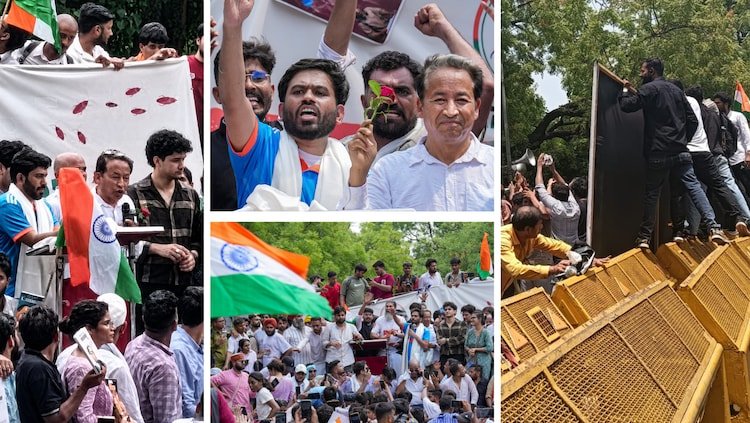
An 83-year-old woman standing under the blazing Delhi sun may have become the most powerful symbol of the Cockroach Janta Party’s (CJP) first major protest at Jantar Mantar. Asked why she had come to a demonstration dominated by students and young job aspirants, her answer was simple yet profound: “All of them are our children.”
Her words captured the deeper significance of a protest that was officially organised to demand the resignation of Union Education Minister Dharmendra Pradhan over examination-related controversies. What unfolded at Jantar Mantar, however, was far bigger than a single political demand. It revealed a growing national frustration among students, parents, researchers, and young professionals who increasingly feel that educational opportunities, recruitment processes, and institutional accountability are becoming matters of uncertainty.
The gathering marked a significant milestone for the Cockroach Janta Party, a movement that emerged online and rapidly evolved into one of the most talked-about youth-driven campaigns in India. While attendance figures may not rival those of established political parties, the event demonstrated something arguably more important: the ability of a digital movement to bring people onto the streets around a common cause.
Who, What, When, Where, Why, and How: Understanding the Protest
The demonstration took place at Jantar Mantar in New Delhi, India’s most recognised venue for democratic protests. Organised by CJP founder Abhijeet Dipke, the event attracted students, competitive exam aspirants, university researchers, working professionals, parents, activists, and supporters from various states.
The primary demand centred on educational accountability, particularly regarding examination irregularities, paper leaks, recruitment delays, and broader concerns about the functioning of educational institutions.
Yet conversations across the protest site revealed that participants were motivated by much more than a single issue. For many, the event became an outlet for accumulated frustrations surrounding unemployment, shrinking opportunities, delayed government recruitments, and declining trust in systems meant to reward merit.
What made the protest particularly notable was how it transformed a digital community into a physical movement. The gathering demonstrated that online activism can still translate into real-world mobilisation when the underlying concerns resonate with a large section of society.
The Rise of a New Kind of Political Mobilisation
Indian Politics has witnessed numerous student movements over the decades, from anti-corruption campaigns to university-led agitations. However, the Cockroach Janta Party represents a distinctly modern phenomenon.
Unlike traditional political organisations built through decades of grassroots expansion, CJP gained visibility primarily through Social Media platforms. Its messaging appealed directly to young people who felt ignored by mainstream political narratives.
This digital-first approach reflects a broader transformation in political engagement. Younger generations increasingly discover, discuss, and organise around issues through online platforms rather than conventional political structures.
However, history shows that online popularity does not automatically translate into sustainable influence. Many viral movements struggle when asked to convert digital engagement into physical participation. The Jantar Mantar Protest therefore served as an important test of the movement’s ability to move beyond social media.
By that measure, the event was largely successful.
A Crowd United by Different Grievances
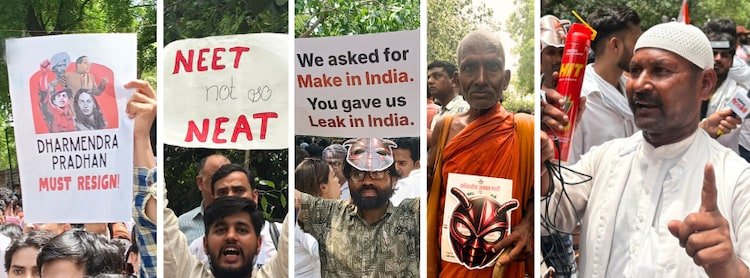
One of the most striking aspects of the protest was the diversity of people present.
Among the participants were:
- School and college students
- Competitive examination aspirants
- Research scholars and PhD candidates
- Private-sector employees
- Unemployed graduates
- Parents and grandparents
- Artists and social activists
Many attendees shared personal stories that reflected broader national concerns. Some worried about examination transparency. Others spoke about delayed recruitment processes. Several expressed frustration about investing years in education only to face uncertain employment prospects.
These stories highlighted a reality often overlooked in policy debates: educational challenges affect entire families, not just individual students.
Parents increasingly view educational uncertainty as a threat to economic Security, social mobility, and future opportunities for their children.
Why Education Has Become a National Political Issue
Education has traditionally been viewed as the most reliable path to advancement in India. Families across economic backgrounds invest heavily in schooling, coaching, higher education, and competitive examinations.
As a result, any disruption in educational systems generates widespread concern.
India currently possesses one of the world’s largest youth populations. Millions compete annually for university admissions, government jobs, and professional opportunities. Even minor irregularities can affect enormous numbers of candidates.
The issue becomes even more significant when viewed alongside employment challenges. For many young Indians, competitive examinations are not merely tests but gateways to economic stability and social progress.
When trust in those gateways weakens, public frustration inevitably rises.
The Jantar Mantar protest reflected precisely that sentiment.
Abhijeet Dipke’s Leadership and the Challenges Ahead
Abhijeet Dipke deserves credit for building a movement capable of attracting significant public attention in a relatively short period.
Throughout the day, supporters sought photographs with him, listened to his speeches, and echoed his calls for accountability. His ability to connect with young audiences has undoubtedly been central to the movement’s rapid growth.
At the same time, the protest revealed the organisational challenges facing emerging grassroots movements.
Observers noted difficulties with sound systems, stage arrangements, and crowd management during the early hours of the event. Much of the infrastructure appeared improvised, reflecting both the enthusiasm and limitations of a rapidly expanding movement.
These challenges are not unusual. Many successful political and social movements begin with passion and public support before gradually developing the structures necessary for long-term sustainability.
For CJP, the next phase will likely require stronger organisational frameworks, clearer policy positions, and a strategy extending beyond protest mobilisation.
The Sonam Wangchuk Moment
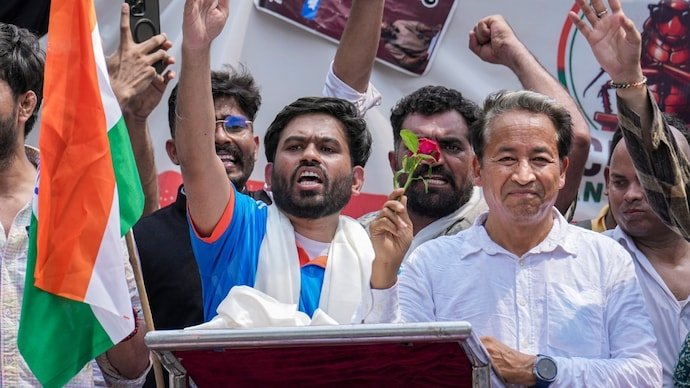
If Dipke brought people to Jantar Mantar, educator and activist Sonam Wangchuk arguably transformed the atmosphere.
Before his arrival, the venue felt fragmented. Multiple groups conducted their own activities, slogans echoed from different corners, and attention remained scattered.
That changed when Wangchuk took the stage.
Participants who had been moving around the venue suddenly focused on a single speaker. His remarks resonated because they moved beyond immediate political demands and addressed structural questions about accountability.
Rather than framing the gathering purely as a protest, Wangchuk described it as an “aagrah” — an earnest appeal for change.
This distinction mattered because it positioned the movement as seeking reform rather than confrontation.
His proposal that the children of elected representatives should study in government-run schools and colleges generated particular discussion. The idea reflected a broader argument that policymakers should share a direct stake in the systems they oversee.
Whether practical or not, the suggestion captured public attention because it touched upon longstanding debates regarding accountability and Governance.
The Symbolism Behind the Cockroach Identity
Political movements often succeed through symbols as much as policies.
The Cockroach Janta Party has embraced an identity that intentionally challenges conventional political branding. Protesters wore cockroach masks, carried constitutional texts, displayed portraits of social reformers, and waved the national flag.
The symbolism conveyed several messages simultaneously:
- Resistance against marginalisation
- Persistence despite criticism
- Commitment to democratic rights
- Focus on accountability and reform
- Solidarity among ordinary citizens
Such symbolism helps movements create emotional connections with supporters while distinguishing themselves from established political organisations.
What the Protest Revealed About India’s Youth
Perhaps the most important lesson from Jantar Mantar had little to do with political personalities.
The protest highlighted the emotional and economic pressures facing many young Indians.
Across conversations, several themes emerged repeatedly:
- Fear of losing opportunities due to administrative failures
- Growing uncertainty about career prospects
- Frustration with recruitment delays
- Demand for transparent systems
- Desire for institutional accountability
These concerns are not confined to one state, examination, or profession. They represent broader challenges associated with educating and employing one of the world’s largest youth populations.
The significance of the protest therefore lies not only in its demands but also in what it revealed about public sentiment.
How the Movement Differs from Traditional Politics
| Feature | Traditional Political Movements | Cockroach Janta Party Movement |
|---|---|---|
| Origin | Established party structures | Social media-driven mobilisation |
| Core Support Base | Party workers and voters | Students, youth, parents and professionals |
| Primary Focus | Electoral outcomes | Accountability and institutional reform |
| Organisation Style | Hierarchical | Volunteer-oriented |
| Growth Model | Grassroots expansion | Digital-first expansion |
This distinction helps explain why political observers are paying attention despite the movement’s relatively recent emergence.
What Comes Next for the Cockroach Janta Party?
The success of the Jantar Mantar gathering creates new expectations for the movement.
Supporters now expect sustained action, policy proposals, and continued advocacy. Critics will question whether the movement can maintain momentum after its initial surge of popularity.
Its future may depend on several factors:
- Ability to expand beyond symbolic protests
- Development of concrete policy recommendations
- Creation of stronger organisational structures
- Maintenance of peaceful mobilisation
- Expansion into wider governance and youth-related issues
If successful, the movement could become a significant voice in debates surrounding education and employment. If not, it risks becoming another short-lived expression of public frustration.
Conclusion: A Protest That Reflected a Generation’s Concerns
The Cockroach Janta Party’s first major protest at Jantar Mantar was more than a demonstration demanding the resignation of a minister. It became a visible expression of concerns shared by students, parents, researchers, and young professionals across India.
The event demonstrated the growing political importance of education, employment, and institutional accountability. It also showed that digital movements can still mobilise people in significant numbers when they speak to genuine public anxieties.
Whether the Cockroach Janta Party evolves into a lasting political force remains uncertain. What is certain is that the frustrations voiced at Jantar Mantar are unlikely to disappear anytime soon. As India continues navigating the challenges of educating and employing its vast youth population, movements centred on accountability, opportunity, and trust in institutions may become increasingly influential in shaping the national conversation.
For breaking news and live news updates, like us on Facebook or follow us on Twitter and Instagram. Read more on Latest India on thefoxdaily.com.






COMMENTS 0