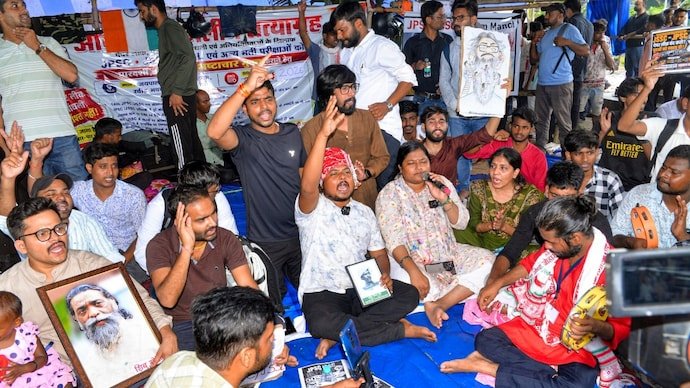
A protest over alleged irregularities in Jharkhand‘s recruitment examinations entered its 14th day on Friday, with the Health of hunger-striking students becoming a major concern after student leader Rahul Kranti was hospitalised in Ranchi.
Kranti, one of six protesters who began a hunger strike earlier this week, was taken to Ranchi Sadar Hospital after his health deteriorated. The protesters are demanding cancellation of the 14th Jharkhand Public Service Commission (JPSC) Civil Services Examination, an independent Investigation into alleged irregularities and broader reforms in the state’s recruitment system.
The escalation comes while the Jharkhand Assembly is in session. Two student organisations have announced a march towards the Assembly, increasing pressure on the state government to respond to the demands.
Why was Rahul Kranti hospitalised?
Rahul Kranti had been refusing food since Tuesday night as part of the hunger strike against the alleged irregularities in recruitment examinations in Jharkhand.
His condition deteriorated on Friday, prompting authorities to take him to Ranchi Sadar Hospital in an ambulance. Kranti is among six protesters who joined the hunger strike, with the group including two women.
Before being taken to hospital, Kranti said protesters had requested a health check-up at the demonstration site. According to him, doctors had not arrived at the site by 8.30 am on Friday.
The hospitalisation has added a health emergency to an already politically sensitive protest. Hunger strikes can place significant physical stress on the body, particularly when they continue for several days, making medical monitoring an important concern for protesters and authorities.
What are the JPSC protesters demanding?
The protesters have focused their campaign on three major demands.
- Cancellation of the 14th Jharkhand PSC Civil Services Examination.
- An independent investigation into alleged irregularities in the recruitment examination.
- Comprehensive reforms in Jharkhand’s recruitment bodies, including the JPSC and Jharkhand Staff Selection Commission (JSSC).
The protesters have also proposed two possible mechanisms for an independent investigation: an inquiry by the Central Bureau of Investigation (CBI) or an investigation by a panel of retired high court judges from outside Jharkhand.
The demands reflect a broader concern about confidence in competitive government recruitment examinations. For candidates who spend years preparing for civil services and other government jobs, allegations of irregularities can raise questions not only about one examination but also about the credibility of the recruitment process itself.
Why the 14th JPSC Civil Services Examination is at the centre of the protest
The 14th JPSC Civil Services Examination is a state-level recruitment examination through which candidates compete for positions in Jharkhand’s civil services.
The current agitation is not simply about examination results or individual candidates. Protesters are alleging irregularities serious enough to warrant cancellation of the examination and an independent investigation.
Those allegations remain allegations unless established through an official inquiry or other credible evidence. That distinction is important because an examination cannot reasonably be cancelled solely on the basis of claims without determining what happened, how widespread any irregularities were and whether they affected the fairness of the process.
The protesters, however, argue that an independent investigation is necessary precisely to establish those facts.
Protest enters Day 14 as Assembly march is announced
The agitation has continued for two weeks, and the announcement of a march towards the Jharkhand Assembly marks a new phase of the campaign.
The timing is significant because the Assembly is currently in session, giving student groups an opportunity to bring their demands directly into the political arena.
Student organisations frequently use Assembly sessions to increase pressure on governments because elected representatives are present and opposition parties can raise public issues inside the House.
The proposed march could therefore turn the examination dispute into a broader political confrontation, particularly if the government does not provide a response that satisfies the protesters.
Babulal Marandi meets protesting students in hospital
Leader of Opposition Babulal Marandi visited Ranchi Sadar Hospital after Kranti was admitted. He met Kranti and another protesting student, Brajkishor, and asked doctors and the civil surgeon about their health and treatment.
Marandi subsequently criticised the state government over its handling of the protest.
“I told the students under treatment that they should not sacrifice their lives just yet because of this obstinate government. They have a long battle ahead of them.”
Other BJP leaders, including Jharkhand Assembly chief whip Naveen Jaiswal, Dhanbad MLA Raj Sinha and BJP vice-president Bhanu Pratap Shahi, also visited the hospital.
The visits show how the health of the hunger strikers has become an important political issue alongside the original examination-related demands.
Jharkhand Health Minister visits Ranchi Sadar Hospital
Health Minister Irfan Ansari also visited the hospital and met a student undergoing treatment.
Ansari said he had visited the hospital on the instructions of Chief Minister Hemant Soren and had sought details from doctors about Kranti’s treatment.
“They are our children. Their safety and health are our top priority. They are being provided with proper medical care, supported by a full medical team.”
The government’s emphasis on medical treatment represents a shift in the immediate focus of the dispute. While the protesters are demanding action on the recruitment examination, authorities must also deal with the physical consequences of the hunger strike.
Whether the government’s intervention extends beyond medical care and addresses the protesters’ substantive demands remains the central political question.
Six students are on hunger strike
The hunger strike began on Tuesday night when five protesters joined Jharkhand Loktantrik Krantikari Morcha leader Devendra Nath Mahto.
Mahto had already been fasting for six days by Friday, while the other protesters had been participating for a shorter period.
The group includes two women, making the protest broader than a single student leader’s campaign.
Hunger strikes are intended to create moral and political pressure by placing the protesters’ own health at risk. But as the duration increases, the medical consequences can become more serious, which is why the hospitalisation of Kranti has raised the stakes.
Sonam Wangchuk urged Mahto to drink water
The hunger strike has also attracted attention beyond Jharkhand.
Social activist Sonam Wangchuk spoke to Mahto by telephone on Wednesday and urged him to at least drink water. Following the conversation, Mahto began taking water.
That development allowed the protest to continue while reducing at least one immediate concern associated with complete refusal of fluids.
However, taking water does not remove the health risks associated with prolonged fasting, particularly when a protest continues for several days. The hospitalisation of another protester demonstrates how quickly the health dimension can become critical.
What is being alleged about the recruitment examinations?
The protesters allege that there were irregularities in Jharkhand’s recruitment examination system and argue that the issue requires an investigation independent of the agencies responsible for conducting recruitment.
The precise allegations and their evidentiary basis will be important in determining the next steps. An independent investigation could examine whether examination procedures were followed, whether candidates were treated equally and whether any irregularities materially affected the examination’s integrity.
The demand for an outside panel of retired high court judges reflects the protesters’ desire for an investigation that they believe would be insulated from the state’s existing administrative and recruitment structures.
The alternative demand for a CBI investigation would place the matter before India‘s central investigative agency.
Neither demand, however, should be treated as proof that irregularities occurred. The purpose of an investigation would be to establish the facts.
Why recruitment exam disputes matter in Jharkhand
Government recruitment examinations have an importance that goes beyond the candidates who sit for them.
For thousands of young people, public-sector employment represents a highly competitive route to a stable career. Candidates often spend years preparing for examinations, paying for coaching, study materials and Travel while waiting for recruitment cycles.
That makes confidence in the examination process essential.
If candidates believe that an examination has been compromised, the damage can extend beyond the disputed test. It can weaken confidence in the recruitment institution itself and encourage further Protests, litigation and demands for procedural changes.
That is why allegations of irregularities typically raise three separate questions: what happened, whether the alleged problem affected the outcome, and what safeguards should be introduced to prevent a repeat.
Why protesters want reforms in JPSC and JSSC
The protesters are seeking broader reforms in both the Jharkhand Public Service Commission and the Jharkhand Staff Selection Commission.
The demand suggests that they view the current dispute as part of a wider problem rather than an isolated examination issue.
Recruitment bodies need procedures that candidates can understand and trust. That includes clear examination rules, transparent handling of complaints, consistent communication and mechanisms for investigating allegations.
For the government, the challenge is to respond to legitimate concerns without undermining the recruitment process itself. Any reform should ideally address specific weaknesses identified through evidence rather than rely solely on political pressure.
What could happen next?
The next stage of the dispute is likely to depend on three developments: the health of the hunger strikers, the proposed march towards the Assembly and the government’s response to the demand for an independent investigation.
The hospitalisation of Kranti may increase pressure on the administration to engage directly with the protesters. Political leaders from both the opposition and government have already visited the hospital, indicating that the issue has moved beyond a student demonstration and into the state’s wider political debate.
If the Assembly march goes ahead, the protest could receive greater visibility during the ongoing legislative session.
At the same time, the government may face pressure to clarify its position on the 14th JPSC examination. Any decision to cancel an examination, order an inquiry or introduce reforms would have consequences for thousands of candidates and the credibility of the recruitment system.
The key issue is trust in the recruitment process
The immediate story is about a hunger strike that has entered a critical phase. But the deeper issue is trust.
Students demanding cancellation of the 14th JPSC Civil Services Examination want authorities to address what they describe as serious irregularities. They are also asking for an investigation conducted independently of the state recruitment machinery and for structural reforms in JPSC and JSSC.
The government, meanwhile, has a responsibility to ensure that the health of protesters is protected while responding to the allegations through an evidence-based process.
Whether the claims ultimately lead to cancellation of the examination will depend on the findings of competent authorities. But the longer the protest continues, particularly as hunger strikers begin requiring hospital treatment, the greater the pressure on the government to provide a credible response.
For Jharkhand’s students, the outcome could extend beyond one recruitment examination. A transparent resolution could help restore confidence in the state’s competitive examination system. A prolonged dispute without a convincing explanation could deepen distrust among candidates who depend on these institutions for a fair opportunity to enter public service.
For breaking news and live news updates, like us on Facebook or follow us on Twitter and Instagram. Read more on Latest India on thefoxdaily.com.




COMMENTS 0