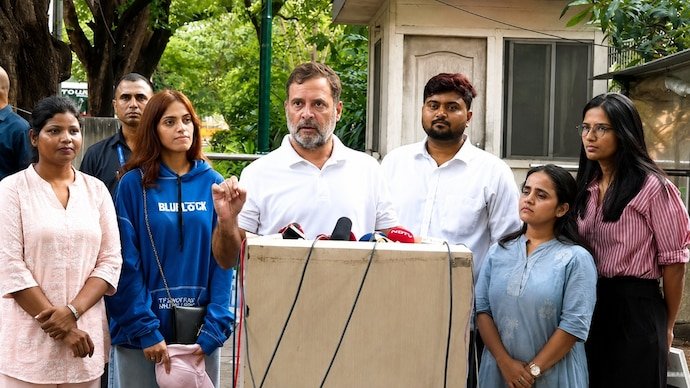
Congress leader Rahul Gandhi’s interaction with students who participated in the recently concluded Jantar Mantar protest has sparked political debate, as it came at a time when a separate student agitation over recruitment examination irregularities continues in Jharkhand. While Gandhi praised students who protested against alleged irregularities in the education system and criticised the BJP-led Central government, he did not comment on the ongoing protests in Ranchi, where demonstrators are demanding action from the Jharkhand government, of which the Congress is a coalition partner.
Rahul Gandhi Meets Students from the Jantar Mantar Protest
On Wednesday, Rahul Gandhi, the Leader of Opposition in the Lok Sabha, met five students at his New Delhi residence who had participated in the Student Protest held at Jantar Mantar.
The Delhi demonstration had focused on allegations surrounding the NEET-UG question paper leak and broader concerns about fairness and transparency in India‘s education system.
According to the source material, the protest concluded on July 26 after Union Education Minister Dharmendra Pradhan resigned a day earlier, which the organisers regarded as fulfilling their principal demand.
During the interaction, Gandhi praised the students for what he described as their courage in raising issues affecting young people.
“These people fought for the Constitution and the education system of India. They didn’t attack anyone. They were lathi-charged,” Rahul Gandhi said during the interaction.
He also told the students that they had nothing to apologise for and described it as the responsibility of political leaders to stand by them.
Political Criticism Directed at the BJP
Rahul Gandhi used the meeting to criticise the BJP leadership, arguing that students had shown greater willingness to publicly defend their views.
“These young people dare to stand before India’s media. But Home Minister Amit Shah and the prime minister don’t dare to stand here,” Gandhi said.
The remarks formed part of the Congress leader’s broader criticism of the Central government regarding education-related issues.
Who Attended the Meeting?
The students accompanying Rahul Gandhi represented different states and had participated in the Delhi protest organised by the Cockroach Janta Party (CJP).
According to the supplied material, those present included:
- Rhiya Ahir from Mumbai.
- Nutan Toppo from Jharkhand.
- Farah Naaz from Uttar Pradesh.
- Bharat Banait from Nagpur.
- Muskan, another participant in the Delhi protest.
Several of these individuals had gained public attention during the demonstrations in New Delhi.
Meanwhile, Student Protests Continue in Jharkhand
While the Delhi protest has concluded, student demonstrations continue in Ranchi.
Thousands of students have been protesting since July 25 over alleged irregularities in the 14th Jharkhand Public Service Commission (JPSC) examination and concerns regarding the functioning of the Jharkhand Staff Selection Commission (JSSC).
The movement has become one of the most prominent political issues in the state in recent weeks.
Unlike the Delhi protest, which centred on alleged irregularities in national entrance examinations, the Ranchi demonstrations focus on state-level recruitment examinations and recruitment processes.
What Are the Jharkhand Protesters Demanding?
According to the source material, the protesters have raised several demands.
- Cancellation of the disputed examination.
- Structural reforms in the Jharkhand Public Service Commission and Jharkhand Staff Selection Commission.
- An independent investigation by the Central Bureau of Investigation (CBI) or a panel of retired High Court judges from outside Jharkhand.
The demonstrators argue that these measures are necessary to restore confidence in the state’s recruitment process.
Why Rahul Gandhi’s Silence Has Become a Political Issue
The source material argues that Rahul Gandhi did not comment on the Ranchi agitation despite Congress being a coalition partner in the Jharkhand Mukti Morcha (JMM)-led government headed by Chief Minister Hemant Soren.
This contrast has become the basis of political criticism.
Opponents contend that while Gandhi highlighted student concerns directed at the BJP-led Central government, he did not publicly address allegations being raised against a state government in which his own party participates.
Whether such criticism gains wider political traction will depend on future responses from the Congress leadership and developments in Jharkhand.
Support for the Ranchi Agitation Continues to Grow
The student movement in Ranchi has continued beyond demonstrations.
According to the supplied material, Jharkhand Loktantrik Krantikari Morcha (JLKM) leader Devendra Nath Mahto has undertaken a hunger strike in support of the protesters.
The report also states that additional participants joined the hunger strike and that organisers are considering a Tiranga March to broaden public support.
These developments suggest that the movement remains active and continues to evolve.
Understanding the Difference Between the Two Student Movements
Although both protests concern examinations and opportunities for young people, they focus on different institutions and levels of government.
| Issue | Delhi Protest | Jharkhand Protest |
|---|---|---|
| Main concern | NEET-UG paper leak and education system issues | JPSC and JSSC recruitment examination irregularities |
| Primary target | Central government | Jharkhand state government |
| Status | Concluded on July 26, according to the source material | Continuing demonstrations in Ranchi |
| Key demands | Action over examination irregularities | Exam cancellation, reforms and an independent investigation |
Why Recruitment Examination Transparency Matters
Recruitment examinations conducted by public service commissions play a significant role in filling government positions.
Any allegations concerning examination integrity can affect public confidence, particularly among young people preparing for competitive examinations over several years.
Similarly, entrance examinations and recruitment tests are often viewed as gateways to education and public employment, making transparency an issue that attracts considerable public attention regardless of which government is in office.
Political Context Behind the Debate
The discussion surrounding Rahul Gandhi’s comments has unfolded within a broader political context.
As Leader of the Opposition, Gandhi has frequently criticised the Central government over issues affecting students, employment and educational institutions.
At the same time, Congress shares power in several state governments through coalition arrangements, creating situations where similar issues may arise under governments in which the party participates.
Such circumstances often invite comparisons regarding how political leaders respond to similar concerns depending on the level of government involved.
Confirmed Facts and Political Interpretation
Several aspects of the story are clearly established.
- Rahul Gandhi met students who participated in the Delhi protest.
- He praised their activism and criticised the BJP leadership.
- Student protests concerning JPSC and JSSC examination issues continue in Ranchi.
- The source material states that Gandhi did not comment on the ongoing Jharkhand agitation during his interaction.
However, whether his silence reflects a political strategy or another consideration is a matter of political interpretation rather than an established fact.
What Could Happen Next?
The immediate direction of the story will depend on developments in Jharkhand.
If the Ranchi protests continue or expand, political
For breaking news and live news updates, like us on Facebook or follow us on Twitter and Instagram. Read more on Latest India on thefoxdaily.com.





COMMENTS 0