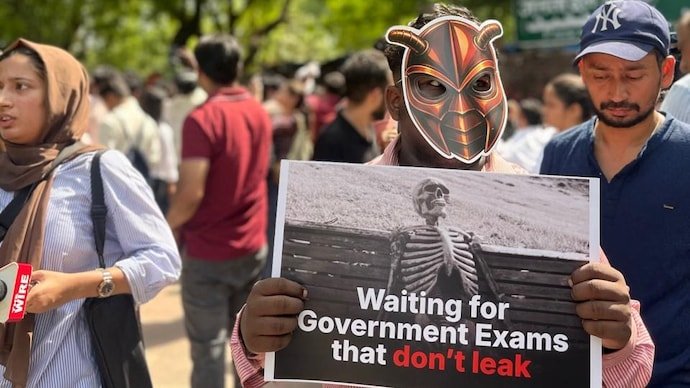
The first major public demonstration organized by the Cockroach Janta Party (CJP) at Delhi’s Jantar Mantar was intended to spotlight alleged failures in India‘s Education system. However, as students, parents, activists, content creators, and political observers gathered under the scorching June heat, the protest revealed something far more significant: a growing crisis of confidence among young Indians who believe that examination systems, evaluation mechanisms, and educational institutions are increasingly failing them.
While the protest featured political speeches, demands for ministerial accountability, and support from prominent public figures, the most powerful voices came from ordinary students and parents whose stories reflected widespread anxiety about fairness, transparency, and opportunity.
For many attendees, the issue extended beyond a single exam Controversy or administrative error. Instead, it reflected deeper concerns about whether hard work and merit can still guarantee success in a system increasingly perceived as vulnerable to mistakes, leaks, glitches, and uncertainty.
Why the CJP Protest Resonated With Students
The crowd that gathered at Jantar Mantar was diverse. Some came because of alleged irregularities in national entrance examinations. Others arrived frustrated by concerns surrounding CBSE’s On-Screen Marking (OSM) evaluation system.
Although the protest centered around demands for accountability from education authorities, conversations among participants revealed a broader concern: trust.
Students invest years preparing for competitive examinations that often determine access to higher education, scholarships, and career opportunities. When controversies emerge around exam leaks, evaluation errors, or technical failures, students often feel that factors beyond their control are influencing outcomes.
For many young participants, the protest represented an attempt to reclaim their voice in decisions that directly affect their futures.
The CBSE On-Screen Marking Debate Explained
One of the major grievances highlighted during the protest involved the CBSE’s On-Screen Marking system.
Digital evaluation systems are increasingly being adopted across the world because they promise faster processing, greater efficiency, and improved record management. However, transitions to new technologies often create challenges if implementation is not accompanied by extensive testing and stakeholder training.
Students and parents attending the protest argued that the system had generated concerns regarding answer sheet evaluation, missing pages, and limitations in the review process.
The issue highlights a larger challenge facing educational institutions worldwide: balancing technological innovation with reliability and transparency.
While digital systems can reduce certain human errors, they also introduce new risks that must be carefully managed through audits, quality controls, and continuous monitoring.
How Examination Integrity Has Become a National Concern
The protest also reflected widespread concern regarding examination Security, particularly after recent controversies involving entrance tests.
Competitive examinations occupy a uniquely important place in India’s educational ecosystem. Every year, millions of students compete for a limited number of seats in prestigious universities, professional colleges, and government institutions.
As competition intensifies, public confidence in examination integrity becomes increasingly important.
When allegations of paper leaks emerge, students often fear that years of preparation could be undermined by factors unrelated to academic performance.
This explains why exam controversies frequently trigger strong emotional responses from students, parents, and educators alike.
The Human Stories Behind the Headlines
Perhaps the most revealing aspect of the protest was the personal stories shared by participants.
For students, examination results are rarely just numbers on a marksheet. They influence university admissions, scholarship opportunities, career pathways, and personal aspirations.
A difference of only a few marks can determine admission outcomes at highly competitive institutions.
This reality explains why concerns about evaluation systems generate such strong reactions.
Parents attending the protest expressed similar frustrations. Many described investing years of emotional, financial, and personal support into their children’s education.
When controversies arise, families often feel powerless against large bureaucratic systems that appear difficult to challenge or understand.
Generation Z and the Rise of Education Activism
The protest highlighted an emerging trend in Indian public life: the growing political engagement of Generation Z around education-related issues.
Unlike previous generations, today’s students have unprecedented access to information, Social Media platforms, and digital communities.
As a result, concerns that might once have remained isolated now spread rapidly across online networks.
Students can organize campaigns, share experiences, analyze policies, and mobilize support within hours.
This digital connectivity has transformed educational grievances into significant public issues capable of influencing political discourse.
The CJP protest demonstrated how student concerns can evolve into broader conversations about Governance, transparency, and institutional accountability.
The Influence of Social Media and Content Creators
One of the most unusual aspects of the protest was the large presence of content creators, YouTubers, and social media influencers.
Their participation reflected the changing nature of modern activism.
Political movements today often unfold simultaneously in physical and digital spaces. A protest is no longer limited to those physically present; millions can engage through videos, livestreams, commentary, and social media posts.
However, this creates both opportunities and challenges.
While content creators can amplify important issues and attract public attention, critics argue that the pursuit of views and engagement can sometimes overshadow the concerns of actual participants.
The protest illustrated this tension between genuine activism and digital spectacle.
Accountability Becomes the Central Theme
Although the protest addressed multiple issues, accountability emerged as its unifying theme.
Participants repeatedly emphasized that they wanted answers from policymakers, examination authorities, and educational institutions.
The demand for accountability reflects a broader societal shift.
Citizens increasingly expect transparency regarding decisions that affect their lives. Educational institutions are no exception.
Students and parents want clear communication regarding examination processes, evaluation standards, grievance mechanisms, and corrective actions when mistakes occur.
In the absence of transparency, public trust becomes difficult to maintain.
The Political Dimension of the Protest
The protest also revealed emerging political divisions regarding student movements and education reform.
Different political parties responded in different ways, reflecting broader ideological and strategic calculations.
Some political actors viewed the protest as a legitimate expression of public frustration. Others questioned aspects of its organization and political positioning.
This divergence highlights how education has become an increasingly important political issue.
Young voters represent a significant demographic group, and concerns related to employment, examinations, skill development, and higher education often influence political debates.
As a result, student movements frequently attract attention from parties seeking to connect with younger generations.
India’s Education System at a Crossroads
The issues raised during the protest point toward broader challenges facing India’s Education System.
The country has made significant progress in expanding educational access and increasing enrollment levels. However, rapid growth also creates pressures related to quality assurance, examination management, infrastructure, and governance.
Several challenges continue to dominate discussions:
- Examination security and integrity.
- Evaluation transparency.
- Digital transformation of assessment systems.
- Student grievance redressal mechanisms.
- Mental health pressures linked to competitive exams.
- Access to higher education opportunities.
Addressing these issues will require sustained reforms rather than short-term responses to individual controversies.
How India Compares Globally
| Challenge | India | Global Trend |
|---|---|---|
| Digital Evaluation Systems | Rapid adoption | Increasing adoption worldwide |
| Exam Security Concerns | Growing scrutiny | Common concern globally |
| Student Activism | Rising participation | Growing among younger generations |
| Technology Integration | Expanding rapidly | Major education priority |
| Transparency Demands | Increasing | Increasing globally |
The comparison shows that many of the issues highlighted by protesters are not unique to India. Educational systems worldwide are grappling with similar questions about technology, fairness, accountability, and student trust.
A Bigger Issue Than Any Single Protest
The significance of the CJP protest may ultimately extend beyond its immediate political demands.
The gathering demonstrated that concerns about education can unite students, parents, activists, and citizens across different backgrounds.
What made the event noteworthy was not merely the speeches delivered from the stage but the stories shared among attendees.
These stories revealed a generation increasingly unwilling to remain silent when institutions fail to meet expectations.
Whether or not the protest achieves its specific objectives, it has already highlighted a broader reality: educational accountability is becoming a major public issue.
Conclusion
The Cockroach Janta Party’s first protest at Jantar Mantar exposed a level of frustration that extends far beyond any single examination controversy. From concerns over the CBSE On-Screen Marking system to fears surrounding examination integrity, students and parents used the event to express growing anxiety about the reliability of educational institutions and processes.
The protest also reflected larger trends shaping modern India, including the rise of digitally connected youth activism, increasing demands for transparency, and the growing political importance of education policy.
At its core, the demonstration was not simply about marks, answer sheets, or administrative decisions. It was about trust. For millions of students whose futures depend on educational systems functioning fairly and transparently, rebuilding that trust may become one of the most important challenges facing policymakers in the years ahead.
For breaking news and live news updates, like us on Facebook or follow us on Twitter and Instagram. Read more on Latest India on thefoxdaily.com.






COMMENTS 0