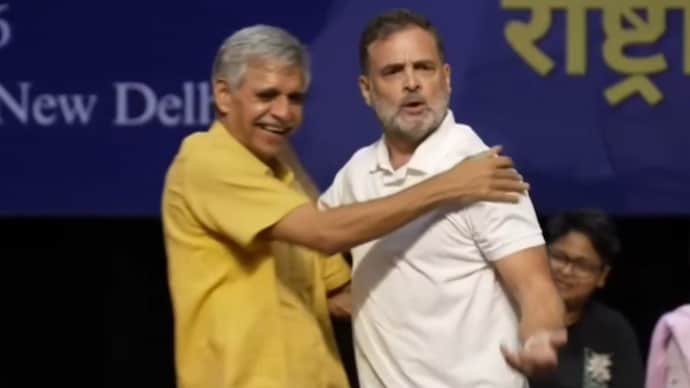
Congress leader Rahul Gandhi turned a political criticism into a moment of humour on Thursday when he hugged party leader Sandeep Dikshit on stage and sarcastically described the gesture as an example of what he called Prime Minister Narendra Modi’s approach to foreign policy.
Speaking at the Rachnatmak Congress national convention, Gandhi took aim at Modi’s well-known public embraces with international leaders, including Italian Prime Minister Giorgia Meloni. He questioned the idea that such personal gestures should be treated as an important part of Diplomacy before demonstrating the point himself with an embrace of Dikshit.
“I don’t know where he got this idea from. Strange ideas get into people’s heads. He thinks this is foreign policy,” Gandhi said before hugging Dikshit.
Dikshit immediately extended the joke, asking Gandhi whether he had been hugging him while imagining that he was Meloni. Gandhi responded, “I haven’t reached that stage yet,” prompting laughter from the gathering.
The exchange provided a lighter moment during a speech that otherwise featured sharp criticism of the BJP, the Rashtriya Swayamsevak Sangh and the government’s political approach. Gandhi also accused the RSS of having changed its character and alleged that it had become increasingly aligned with large business interests.
Rahul Gandhi’s Meloni joke targets Modi’s diplomatic image
The reference to Meloni was aimed at a recurring feature of Modi’s international public appearances: his highly visible personal interactions with foreign leaders.
Modi’s public meetings with Meloni have attracted considerable attention in India, particularly because photographs and videos of the two leaders greeting or embracing each other have frequently circulated online.
Gandhi used that familiarity to construct a political joke. Rather than directly discussing the substance of India’s relations with Italy or another country, he focused on the optics of political leadership and questioned whether personal gestures could be treated as foreign policy.
The decision to demonstrate the joke by embracing another Congress leader made the criticism theatrical as well as verbal.
Dikshit’s response then gave Gandhi an opening for the Meloni reference, turning what could have been a conventional political attack into an exchange designed to generate laughter from the audience.
The episode also illustrates how political communication increasingly blends policy criticism with moments intended to Travel easily through video clips and social media.
From humour to a broader attack on BJP and RSS
After the exchange over Modi and Meloni, Gandhi shifted to a much more serious political argument.
He described the BJP and RSS in highly critical terms, calling them a “bunch of jokers” and “clowns” and accusing them of failing to understand India’s history, culture and contemporary reality.
Gandhi framed the wider political contest as a disagreement over how India should be governed and how citizens should be allowed to express themselves.
According to Gandhi, the RSS-BJP approach was focused on imposing an order that benefits particular interests, while the Congress vision was based on allowing India to express itself.
He used student protests at Jantar Mantar as an example of what he described as this larger conflict.
“The students wanted to express themselves, but the government stated that ‘we want order and you cannot express yourselves’,” he said.
Gandhi argued that the political struggle was therefore not simply between two parties. In his framing, it was between those seeking to impose an order on society and those who want individuals and communities to express themselves freely.
What Rahul Gandhi said about the RSS
Gandhi also directed some of his strongest criticism at the RSS, arguing that the organisation had changed significantly from what he described as its earlier character.
He claimed that the RSS had been “captured and utilised by large capital” and specifically named industrialists Gautam Adani and Mukesh Ambani while making the allegation.
Gandhi further alleged that the RSS had become an instrument of large business interests and said Prime Minister Modi was serving those interests.
These were political allegations made by Gandhi during his speech and were part of his broader criticism of the BJP-RSS relationship with major business groups.
He argued that the RSS originally represented sections of India’s small-business community but had changed over time.
Gandhi connected this argument to demonetisation, alleging that the RSS had contributed to policies that harmed small businesses.
The criticism reflects a recurring Congress argument that the Modi government’s economic policies have favoured large corporations at the expense of smaller enterprises. Gandhi used the issue to support his broader claim that the political character of the RSS has changed.
Gandhi says Modi and Amit Shah will be kept ‘awake’
The Congress leader also promised to maintain political pressure on Prime Minister Modi and Union Home Minister Amit Shah.
Gandhi said the opposition would continue its campaign until Modi and Shah resigned, using the language of keeping the two leaders “awake”.
“Till the day PM Modi and Amit Shah don’t give their resignations, they will not be able to sleep. We will keep them awake,” he said.
The remark was both a political challenge and a continuation of the speech’s recurring theme of resistance. Earlier, Gandhi had argued that the Congress should challenge what he described as attempts to impose political and social order on citizens.
He also stressed that the Congress campaign would not be based on violence or hatred.
“We will do it without hate, violence. We are fighting for our culture. Our country is not about hate but about love, brotherhood and ahimsa,” Gandhi said.
Gandhi’s argument about ‘expression’ and India
A central theme of Gandhi’s speech was the idea of India as a society whose character cannot be reduced to a single political or ideological framework.
He argued that understanding India requires more than looking at its distant history. According to Gandhi, India must also be understood through the way its people express themselves in the present.
“You cannot understand India 3,000 years ago, you have to understand India today. To understand it today you have to understand its expression,” he said.
That argument formed the philosophical basis for his criticism of the RSS-BJP approach.
Gandhi suggested that attempts to construct a fixed political order would eventually face resistance from the diverse ways in which Indians express themselves.
He said that even if the RSS attempted to create its own “little order”, India’s broader expression would eventually challenge and break it.
Why the hug became the most viral moment
Despite the speech covering several political issues, the exchange between Gandhi and Dikshit was likely to attract the most immediate attention because of its simplicity.
The sequence was easy to understand: Gandhi criticised Modi’s approach to foreign policy, hugged a fellow Congress leader, and then received a joke about Meloni.
That made the moment particularly suitable for short video clips and social media posts.
Political speeches often contain lengthy arguments about economic policy, institutions, ideology and governance. A brief joke, however, can become the most memorable part of an event because it requires little context to understand.
Gandhi’s reference also relied on something already familiar to political audiences: Modi’s highly publicised interactions with foreign leaders.
By turning that visual image into a staged joke, Gandhi transformed an abstract criticism of diplomatic optics into something the audience could immediately see.
The politics behind Gandhi’s foreign policy criticism
Gandhi’s comment was not an assessment of India’s entire foreign-policy framework. It was a political criticism of the importance given to personal leadership and public symbolism in international diplomacy.
Modern diplomacy frequently involves high-profile meetings, photographs, handshakes and other public gestures. Such moments can communicate warmth and political proximity, but they are only one visible part of relationships between governments.
Actual foreign policy also involves negotiations, treaties, trade, defence cooperation, diplomatic communications and strategic decisions.
Gandhi’s joke focused deliberately on the visible side of diplomacy rather than those less visible processes.
The Meloni reference gave the criticism a recognisable political image, while the hug with Dikshit supplied the punchline.
Gandhi’s speech goes beyond Modi’s public image
Although the Modi-Meloni joke dominated the lighter part of the event, Gandhi’s larger argument was about the political direction of India.
His criticism of the BJP and RSS centred on competing ideas about social order, expression, economic power and India’s political culture.
He argued that the Congress wanted people to express themselves rather than accept an order imposed from above.
He also linked that argument to students, small businesses and what he described as the changing relationship between the RSS and large corporate interests.
These claims represent Gandhi’s political interpretation and form part of the Congress’s broader opposition narrative against the BJP-led government.
What the exchange reveals about Congress’s political messaging
The episode demonstrates the range of tactics Gandhi is using in political communication: humour, personal criticism, ideological arguments and direct challenges to the government’s leadership.
The hug was a theatrical device, but it served a clear political purpose. Gandhi took an image associated with Modi’s international engagements and reproduced it in a deliberately exaggerated setting.
The Meloni joke then reinforced the reference without requiring a lengthy explanation.
Immediately afterward, Gandhi returned to substantive political themes, including the role of the RSS, the influence of large capital and the Congress’s claim that Indian democracy should allow greater freedom of expression.
This combination allows a speech to operate on two levels. The jokes can attract attention, while the longer political argument provides the substance of the message.
Why the Meloni reference matters in Indian politics
Giorgia Meloni has become a familiar figure in Indian political discourse because of her interactions with Modi and the visibility of India-Italy relations during the leaders’ meetings.
Gandhi’s reference to her therefore carried an immediate political association for the audience.
Rather than making Meloni herself the subject of criticism, Gandhi used her name as part of a joke about Modi’s public diplomacy.
The exchange with Dikshit allowed him to turn that association into humour while keeping the focus on his criticism of the prime minister.
What Rahul Gandhi’s message ultimately was
The hug may have been the most entertaining moment of Gandhi’s speech, but it was not the central argument.
His larger message was that India should not be reduced to a political order imposed by one ideological group. He argued that the country must be understood through its contemporary diversity and through the ways citizens express themselves.
He paired that argument with attacks on the BJP and RSS, allegations about the influence of large business interests and a promise to keep political pressure on Modi and Shah.
The Modi-Meloni joke provided an attention-grabbing opening to that broader message.
In the end, Gandhi’s staged embrace of Sandeep Dikshit was a political parody of the prime minister’s public embraces with foreign leaders. Dikshit’s Meloni quip gave the moment its punchline, but the speech that followed made clear that Gandhi’s real target was much larger: the BJP’s political ideology, the RSS’s influence and what he described as a struggle between imposed order and India’s freedom of expression.
For breaking news and live news updates, like us on Facebook or follow us on Twitter and Instagram. Read more on Latest India on thefoxdaily.com.





COMMENTS 0