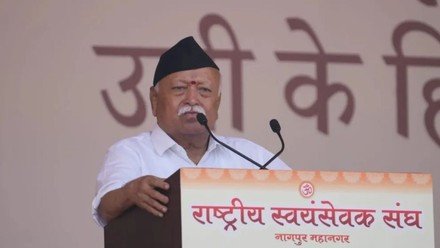
Youth unrest driven by concerns over unemployment and examination paper leaks is likely to feature prominently at the Rashtriya Swayamsevak Sangh’s (RSS) Akhil Bharatiya Karyakari Mandal Baithak next week. The organisation is also expected to discuss the possibility of foreign actors exploiting ongoing agitations over alleged irregularities in the Special Intensive Revision (SIR) of electoral rolls, according to sources cited by The Indian Express.
The three-day meeting will take place in Indore from November 2 to 4, as the Sangh Parivar considers how to engage a younger generation whose political views, communication habits and methods of mobilisation are increasingly shaped by Social Media and platforms outside traditional organisational structures.
The discussions are expected to address a wider challenge for the RSS and the Bharatiya Janata Party (BJP): understanding the concerns of young people while adapting to rapidly changing online spaces where humour, satire, short-form videos and independent creators can influence political debate.
A senior RSS functionary said the organisation recognises that young people have legitimate concerns. The functionary also sought to distinguish those concerns from the possibility that external forces could attempt to exploit public agitation.
“The concerns of the youth are genuine. They have been acknowledged by sarsanghchalak Mohan Bhagwat ji. What he said during his Vijayadashami speech about the possibility of foreign hand in certain ongoing agitations should not be interpreted as a shifting of RSS stand on genuine Youth Issues. These are separate issues,” the functionary said.
According to the RSS’s announcement, the meeting will include extensive discussions on contemporary issues such as content on new media platforms, drug abuse, external interference in India’s internal affairs and the global situation.
The gathering will also review the organisation’s centenary programmes and consider follow-up action on issues raised by RSS chief Mohan Bhagwat in his Vijayadashami address.
RSS Plans to Address Youth Concerns Through Dialogue and Engagement
The RSS is expected to emphasise communication and continued engagement as its response to anxiety and anger among young people. Rather than relying solely on attempts to persuade the younger generation, the organisation says it wants to listen to their concerns and maintain contact with them.
A senior RSS functionary said youth unrest occurs in countries around the world and that engagement is the most constructive response. The functionary argued that young people should be heard and that communication should not become an effort to impose a particular viewpoint.
The RSS also points to its shakhas, or local organisational units, as an established channel for connecting with younger people. According to the functionary, young participants account for around 60 per cent of attendees across more than 88,000 shakhas.
“What we can do best is to listen to them, communicate our views and remain engaged with them. There is no point trying to convince them of something,” the functionary said, adding that youth participation in the organisation’s activities was already substantial.
The issue had also featured at the RSS’s Akhil Bharatiya Samanvay Baithak in August, where concerns among young people, including problems in the examination system, were discussed.
Questions surrounding examination integrity have become an important part of the wider debate about youth frustration. Responding to concerns such as the NEET examination paper leak, the Sangh acknowledged shortcomings in the system and stressed that engagement with young people should involve dialogue and an understanding of their experiences rather than a purely didactic approach.
Youth outreach has also been a major component of the RSS’s centenary-year activities. In his Vijayadashami address earlier this month, Bhagwat said that 39.25 lakh young people had participated in Yuva Sammelans organised during the centenary year.
Bhagwat’s Earlier Interaction With Gen Z and Gen Alpha Students
The RSS’s approach to youth unrest was visible during an interaction between Bhagwat and students in Mumbai on August 6. The event brought together nearly 2,000 students from Generation Z and Generation Alpha amid protests led by the Cockroach Janta Party (CJP) over examination irregularities earlier in the year.
During the interaction, Bhagwat acknowledged the legitimacy of the concerns raised by young protesters and described demonstrations as a valid part of democratic engagement. He said that protest could serve as a form of dialogue and help build consensus in a democracy.
He also cautioned against labelling young people participating in agitations as anti-national merely because they were expressing dissatisfaction with the system.
The remarks reflected an effort to separate the grievances of young protesters from broader political interpretations of their actions. Concerns about employment opportunities, examination processes and institutional accountability can contribute to public frustration, making it important for organisations and authorities to engage with those affected.
However, Bhagwat adopted a more cautionary tone in his Vijayadashami address. While acknowledging that problems and shortcomings in the system could naturally lead to agitations, he warned that such movements could also be exploited by forces seeking to create instability in India.
Without naming the SIR agitation directly, Bhagwat spoke about external forces allegedly attempting to deepen social divisions, encourage a sense of victimhood, weaken public confidence in institutions and create discord, intense discontent, separatism, disorder and chaos.
The distinction between legitimate public grievances and possible attempts to exploit them is expected to remain an important part of the discussions at the Indore meeting.
Foreign Interference Claims and the Meta Controversy
The possibility of foreign interference in domestic agitation is among the issues the RSS is expected to examine. A senior functionary claimed that foreign powers often try to take advantage of periods of public unrest and cited Meta as part of the argument.
“Whenever a country goes through any public unrest, there are foreign powers who try to take advantage of it. In the ongoing agitations, it has already been proved. Meta has already apologised,” the functionary said.
However, there is no publicly established admission from Meta proving foreign involvement in the SIR agitation. The company apologised to the Union government in August after a post by Prime Minister Narendra Modi was temporarily restricted on Facebook, describing the incident as an operational error.
That episode concerned the temporary restriction of a particular post and does not, by itself, establish that foreign actors were involved in the electoral-roll agitation.
Separately, the government has raised concerns about how Meta’s platforms recommend content to users. In an advisory dated October 10, the Ministry of Electronics and Information Technology asked Meta to ensure that its recommendation systems did not expose users disproportionately to a single or limited set of narratives.
The ministry also sought stronger checks against misleading or out-of-context material. These concerns reflect a wider debate about how social-media algorithms influence the information users encounter and whether recommendation systems can intensify the circulation of particular viewpoints.
For the RSS, discussions about external interference and online content are likely to intersect with the challenge of understanding how political messages, grievances and allegations spread through digital platforms.
Why Social Media Has Become a Major Challenge for the Sangh Parivar
The proposed discussion on content published through new media platforms is significant because recent youth protests have highlighted changes in how political anger is communicated and organised.
The BJP has developed an extensive political communication network using platforms such as Facebook, X and WhatsApp. However, the political language associated with Instagram and short-form video platforms presents a different set of challenges.
The CJP emerged as a satirical social-media phenomenon, using humour, irreverence and pop-culture references to express anger over employment concerns and examination irregularities. Its online presence subsequently extended into street protests.
The movement illustrates how political mobilisation can develop through informal digital communities rather than relying exclusively on established political organisations. Memes, short videos, jokes and creator-led commentary can provide young people with ways to express frustration and share their views with wider audiences.
Such formats can also spread political criticism quickly, particularly when they connect with everyday concerns such as jobs, examination results and the perceived fairness of public institutions.
Following the protests, Prime Minister Narendra Modi and the BJP began experimenting more visibly with vertical videos, informal presentation styles and formats aimed at younger audiences.
During the Monsoon Session of Parliament, younger MPs from the National Democratic Alliance (NDA) also used internet slang and expressions such as “delulu”, “FOMO” and “clocked it”, reflecting the growing visibility of online youth culture in political communication.
Nevertheless, adapting to new platforms involves more than transferring existing political messages into a different format. Instagram and similar services often reward humour, irony, spontaneity and creator-driven content, which can differ substantially from the centralised and polished messaging that political organisations have used successfully across older social-media networks.
The SIR agitation has also generated memes, videos, satire and online games focused on protests and police action. Such content demonstrates how political events can be reinterpreted through digital entertainment and shared across online communities.
For the Sangh Parivar, the challenge is to understand these forms of expression without losing sight of the underlying concerns that motivate young people. The Indore meeting is expected to provide an opportunity to discuss how the organisation can remain engaged with a generation whose political participation increasingly extends beyond traditional structures.
RSS Centenary Programmes and the Upcoming Rashtra Vandanam Event
The Indore meeting will also review activities organised as part of the RSS’s centenary year and consider follow-up action on Bhagwat’s Vijayadashami address.
Another major event on the organisation’s calendar is Rashtra Vandanam, scheduled to take place in Delhi’s Rohini area on November 29. Bhagwat is expected to address the gathering at Sector 23.
RSS sources have estimated that more than one lakh swayamsevaks and invitees could participate in the event, which is part of the organisation’s centenary-related activities.
A senior RSS functionary described the gathering as an opportunity to mark the centenary celebrations and demonstrate organisational strength amid political tensions and opposition-led criticism of the government.
“Apart from centenary celebrations, this will also be a show of strength at a time when the Opposition is fuelling unrest against the government,” the functionary said.
The event is expected to bring together RSS members and invitees as the organisation continues its centenary-year outreach and reviews its priorities for the coming period.
What the Indore Meeting Could Mean for the RSS’s Youth Outreach
The discussions in Indore come at a time when youth concerns, digital communication and political mobilisation are increasingly connected. Unemployment, examination irregularities and questions about institutional accountability have become important subjects in online debate and public demonstrations.
The RSS has indicated that it considers these concerns genuine and wants to respond through listening, communication and continued engagement. At the same time, its leadership has warned that public grievances could be exploited by actors seeking to create instability.
The meeting is expected to address how the organisation should approach both sides of this challenge: engaging young people on the substance of their concerns and understanding the changing digital environment in which those concerns are expressed.
The discussion on new media platforms is particularly relevant as political communication moves beyond conventional messaging networks towards short-form videos, satire, memes and creator-led content. These formats can shape how young people interpret public events and how quickly dissatisfaction spreads.
Whether the RSS can translate its established grassroots presence into more effective engagement across these digital spaces remains an important question. The Indore meeting will offer an indication of how the organisation intends to respond to youth unrest while adapting to changing patterns of communication and political participation.
For breaking news and live news updates, like us on Facebook or follow us on Twitter and Instagram. Read more on Latest India on thefoxdaily.com.






COMMENTS 0