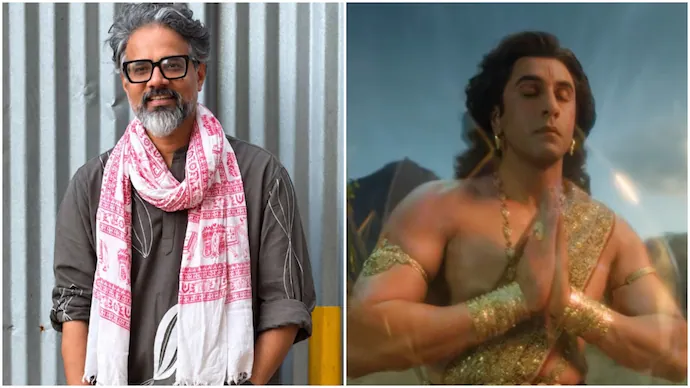
Indian mythology and devotional stories are attracting renewed attention from filmmakers, creating opportunities for both large-scale cinematic productions and independent projects rooted in faith. Director Vishal Chaturvedi, whose film Hanuman Ansh explores the life and devotion of Neem Karoli Baba, sees this growing interest as a positive development. In an interview with India Today, he described the wave of films centred on religious and spiritual figures as a potential “cultural renaissance”.
His comments came amid discussion surrounding Nitesh Tiwari’s Ramayana: Rise of a Legend, featuring Ranbir Kapoor and Sai Pallavi. While the film has attracted attention for its scale, reported financial ambitions and portrayal of the Ramayana, Chaturvedi said he was looking forward to watching it and welcomed the fact that another major production was bringing Lord Rama’s story to cinema audiences.
Chaturvedi’s perspective also reflects a wider question facing Indian devotional cinema: how can filmmakers balance faith, storytelling, historical and literary references, visual spectacle and commercial expectations? His experience with a relatively modestly budgeted film offers an alternative to the idea that religious cinema must depend on enormous production budgets to connect with viewers.
Why Vishal Chaturvedi sees Ramayana films as a cultural renaissance
Chaturvedi expressed enthusiasm about Ramayana: Rise of a Legend, although he made it clear that he had not watched the film when the interview took place. He said he was trying to find time to see it and did not want to offer an opinion on a production he had not experienced.
He had, however, heard about the audience response to a scene involving Hanuman and said he hoped films of this kind would succeed. For him, the significance extends beyond the performance of an individual film at the box office.
“I hope such films work for good and the cultural renaissance of such films is very important,” he said.
The expression captures his belief that renewed interest in stories from Indian spiritual and literary traditions can encourage more filmmakers to explore subjects that have influenced generations of audiences. The Ramayana, in particular, is not limited to a single literary interpretation or cultural setting. Its characters, moral questions and ideas about duty, devotion and responsibility have been retold through different regional traditions, performances, books and artistic forms.
New cinematic adaptations can introduce these stories to viewers who may encounter them through films rather than traditional forms of storytelling. They can also encourage audiences to revisit familiar narratives from different creative perspectives.
However, Chaturvedi’s enthusiasm is not based on spectacle alone. His comments repeatedly return to the importance of writing, suggesting that the success of devotional cinema depends on how effectively filmmakers communicate the emotional and philosophical substance of the stories they choose to tell.
Ranbir Kapoor’s Ramayana and the debate over budget versus content
Large-scale mythological productions naturally invite discussion about production budgets, visual effects, casting and the commercial expectations attached to them. Ramayana: Rise of a Legend, starring Ranbir Kapoor and Sai Pallavi, has become part of that conversation because of the attention surrounding its scale.
Chaturvedi, however, does not see budget and storytelling as competing priorities. He believes that writing must come first, with production resources used to strengthen the material rather than compensate for weaknesses in it.
“There is nothing beyond writing. What you have written in the paper is what matters. If what you have written is not good, then other things don’t work. But if it is good, then other things can lead to exponential growth,” he explained.
His argument is particularly relevant to films based on well-known religious and literary works. Familiarity with a story can attract an initial audience, but recognition alone does not guarantee an engaging film. The screenplay must give viewers a reason to remain invested, whether through character development, emotional conflict, dialogue or the way established events are presented.
Visual effects can make a supernatural world convincing, while elaborate sets and large-scale sequences can give a mythological story a sense of grandeur. Yet these elements work best when they serve a clear narrative purpose. A spectacular sequence may create an immediate impression, but its lasting impact depends on what it contributes to the story.
Chaturvedi also emphasised the importance of dialogue and expressions. He believes filmmakers should pay close attention to the words spoken by characters and the way emotions are communicated. Scale and visual spectacle, he said, should be added when the budget allows. If they cannot be afforded, simplicity remains a valid creative choice.
This approach offers a useful distinction between a film’s production value and its storytelling value. A modest production can still create a meaningful cinematic experience if its performances, writing and direction are effective. Conversely, a large budget does not automatically ensure emotional engagement.
How Hanuman Ansh approached devotional storytelling
Hanuman Ansh provides the context for Chaturvedi’s views. The film depicts the life of Neem Karoli Baba and his devotion to Lord Hanuman, placing a spiritual figure and his relationship with faith at the centre of the narrative.
According to the director, the project was made without relying on major stars or the scale associated with the biggest commercial productions. He described it as a small-budget film whose impact, in his assessment, was much larger than its production scale might suggest.
“It was a small-budget film, but the result was of a big budget,” he said.
The statement reflects his belief that the emotional connection between a film and its audience cannot be measured only through the amount spent on production. For devotional cinema, that connection may depend on whether viewers find the portrayal sincere, whether the central figure is presented with sensitivity and whether the narrative gives them something meaningful to reflect upon.
There is also a practical challenge in making films about spiritual personalities. Such subjects often have devoted followers who approach the story with existing beliefs and expectations. Filmmakers must therefore consider not only how to create a compelling screenplay but also how to represent the subject responsibly.
Chaturvedi’s emphasis on writing and reference points suggests that he sees research and narrative discipline as essential to this process. His comments indicate that he does not believe controversy should be used as a shortcut to publicity or audience attention.
Two RamBola films on Goswami Tulsidas: Chaturvedi welcomes different perspectives
Another significant subject in the interview was the announcement of separate films on Goswami Tulsidas by Vishal Chaturvedi and Dr Chandraprakash Dwivedi. Both filmmakers introduced projects carrying the title RamBola on the same day, prompting questions about the overlap.
Tulsidas occupies an important place in the history of Indian devotional literature. He is widely associated with the Ramcharitmanas, the influential retelling of the Ramayana in Awadhi. The work helped bring the story of Lord Rama into a literary and devotional tradition that has remained significant across generations.
Given the importance of Tulsidas’s life and writings, Chaturvedi does not consider two filmmakers exploring the same subject a problem. He argued that the story belongs to the public domain and that different creative interpretations can add to the audience’s understanding.
“There can be so much on Tulsidas ji that even if we make 10 films on him, there will be less,” he said, adding that he wished Dwivedi well.
He also expressed the hope that audiences would be able to see Tulsidas through two different perspectives and learn more about the poet through the separate productions.
The response is notable because projects dealing with the same historical or literary personality can easily become a source of public comparison. However, two films about one figure do not necessarily need to tell the same story. One filmmaker might focus on the subject’s personal journey, while another may place greater emphasis on literary contributions, spiritual ideas or the social and cultural environment in which the person lived.
In the case of Tulsidas, the available material offers several possible narrative directions. His association with the Ramcharitmanas provides a strong literary foundation, while the continuing influence of the text creates opportunities to explore its place in devotional culture.
For viewers, separate adaptations could offer different interpretations rather than competing versions of a single definitive account. Their value will ultimately depend on the research, writing and filmmaking behind each project.
Why films about religious figures require sensitivity and research
Religious and spiritual films often attract intense scrutiny because they deal with figures and stories that audiences may regard as sacred. Creative decisions involving dialogue, characterisation, historical interpretation and visual representation can therefore become subjects of public debate.
Chaturvedi said sensitivity and sensibility should guide the treatment of such subjects. He also argued that filmmakers should rely on primary sources and factual reference points instead of deliberately generating controversy to attract attention.
“If you genuinely want to talk heart-to-heart, you focus on the narrative and try to make the facts a reference point. All the scenes of our film have a reference point,” he said while discussing Hanuman Ansh.
His comments point to an important distinction between creative interpretation and unsupported invention. A film based on a spiritual personality may need to make narrative choices to create a coherent cinematic experience. However, those choices should not be confused with established historical facts.
Research becomes particularly important when a film depicts a real person. The filmmaker must consider which details are supported by available accounts, which elements belong to devotional tradition and which scenes have been constructed for dramatic purposes. Making those distinctions can help audiences understand the nature of the portrayal.
Chaturvedi also dismissed controversy as a reliable route to success, arguing that negativity cannot create genuine positivity. His position is that a film should connect with viewers through its narrative rather than depend on disputes around its subject.
That approach does not mean religious cinema will avoid disagreement altogether. Audiences can interpret the same story differently, and filmmakers may face criticism even when they approach a subject carefully. But research, transparent storytelling and respect for the material provide a stronger foundation than deliberately provocative publicity.
Hanuman Ansh OTT release: Why the director wants a wider audience
Chaturvedi also discussed the film’s digital release and the reasons for clarifying its distribution arrangements. He said a statement issued by him and producer Namrata G Singh was intended to address speculation about the film’s OTT and satellite rights.
According to the director, the clarification became necessary after conversations in the market began creating confusion about the project’s release arrangements. He explained that the team wanted audiences to understand that discussions about OTT and satellite distribution were being handled through authorised channels.
He acknowledged that the clarification came later than it could have, but said the team felt it was necessary once speculation had become widespread. His comments highlight a practical issue for independent film productions: uncertainty around distribution can quickly become a subject of online discussion, particularly when audiences are waiting to find out where they can watch a film.
For Hanuman Ansh, the digital release also represents an opportunity to reach people who could not attend theatrical screenings.
Chaturvedi said some families live in places without cinema halls, while others missed the film because of health conditions or personal circumstances. He also referred to viewers who had watched the film more than once and might want to revisit it.
The director’s stated aim is to make the film accessible to as many people as possible. A streaming release can serve audiences who face geographical or practical barriers to visiting a cinema, although the viewing experience will naturally differ from a theatrical screening.
Hanuman Ansh is scheduled to premiere on SonyLIV on November 27, 2026, according to the announcement shared in the interview.
What the growing interest in devotional cinema could mean for Indian films
Chaturvedi’s comments raise a wider question about the direction of devotional and mythological filmmaking in India. Stories from the Ramayana and other spiritual traditions have long appeared in different forms of popular culture. Cinema offers another way to interpret these narratives, combining performances, music, production design and visual effects to reach contemporary audiences.
The growing attention around large-scale productions may encourage more investment in mythological storytelling. At the same time, films such as Hanuman Ansh demonstrate why the genre should not be viewed only through the lens of expensive productions.
There is room for different approaches. A large-scale adaptation can use elaborate visual effects to present a vast mythological world, while a smaller film can focus on an individual spiritual figure and the emotional meaning of devotion. Neither approach is automatically superior. Their effectiveness depends on whether the filmmaking choices suit the story.
The same principle applies to films about historical and literary personalities such as Goswami Tulsidas. Multiple interpretations can expand the conversation around a figure, provided filmmakers approach the subject with adequate research and a clear creative purpose.
The next important test for this emerging wave of projects will be the quality of the finished films and the way audiences respond to them. Public interest can create opportunities, but lasting engagement requires more than a recognisable religious subject or an impressive production budget.
Final word: Strong writing remains the foundation of devotional cinema
Vishal Chaturvedi’s description of the renewed interest in religious filmmaking as a “cultural renaissance” reflects his optimism about the possibilities of Indian devotional cinema. His support for Nitesh Tiwari’s Ramayana: Rise of a Legend, despite not having watched it at the time of the interview, is rooted in the belief that more films about Lord Rama and other spiritual figures can benefit the wider cinematic landscape.
His comments also offer a clear perspective on what makes such projects work. Production scale and visual spectacle can enhance a film, but they cannot replace a well-written story. Sensitivity, research and meaningful characterisation are especially important when filmmakers deal with religious subjects and real spiritual personalities.
With two separate RamBola projects exploring Goswami Tulsidas and Hanuman Ansh preparing for its digital premiere, Chaturvedi’s own work remains connected to this expanding interest in devotional storytelling. Whether these films take a grand cinematic route or a more intimate approach, their lasting value will depend on how honestly and effectively they bring their subjects to the screen.
For breaking news and live news updates, like us on Facebook or follow us on Twitter and Instagram. Read more on Latest India on thefoxdaily.com.






COMMENTS 0