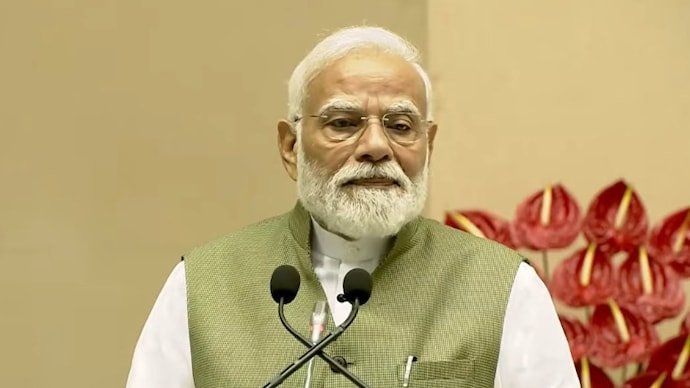
Prime Minister Narendra Modi has offered India‘s Gen Z a simple warning in an increasingly digital age: the fastest route is not always the best one.
Speaking at the launch of former President Ram Nath Kovind’s autobiography, Triumph of the Indian Republic: My Life, My Struggles, in Delhi on Wednesday, Modi used a familiar railway safety message to make a broader point about ambition, Social Media and the temptation of instant success.
He recalled how some people choose to cross railway tracks rather than use footbridges because they believe the shortcut will save time. The warning often displayed at such crossings, he suggested, carries a lesson that extends well beyond railway safety.
“A shortcut will cut you short,” Modi said, while also advising young people to be careful about influencers who can pull them in different directions.
The remarks come as the Prime Minister’s public outreach increasingly targets young, digitally active Indians. Social media platforms, short videos, informal language and influencer-style formats have become a more visible part of the government’s attempt to communicate with younger audiences.
PM Modi’s message: don’t confuse speed with success
The railway-track example gave Modi’s message a practical starting point. Someone crossing the tracks may reach the other side faster, but the apparent saving of time comes with a potentially serious risk.
For young people navigating Education, Careers and social media, the same logic can apply to the pursuit of quick results. Online platforms can create the impression that success happens instantly, whether through a viral video, a successful business, a glamorous career or sudden popularity.
Modi’s warning was that young people should not allow that culture of immediacy to replace patience and sustained effort.
His reference to influencers added another dimension. Social media personalities can shape what young users watch, buy, believe and aspire to, but their incentives and experiences are not necessarily the same as those of their audiences.
The Prime Minister did not suggest that young people should abandon social media. Instead, his remarks focused on being selective about whom to follow and which advice to accept.
Why the autobiography was part of the message
Modi’s remarks came at an event centred on the life of former President Ram Nath Kovind, whose autobiography documents his personal and political journey.
The Prime Minister encouraged young people to read the autobiography of people they admire if they want to find a way forward.
That suggestion reflects a contrast between two ways of consuming information. Short-form social media can offer quick advice, motivational clips and simplified success stories, while a full autobiography can provide a much longer account of setbacks, decisions, struggles and experiences that are often left out of short online content.
For Modi, reading the life stories of people young Indians admire appears to be a way of encouraging deeper engagement with their experiences rather than relying solely on snippets delivered through social media.
That distinction is particularly relevant in a culture dominated by reels and short videos, where a complex career can be compressed into a few seconds of carefully selected content.
PM Modi’s growing focus on Gen Z
The remarks are part of a broader effort by Modi and the Bharatiya Janata Party to connect with younger audiences through platforms and communication styles that feel familiar to them.
Modi has increasingly appeared in more informal social media content, including selfie-style videos and messages using language associated with online Youth culture.
He has used phrases such as “first in my bloodline” and promoted the GRWM, or “Get Ready With Me,” format while showcasing traditional Indian textiles through social media.
These formats represent a noticeable change from conventional political communication, in which leaders typically rely on speeches, formal interviews and carefully produced campaign material.
Short-form video gives political leaders a direct route to younger audiences without depending entirely on traditional media. It also allows messages to be presented in a more personal and informal setting.
From speeches to selfie videos
The evolution of political communication is particularly visible on platforms dominated by short-form content.
A traditional political speech can take several minutes or longer to explain a policy. A reel or short video, by contrast, needs to capture attention almost immediately.
That environment encourages a different style of communication: shorter sentences, stronger visual elements, informal presentation and content designed to be shared.
Modi’s increased use of such formats suggests an attempt to meet younger users where they already spend much of their time online.
But there is an interesting tension in his latest message. The Prime Minister is using the language and formats of the social media environment to warn young people about some of its potential influences.
That does not necessarily make the message contradictory. It highlights the distinction between using digital platforms as communication tools and accepting everything those platforms promote.
The influencer economy behind the warning
Influencers occupy an increasingly important position in online culture. Their popularity can give them considerable influence over trends, consumer choices and perceptions of success.
For younger users, the boundary between Entertainment, advice and advertising can sometimes be difficult to distinguish. A personality may present a lifestyle as aspirational while leaving out the circumstances, failures or commercial interests behind it.
That is why Modi’s warning about influencers connects with his broader argument about shortcuts. Social media often shows the destination without showing the route.
A short video may show a successful entrepreneur, athlete, creator or professional enjoying the rewards of achievement. It may not show years of education, practice, failed attempts or financial uncertainty that preceded that moment.
For young viewers, understanding that difference can help prevent a polished online narrative from being mistaken for a complete picture of reality.
What “shortcut” means in the digital age
The idea of a shortcut has taken on a broader meaning in the era of social media.
Students can find instant explanations online instead of spending time with a textbook. Job seekers can encounter quick career advice presented as universal rules. Aspiring creators can be promised rapid growth. Consumers can be persuaded that a particular product or lifestyle is the key to success.
Some of these tools are genuinely useful. Technology can make information easier to access and help people learn more efficiently.
The problem arises when efficiency is confused with avoiding the underlying work.
There is a meaningful difference between finding a better way to accomplish something and trying to bypass the process entirely. Modi’s railway analogy captures that distinction: a shortcut can save a few minutes, but it can also create a much greater risk.
Why young people are a key audience for political communication
India’s young population represents an important audience for political parties and public institutions. Young Indians are also among the most active users of digital platforms, making social media an increasingly important space for political messaging.
For political leaders, this creates both an opportunity and a challenge.
The opportunity is direct communication. A leader can publish a video and reach viewers without waiting for a television broadcast or newspaper report.
The challenge is competition for attention. Political messages appear alongside entertainment, influencers, advertisements, memes and personal content.
In such an environment, political communication has to compete with everything else on a user’s screen.
That helps explain the government’s increasing interest in short-form and informal content.
The wider government push toward youth-oriented platforms
The shift has not been limited to Modi’s personal social media presence. Ministers and government departments have also increased their use of short-form video and platforms associated with younger audiences.
The Ministry of External Affairs, for example, made its debut on Snapchat last week, according to the supplied material.
The move reflects a broader effort to adapt official communication to the changing habits of digital audiences.
Government departments traditionally communicated through press releases, websites, television appearances and official statements. Those channels remain important, but they do not necessarily reach younger users in the same way as social platforms.
Short-form content allows government agencies to explain programmes, policies and national issues in a format that can be consumed quickly on mobile devices.
The political backdrop to the outreach
The increased focus on Gen Z comes against the backdrop of recent student and youth mobilisation described in the source material.
Student protests and demonstrations by job seekers created a significant political challenge for the government. The protests were spearheaded in part by the satirical platform Cockroach Janta Party, according to the supplied account, and focused on issues including the NEET-UG paper leak.
The demonstrations subsequently became a wider political issue, with Education Minister Dharmendra Pradhan’s resignation described in the source material as an eventual consequence.
That backdrop helps explain why youth engagement has become a more prominent political priority.
Young voters are not simply an audience to be reached through conventional campaign speeches. Their political conversations increasingly take place online, where criticism, humour, satire and political mobilisation can spread quickly.
Why authenticity matters on social media
The government’s shift toward less formal content also reflects a broader lesson about social media: polished communication does not always feel authentic to younger audiences.
According to the source material, Modi encouraged ministers after the protests to become more active on platforms popular with young people and to make their videos appear less polished and more relatable.
That approach attempts to narrow the distance between formal political institutions and everyday digital communication.
For Gen Z users accustomed to creators speaking directly into a phone camera, a highly produced political advertisement can feel distant. A selfie-style video can appear more conversational even when the speaker is a senior government official.
The challenge is that appearing relatable is not the same as being trusted. Digital presentation may attract attention, but credibility ultimately depends on the substance of the message.
Modi’s railway analogy has a wider lesson
The strongest part of Modi’s message is perhaps its simplicity. The railway warning is familiar, but its meaning can be applied to many aspects of modern life.
A shortcut can mean copying instead of learning, chasing virality instead of building skill, following an influencer without checking the advice, or expecting immediate results from a process that naturally takes time.
At the same time, not every shortcut is harmful. Technology exists partly to make difficult tasks faster and more efficient. The important question is whether a shortcut removes unnecessary effort or simply removes necessary effort.
That distinction is particularly useful for young people navigating an online environment where extraordinary success stories are constantly visible.
The real challenge: balancing digital life with deeper learning
Social media is unlikely to disappear from the lives of India’s young people, and neither should it necessarily. Reels, influencers and short videos can provide entertainment, information and even educational opportunities.
The challenge is maintaining enough distance from the feed to question what it presents.
Reading books, examining complete life stories and developing skills over time require a different kind of attention from scrolling through short videos. Modi’s recommendation to read the autobiography of someone young people admire fits directly into that idea.
A biography can reveal the parts of a journey that a social media post cannot easily capture: uncertainty, failure, persistence and gradual progress.
That is ultimately the deeper meaning behind the Prime Minister’s warning about shortcuts. The fastest path to an answer is not necessarily the best path to understanding.
What PM Modi’s Gen Z strategy signals
Modi’s latest remarks combine two elements of his youth outreach: using the digital language of Gen Z while encouraging young people to think critically about the same online environment.
His increased use of reels, selfie-style videos and informal phrases shows how political communication is adapting to changing media habits. His warning about influencers and shortcuts, meanwhile, suggests an attempt to shape how young audiences consume that information.
Whether this approach succeeds will depend not only on how many young people watch political content but also on whether they find it credible and relevant to their lives.
For now, the message is clear. In a digital culture built around speed, Modi is asking young Indians to slow down when the stakes are high, question the advice coming through their screens and remember that meaningful progress rarely happens as quickly as a reel.
For breaking news and live news updates, like us on Facebook or follow us on Twitter and Instagram. Read more on Latest India on thefoxdaily.com.




COMMENTS 0