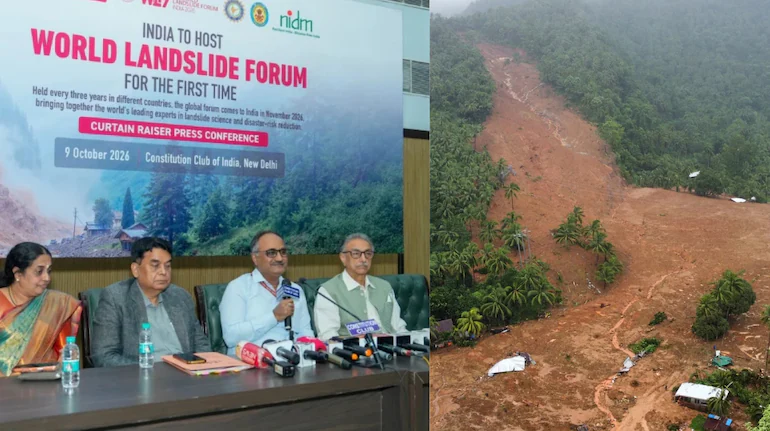
India is preparing to host the 7th World Landslide Forum (WLF7) from November 23 to 27, 2026, bringing together international scientists, engineers, researchers and disaster-management experts to discuss one of the world’s most challenging natural hazards. The five-day event will take place at Amrita Vishwa Vidyapeetham in Faridabad, Haryana, with pre-conference workshops scheduled for November 22.
Delegates from more than 75 countries and regions are expected to participate in discussions on landslide science, slope stability, hazard mapping, monitoring technologies and disaster-risk reduction. The forum will also examine how artificial intelligence (AI), satellite observations and remote sensing can improve landslide detection and early-warning systems.
WLF7 is particularly significant for India because several parts of the country, especially the Himalayan region and other hilly areas, face recurring landslide risks. Heavy rainfall, unstable slopes, changing environmental conditions and human activity can increase the vulnerability of communities living in these areas.
Here is everything to know about the World Landslide Forum 2026, including its exact dates, venue, theme, expected participants and key discussion areas.
World Landslide Forum 2026: Date, Venue and Theme
Event detail Information Event 7th World Landslide Forum (WLF7) Dates November 23–27, 2026 Pre-conference workshops November 22, 2026 Venue Amrita Vishwa Vidyapeetham, Faridabad, Haryana Theme Landslide Science and Practice for Safe and Resilient Communities Expected participation Delegates from more than 75 countries and regions
World Landslide Forum 2026: 75+ Countries to Gather in India; Check Exact Date, Venue, Theme and What to Expect
India is set to host the 7th World Landslide Forum (WLF7) from November 23 to 27, 2026, bringing together scientists, engineers, researchers, policymakers and disaster-management professionals to discuss landslide risks and ways to reduce their impact. The international event will take place at Amrita Vishwa Vidyapeetham in Faridabad, Haryana, with pre-conference workshops scheduled for November 22.
The forum is being organised under the theme ‘Landslide Science and Practice for Safe and Resilient Communities’. Its programme will cover landslide monitoring, hazard mapping, slope stability, risk assessment, mitigation techniques and early-warning systems.
International participation is expected to make the event an important platform for exchanging research and practical experience. The organisers have described WLF7 as a global gathering of the landslide community, while the event’s host institution has highlighted expectations of more than 1,280 international participants.
The seventh edition is particularly significant because India will host the World Landslide Forum for the first time. Several parts of the country, especially the Himalayan region, face recurring landslide threats, making research, monitoring and disaster preparedness important national priorities.
World Landslide Forum 2026: Date, Venue and Theme
Here are the key details of the seventh edition of the World Landslide Forum:
| Event detail | Information |
|---|---|
| Event name | 7th World Landslide Forum (WLF7) |
| Main event dates | November 23–27, 2026 |
| Pre-conference workshops | November 22, 2026 |
| Venue | Amrita Vishwa Vidyapeetham, Faridabad |
| Location | Sector 88, Faridabad, Haryana |
| Theme | Landslide Science and Practice for Safe and Resilient Communities |
| Organising institution | Amrita Vishwa Vidyapeetham |
| Expected participation | International scientists, researchers, engineers and disaster-management professionals |
What Is the World Landslide Forum?
The World Landslide Forum is an international scientific event dedicated to understanding landslides, improving risk-management strategies and strengthening cooperation between researchers and disaster-management professionals.
It brings together experts working in fields such as geology, geotechnical engineering, environmental science, remote sensing, hazard assessment and disaster preparedness. Participants share research findings, discuss technological developments and explore practical ways to reduce the damage caused by landslides.
The forum is organised under the aegis of the International Consortium on Landslides (ICL), in collaboration with UNESCO and other United Nations organisations and international institutions.
Unlike a general disaster-management conference, the World Landslide Forum focuses specifically on landslide science and its practical applications. Discussions cover how landslides occur, what triggers them, how vulnerable slopes can be identified and how communities can receive warnings before dangerous events develop.
The event is held every three years. Its first edition took place in Tokyo, Japan, in 2008. Subsequent editions were hosted in Rome, Beijing, Ljubljana, Kyoto and Florence. The 2026 edition will bring the international forum to India for the first time.
Why Is India Hosting the World Landslide Forum for the First Time?
India’s selection as the host country is significant because landslides are a recurring natural hazard in several regions. The Himalayan states, parts of the northeastern region and other mountainous areas are particularly vulnerable to slope failures.
Heavy rainfall can saturate soil and weaken slopes, increasing the possibility of landslides. Geological conditions, steep terrain, earthquakes, erosion and changes in land use can also contribute to slope instability.
In the Himalayan region, infrastructure development, road construction and changing environmental conditions add further challenges to managing landslide risks. A landslide can damage roads, disrupt communication networks, affect settlements and isolate communities from essential services.
The risks are not limited to immediate destruction. Landslides can also block rivers, damage agricultural land, disrupt tourism and create secondary hazards such as floods when natural or artificial barriers collapse.
Hosting WLF7 gives Indian researchers and institutions an opportunity to exchange knowledge with international specialists. It also creates a platform to discuss how scientific research can be translated into practical measures for protecting vulnerable communities.
World Landslide Forum 2026: What Will Be Discussed?
The five-day programme will cover several areas of landslide science, technology and disaster-risk management. The discussions are intended to connect scientific research with the needs of governments, infrastructure planners and communities exposed to landslide hazards.
1. Landslide Monitoring and Early-Warning Systems
One of the major discussion areas will be the monitoring of unstable slopes and the development of early-warning systems. These systems use observations and measurements to identify changes that may indicate an increased risk of slope failure.
Monitoring can involve rainfall measurements, ground movement sensors, satellite observations and field investigations. When combined with reliable communication systems, such information can help authorities issue warnings and prepare evacuation measures.
Experts will discuss ways to improve the accuracy and practical use of early-warning systems, particularly in areas where communities have limited time to respond to rapidly developing hazards.
2. Artificial Intelligence in Landslide Prediction
Artificial intelligence is becoming an important research tool in the analysis of environmental hazards. AI-based systems can process large datasets, identify patterns and support the assessment of areas vulnerable to landslides.
At WLF7, AI and geospatial technologies will feature in discussions and pre-conference workshops. Researchers are expected to examine how these tools can support landslide detection, monitoring, prediction and risk-informed decision-making.
However, AI cannot eliminate uncertainty from landslide forecasting. Its usefulness depends on the quality of available data, reliable models and the integration of computer-based analysis with geological knowledge and field observations.
3. Satellite-Based Monitoring and Remote Sensing
Satellite technology allows scientists to observe large and difficult-to-access areas, making it particularly valuable for monitoring mountainous regions. Remote sensing can help identify changes in terrain, detect ground movement and map areas affected by landslides.
The forum’s programme includes discussions on satellite radar technologies, including Sentinel-1 and NISAR, as well as interferometric synthetic aperture radar (InSAR). These technologies can help researchers measure ground deformation and monitor changes over time.
Such information can support the identification of unstable slopes and improve understanding of how landslides develop. Experts will also examine the limitations of satellite observations and how they can be combined with field surveys, optical imagery and other monitoring techniques.
4. Landslide Hazard Mapping and Risk Assessment
Hazard mapping is another important part of landslide-risk management. It helps identify locations where slope failures are more likely and provides information that can support infrastructure planning and disaster preparedness.
Risk assessment goes beyond identifying unstable slopes. It also considers the people, buildings, roads and other assets that could be affected if a landslide occurs.
Discussions at WLF7 will examine mapping techniques, risk-assessment methods and approaches to managing landslide-prone areas. These findings can help authorities make better-informed decisions about development, construction and community safety.
5. Slope Stability, Modelling and Mitigation
Understanding slope stability is essential for preventing landslide disasters. Engineers and researchers study the physical properties of soil and rock, groundwater conditions, slope geometry and other factors that influence the likelihood of failure.
The forum will provide opportunities to discuss modelling techniques, testing methods and mitigation measures. These can include drainage improvements, slope reinforcement, protective structures and land-management practices, depending on the conditions at a particular site.
The objective is to improve the scientific basis for identifying dangerous slopes and selecting suitable measures to reduce risks.
What to Expect at the 7th World Landslide Forum?
WLF7 will feature more than traditional academic presentations. Its programme includes plenary sessions, keynote lectures, parallel scientific sessions, policy discussions, workshops, exhibitions and field-related activities.
Some of the major activities planned for the event include:
- Opening plenary: The forum will begin on November 23 with opening addresses, international greetings, a high-level panel discussion and scientific lectures.
- Keynote lectures: Experts will present research and perspectives on landslide science, monitoring, mitigation and disaster-risk reduction.
- Technical sessions: Researchers will share findings through parallel sessions covering different areas of landslide science and engineering.
- Policy dialogues: Discussions will explore how scientific knowledge can be integrated into disaster-management policies and practical decision-making.
- PhD Forum: The programme includes a platform for doctoral researchers to engage with the international scientific community.
- Workshops: Pre-conference and thematic workshops will cover emerging technologies, research methods and capacity-building activities.
- Exhibitions and marketplace: Institutions and technology providers will have opportunities to showcase research, tools and solutions.
- Field visits: The forum programme also includes opportunities for participants to engage with field-based demonstrations and practical applications.
Important Dates: What Happens Between November 22 and 27?
The programme begins with pre-conference workshops on November 22, followed by the main forum from November 23 to 27.
| Date | Major activities |
|---|---|
| November 22 | Pre-conference workshops and international committee meetings |
| November 23 | Opening plenary, high-level panel, forum lectures and awards |
| November 24 | Keynote lectures, parallel sessions and South Asian landslide-resilience dialogue |
| November 25 | Scientific sessions, PhD Forum, science-policy dialogue and exhibition activities |
| November 26 | Keynote lectures, parallel sessions and national leadership dialogue |
| November 27 | Final scientific sessions and closing ceremony |
The programme is subject to change, so participants should check the official WLF7 website for the latest schedule and session details.
Why the Forum Matters for India’s Himalayan States
The World Landslide Forum has particular relevance for India’s Himalayan region, where landslides frequently affect communities, transport infrastructure and local economies.
States such as Uttarakhand, Himachal Pradesh, Sikkim and Arunachal Pradesh have mountainous terrain and areas exposed to heavy rainfall and slope instability. Landslides can disrupt important highways, damage homes and affect access to healthcare, education and essential supplies.
For these regions, better hazard mapping and monitoring can help authorities identify vulnerable locations before disasters occur. Early-warning systems can also give residents and emergency services more time to respond when dangerous conditions develop.
International collaboration can help Indian institutions learn from monitoring methods, engineering approaches and disaster-management experiences developed in other landslide-prone countries.
However, technology alone cannot address every risk. Effective landslide management also requires reliable local data, suitable land-use planning, infrastructure standards, public awareness and coordination between scientific institutions and government agencies.
Who Can Participate in World Landslide Forum 2026?
The forum is intended for a broad international audience working in landslide science, engineering and disaster-risk reduction. Its participants are expected to include:
- Scientists, researchers and university faculty members.
- Geologists, civil engineers and geotechnical specialists.
- Government officials and policymakers.
- Disaster-management professionals and emergency planners.
- Representatives of international organisations and research institutions.
- Technology companies and providers of monitoring solutions.
- Students, doctoral researchers and early-career scientists.
The event also provides opportunities for researchers to present scientific work, exchange ideas and develop collaborations with experts from other countries.
What Is the Main Objective of WLF7?
The central objective of the seventh World Landslide Forum is to strengthen cooperation between science, practical engineering and public policy. Its theme, ‘Landslide Science and Practice for Safe and Resilient Communities’, reflects the need to turn scientific knowledge into measures that reduce risks for people living in vulnerable areas.
The forum also connects its work with international disaster-risk and sustainability frameworks, including the Sendai Framework for Disaster Risk Reduction 2015–2030, the Kyoto Landslide Commitment 2020 and the United Nations Sustainable Development Goals.
These frameworks emphasise disaster prevention, risk awareness, preparedness and cooperation between countries and institutions. WLF7 aims to contribute to those objectives by bringing researchers and decision-makers together.
Conclusion
The 7th World Landslide Forum will bring the international landslide research community to Faridabad from November 23 to 27, 2026. Hosted by Amrita Vishwa Vidyapeetham, the event will focus on monitoring, prediction, hazard mapping, slope stability, early-warning systems and practical disaster-risk reduction.
For India, hosting the forum is an opportunity to strengthen international research cooperation and discuss challenges that directly affect its Himalayan and other landslide-prone regions. The emphasis on AI, satellite monitoring and science-based risk management also reflects the growing role of technology in disaster preparedness.
The broader challenge will be translating research findings into practical action. Better monitoring, reliable warnings, informed infrastructure planning and community preparedness are essential to reducing the human and economic impact of landslides.
Frequently Asked Questions
When will the World Landslide Forum 2026 take place?
The 7th World Landslide Forum will take place from November 23 to 27, 2026. Pre-conference workshops are scheduled for November 22.
Where will WLF7 2026 be held?
The event will be hosted at Amrita Vishwa Vidyapeetham, Faridabad Campus, in Sector 88, Faridabad, Haryana.
What is the theme of World Landslide Forum 2026?
The theme is ‘Landslide Science and Practice for Safe and Resilient Communities’. It focuses on connecting scientific research with practical measures to reduce landslide risks.
Is India hosting the World Landslide Forum for the first time?
Yes. The seventh edition in 2026 will be the first time the World Landslide Forum is hosted in India.
Which countries will participate in WLF7?
The forum is expected to attract an international gathering of researchers, scientists, engineers and policymakers. The organisers describe it as a global event, with the host institution highlighting expectations of more than 1,280 international participants.
What topics will be discussed at the forum?
Major topics include landslide monitoring, early-warning systems, artificial intelligence, satellite-based observation, remote sensing, hazard mapping, slope stability, risk assessment and mitigation.
Who is organising the World Landslide Forum 2026?
Amrita Vishwa Vidyapeetham is hosting the event under the aegis of the International Consortium on Landslides, in collaboration with UNESCO and other international organisations.
Why is the World Landslide Forum important for India?
Several Indian regions, particularly the Himalayas and other mountainous areas, face landslide risks. The forum provides an opportunity to exchange research, improve monitoring approaches and discuss strategies for protecting vulnerable communities.
For breaking news and live news updates, like us on Facebook or follow us on Twitter and Instagram. Read more on Latest India on thefoxdaily.com.





COMMENTS 0