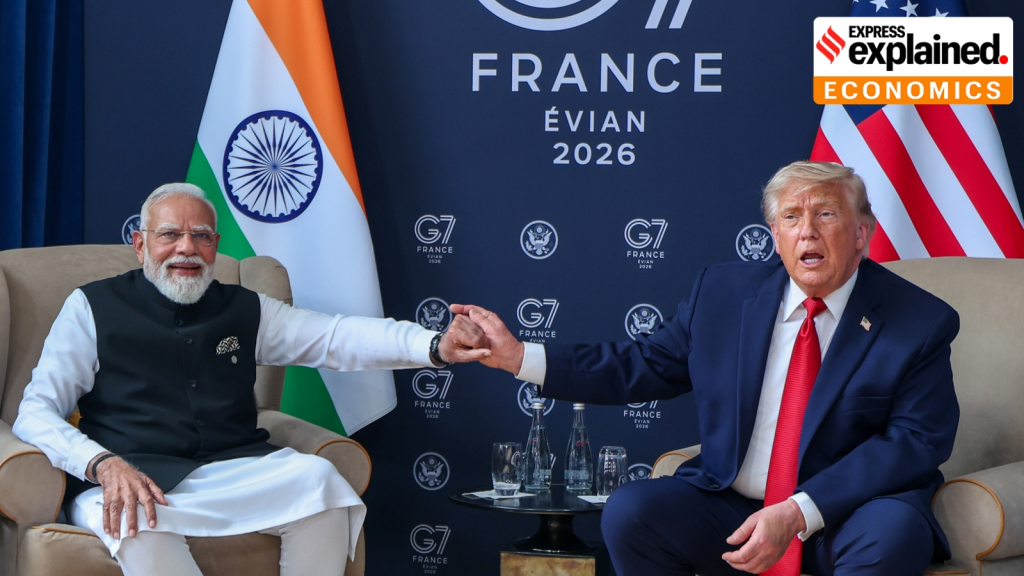
The resemblance is striking, but the legal distinction is important: the new Section 301 duties are not a reinstatement of the tariffs invalidated by the Supreme Court. They arise from separate investigations under a different trade law, with their own findings, consultation process and proposed remedies. The November 25 announcement is also a proposal open to public comment, not a set of duties that has already taken effect.
From Liberation Day to the Section 301 investigations
On April 2, 2025, Trump announced sweeping reciprocal tariffs from the White House Rose Garden, describing the move as part of his administration’s effort to address what it considered unfair trade practices and persistent trade imbalances. The announcement became known as Liberation Day and marked a major escalation in Washington’s trade policy.
India was assigned a 26% reciprocal tariff. The rate was based on the administration’s calculation of trade barriers and other factors, rather than a conventional product-by-product finding that Indian exports were being subsidised or dumped in the US market.
On April 9, 2025, the administration paused the higher country-specific reciprocal rates for 90 days for most trading partners while retaining a 10% baseline tariff. The pause created room for negotiations, but it did not end the wider tariff campaign.
India faced another escalation on July 31, 2025, when Trump announced a 25% tariff on Indian goods, citing trade barriers and market-access concerns. In August, Washington added a further 25% penalty linked to India’s purchases of Russian oil, taking the headline tariff burden on many Indian exports to 50% before subsequent changes.
The administration’s approach relied heavily on the International Emergency Economic Powers Act, or IEEPA. That law gives the US president certain powers to address declared national emergencies, but its use as the legal foundation for broad tariffs became the subject of a major constitutional and statutory dispute.
Why the US Supreme Court struck down the IEEPA tariffs
In February 2026, the US Supreme Court ruled that IEEPA did not authorise the president to impose the broad tariffs used in the Liberation Day programme. The decision removed the legal foundation for those emergency-power duties, including the reciprocal tariff measures imposed under that authority.
The ruling did not mean that the US government had lost all authority to impose tariffs. Congress has created several separate legal mechanisms that allow the executive branch to restrict imports or impose duties in defined circumstances. These include Section 232 of the Trade Expansion Act of 1962, which concerns national-security grounds, and Section 301 of the Trade Act of 1974, which addresses certain foreign acts, policies and practices considered unfair or harmful to US commerce.
The distinction is central to understanding the latest announcement. The Supreme Court’s decision limited the administration’s use of IEEPA; it did not abolish the country’s trade-remedy laws or prevent the USTR from investigating foreign trade practices under Section 301.
After the ruling, the administration also used Section 122 of the Trade Act of 1974 to impose a temporary 10% global import duty. That measure had a statutory time limit of 150 days and expired in July 2026. Separate duties imposed under other laws, including Section 301 and Section 232, were not automatically invalidated by the Supreme Court’s IEEPA ruling.
How Section 301 became Washington’s alternative tariff route
Section 301 of the Trade Act of 1974 gives the US Trade Representative authority to investigate foreign government acts, policies or practices that are considered unjustifiable, unreasonable or discriminatory and that burden or restrict US commerce. If the investigation supports such a determination, the USTR can recommend or impose trade action, subject to the requirements of the law.
Unlike the broad emergency-power approach used for Liberation Day, Section 301 requires an investigation into identified foreign practices. The process can include requests for information, consultations with affected governments, public submissions and hearings. The administration must connect the proposed response to the findings of the investigation.
The USTR opened a new set of investigations on March 11, 2026, examining alleged structural excess capacity and production in manufacturing sectors across 16 economies. The initial group included India, China, the European Union and several major Asian manufacturing exporters, as well as Mexico and Norway.
On November 25, the USTR announced determinations concerning 14 of those economies and proposed tariff action against them. It did not make determinations on Mexico and Norway at that stage. The announcement therefore marked a move from investigation to proposed remedies, rather than the immediate introduction of a new global tariff schedule.
Why Washington is targeting alleged industrial overcapacity
Structural excess capacity generally refers to a situation in which an economy’s industries can produce substantially more goods than domestic and international demand can absorb. Governments may be accused of sustaining such capacity through subsidies, state support, preferential financing, regulatory policies or other measures that encourage production beyond market demand.
When domestic demand cannot absorb the output, manufacturers may seek overseas markets. Critics argue that large export surpluses can put pressure on producers in importing countries, depress prices and make it harder for domestic industries to compete.
The USTR’s investigation examined whether policies and practices in the 16 economies contributed to excess manufacturing capacity and production in ways that burdened or restricted US commerce. The agency’s November determinations found actionable practices in 14 economies and proposed duties as a response.
However, the concept of excess capacity is contested. A country’s ability to manufacture more than it consumes domestically does not automatically prove that its exports are unfair. Export-oriented production can reflect investment, productivity, comparative advantage and global demand. The central disagreement is whether government intervention creates distortions that harm competitors or whether the US is using the issue to justify protection for its own industries.
India faces a proposed tariff of up to 25%
India is among the countries facing the new Section 301 proposal. The USTR has proposed tariffs of up to 25% on Indian goods, net of existing Section 301 duties, with exemptions for certain products. It has also indicated that the rate could be adjusted to 17% if India concludes an Agreement on Reciprocal Trade with the United States that addresses the concerns identified in the investigation.
The conditional 17% figure is particularly important because it links tariff relief to the outcome of bilateral trade negotiations. In practical terms, the proposal gives New Delhi a potential lower rate if an agreement is reached, while leaving the higher proposed rate as the alternative if negotiations do not produce the required commitments.
The USTR’s assessment identified concerns involving manufacturing sectors such as pharmaceuticals, medical devices, steel, solar products and information and communications technology. Its broader examination also considered industrial policies, production patterns and trade-related practices that Washington says contribute to structural excess capacity.
The proposed 25% figure should not be interpreted as an additional 25 percentage points automatically added to every existing duty on Indian goods. The USTR describes the proposed rate as net of existing Section 301 tariffs, and the notice provides for exemptions and adjustments that may affect the final treatment of individual products.
India rejects the excess-capacity allegation
New Delhi has disputed the US assessment. In its November 25 statement, India’s Ministry of Commerce and Industry said the government had examined the USTR notice and reiterated its position that India does not have structural excess capacity in any sector.
The ministry said India had engaged constructively throughout the investigation and had conveyed its position to the US Department of Commerce. It also stressed that trade-related concerns should be addressed through the ongoing negotiations for a bilateral trade agreement.
India and the United States had announced a framework for an interim trade agreement in February 2026. The two governments have continued discussions towards a broader bilateral trade agreement, with market access, tariffs and other trade issues forming part of the negotiations.
India’s position is that disagreements over trade practices should be resolved through those negotiations rather than through unilateral tariff pressure. The government has said it remains committed to working with Washington towards an early conclusion of the agreement.
India’s tariff journey: From 26% to 50%, then back towards 17–25%
The sequence of tariff announcements shows why the latest proposal has been described as a return to familiar numbers. The legal instruments and policy justifications have changed, but the headline rates being discussed for India are close to those used during the earlier stages of Trump’s trade campaign.
| Date | US action | Implication for India |
|---|---|---|
| April 2, 2025 | Liberation Day reciprocal tariff announcement | India assigned a 26% reciprocal tariff. |
| April 9–10, 2025 | Higher country-specific rates paused for 90 days | A 10% baseline tariff remained for most trading partners. |
| July 31, 2025 | Trump announced a 25% tariff on Indian goods | A new 25% rate was announced amid trade and market-access disputes. |
| August 2025 | Additional penalty linked to Russian oil purchases | The headline tariff burden on many Indian exports rose to 50%. |
| February 2026 | US Supreme Court rejected the broad use of IEEPA for the tariffs | The IEEPA-based reciprocal tariff framework lost its legal foundation. |
| February 2026 | India-US interim trade framework announced | An 18% reciprocal tariff rate was outlined for India under the framework. |
| July 2026 | Separate Section 301 action on forced-labour import restrictions | The US imposed a 10% Section 301 duty on covered Indian products, subject to exemptions. |
| November 25, 2026 | USTR proposed new Section 301 action over structural excess capacity | Up to 25% was proposed, with a possible 17% rate under a qualifying trade agreement. |
The timeline shows that the tariff burden did not move in a straight line. The 26% reciprocal rate was paused, a separate 25% tariff and Russia-related penalty followed, and the Supreme Court later invalidated the administration’s broad IEEPA-based tariff approach. The February framework then outlined an 18% rate, while subsequent Section 301 actions introduced separate duties on specific grounds.
The November proposal brings the discussion back to a 25% upper rate and a lower rate tied to a trade agreement. But the comparison is about headline figures, not identical legal measures. The products covered, exemptions, calculation methods and interaction with other duties all matter.
Why the proposed 17% rate matters for India
The proposed 17% rate would be lower than the 18% figure outlined in the February 2026 framework. It would also place India below several competing manufacturing exporters for which the USTR has proposed an 18% rate under their respective arrangements, including Bangladesh, Cambodia, Indonesia, Malaysia and Thailand.
Vietnam and China face proposed rates of up to 20% under the structural excess-capacity action, although the detailed treatment differs by economy and product. The comparison suggests that Washington is using differentiated tariff rates as part of its negotiating strategy rather than applying one uniform duty to every trading partner.
For Indian exporters, even a one-percentage-point difference can matter in sectors where margins are tight and buyers can shift orders between competing suppliers. A lower US tariff could help preserve price competitiveness in textiles, engineering goods, pharmaceuticals and other export categories, depending on the final product coverage and exemptions.
However, the proposed advantage is conditional. The 17% rate depends on an agreement that responds to the findings of the investigation. Until the terms are settled and the proposal is finalised, exporters cannot treat the lower figure as a guaranteed tariff rate.
How China and other economies are affected
China is also among the economies targeted by the new Section 301 action. The USTR has proposed duties of up to 20% on specified Chinese goods, with the treatment of certain products linked to existing Section 301 duties and exemptions. The notice also sets out differentiated provisions for products identified in its annexes.
The proposed rates are not uniform across all 14 economies. Bangladesh and Cambodia face proposals of up to 18%, while Indonesia is also listed at up to 18%. The European Union faces a proposed 15% rate, with other rates and adjustments applying to Japan, South Korea, Taiwan, Singapore, Switzerland and other investigated economies.
These differences reflect the USTR’s country-specific determinations, existing trade arrangements and the way duties are calculated alongside other measures. They also show how the US is attempting to negotiate separate outcomes with a wide range of manufacturing economies rather than relying exclusively on a single global tariff announcement.
China has rejected the allegation that its industrial production creates unfair excess capacity. Beijing has argued that the concept is being used as a pretext for protectionism and has called on Washington to maintain stable economic and trade relations. The latest proposal adds another point of tension even as both countries have sought to manage broader trade disagreements.
Why Section 301 tariffs are not the same as the old IEEPA tariffs
The most important legal difference is the basis on which the duties are being pursued. The Liberation Day tariffs relied on IEEPA, a statute intended to provide the president with powers to address certain national emergencies. The Supreme Court concluded that the law did not authorise the broad tariff programme imposed by the administration.
Section 301, by contrast, is a trade law specifically designed to address certain foreign trade practices. It requires the USTR to investigate the conduct at issue and make findings before taking action. The administration is therefore using a legal mechanism that has a more direct connection to trade disputes and that has been used by previous US administrations.
This does not mean Section 301 gives the president unlimited authority to impose any tariff at any time. The government must comply with the statute, explain the basis for its findings and follow the applicable procedures. Affected governments and businesses can challenge the measures through available domestic and international legal channels.
The new approach also carries a different political and economic message. Rather than presenting tariffs primarily as an emergency response to trade deficits, Washington is framing the latest duties as a remedy for manufacturing policies it considers unfair or damaging to US commerce.
Could the new tariffs create another round of trade disputes?
The proposed duties have the potential to complicate trade negotiations with several major US partners. Governments facing higher tariffs may seek exemptions, negotiate lower rates or consider retaliatory measures if they believe the action is unjustified.
For India, the immediate challenge is to protect export interests while continuing negotiations on the bilateral trade agreement. A deal could provide greater certainty and potentially secure the proposed 17% rate, but the government will have to weigh any concessions against its domestic industrial and agricultural priorities.
There are also risks beyond the initial tariff rate. A final adverse determination or further action under Section 301 could lead to additional trade restrictions, depending on the findings and legal process. Separate US trade laws may also be used in other disputes, meaning that a lower rate under one investigation does not necessarily eliminate exposure to duties imposed under another.
The possibility of renewed penalties connected to India’s purchases of Russian oil is another uncertainty in the wider trade relationship. Such measures would involve a separate policy and legal basis from the structural excess-capacity investigation and should not be confused with the proposed Section 301 tariff.
What happens next in the Section 301 process?
The November 25 announcement is not the final stage of the investigation. The USTR has published proposed actions and invited public comments, giving governments, companies, trade associations and other interested parties an opportunity to respond to the findings and proposed duties.
Written submissions are due by January 5, 2027, while public hearings are scheduled to begin on January 25, 2027. The USTR will be able to consider the submissions and hearing testimony before deciding what action to take.
For India, the outcome will depend partly on the investigation process and partly on the progress of bilateral negotiations. A trade agreement could influence the final rate, but the 17% figure remains conditional on an agreement that addresses the concerns identified by Washington.
Businesses exporting to the US will need to monitor the final notices carefully. The effective tariff burden can depend on the product’s classification, country of origin, exemptions, existing Section 301 duties and any other applicable measures. A headline rate alone is not enough to calculate the cost of importing a particular product.
US tariffs have come full circle, but the legal route has changed
Nearly 20 months after Liberation Day, the Trump administration is again pursuing tariffs that could put Indian exports under a 25% headline rate, with a lower 17% option linked to a trade agreement. The resemblance to the earlier 25% tariff and the February 2026 framework’s 18% rate is difficult to miss.
Yet this is not simply the return of the same tariff programme struck down by the Supreme Court. The IEEPA-based duties and the new Section 301 proposals rest on different legal foundations, and the latest measures remain subject to a separate investigation and consultation process.
For India, the immediate question is whether negotiations can secure a lower and more predictable tariff arrangement without requiring concessions that undermine domestic priorities. For Washington, Section 301 offers a route to continue using tariffs as leverage in trade negotiations after the Supreme Court restricted its earlier approach.
The broader message is that the legal mechanism behind US tariffs may change, but the administration’s reliance on import duties as a tool of economic and foreign policy remains firmly in place. The next phase will determine whether the proposed rates become binding measures or are reshaped through negotiations before they take effect.
For breaking news and live news updates, like us on Facebook or follow us on Twitter and Instagram. Read more on Latest India on thefoxdaily.com.



COMMENTS 0