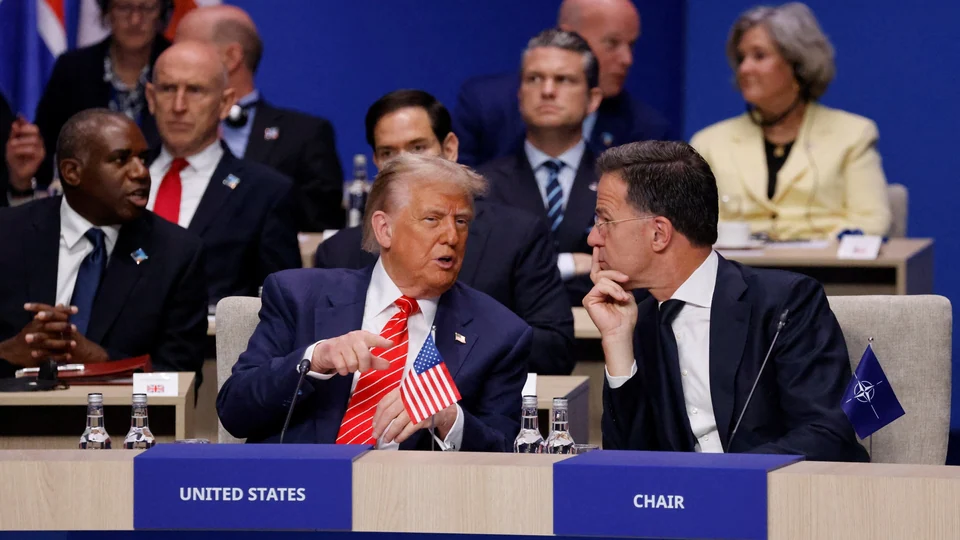
US President Donald Trump and NATO Secretary-General Mark Rutte have called on Russia to avoid any action that could intentionally or unintentionally widen its war against Ukraine, underscoring the need for a diplomatic settlement after their meeting in Florida on Wednesday, November 25, 2026.
The two leaders issued a joint statement following discussions at Trump’s Mar-a-Lago residence, describing the Russia-Ukraine war and the conflict involving Iran as the primary subjects of their meeting. They also discussed expanding defence spending and investment in the defence industrial base in the United States and across NATO member countries.
The meeting took place amid renewed diplomatic activity surrounding the Ukraine conflict and questions over Europe’s role in negotiations led by Washington. It followed Trump’s recent meetings with Russian President Vladimir Putin and Chinese President Xi Jinping during his visit to Asia, where he referred to both leaders as his friends.
Trump’s engagement with Putin has drawn criticism from Democratic opponents in the United States and some European allies, who have pressed for a greater role in any US-backed effort to negotiate an end to the war. Ukrainian President Volodymyr Zelenskyy has also insisted that Europe must be included in discussions affecting Ukraine’s security and future.
What Trump and Mark Rutte Said About Russia and the Ukraine War
The central message of the joint statement was that Russia should avoid actions that could widen the conflict, regardless of whether such actions were deliberate or unintended.
“We also discussed the importance of Russia avoiding any actions that intentionally, or unintentionally, expand the war, and the importance of obtaining a peaceful resolution to the war as rapidly as possible,” the statement said.
The wording reflects concern about the possibility of further escalation beyond the existing battlefield. The conflict has already involved extensive military operations, attacks on infrastructure and significant international security consequences. Any expansion could increase the risks for neighbouring countries and complicate efforts to establish a ceasefire or negotiated settlement.
However, the statement did not announce a new peace initiative, a ceasefire agreement or a specific diplomatic framework. It also did not identify particular Russian actions that Trump and Rutte wanted Moscow to avoid.
Instead, the two leaders reiterated the importance of preventing further escalation and reaching a peaceful resolution quickly. The absence of detailed proposals means the statement should be understood as a diplomatic position rather than evidence that a breakthrough in negotiations has been achieved.
Why the Florida Meeting Matters for NATO and Ukraine
Rutte’s meeting with Trump comes at a sensitive time for NATO, whose members depend on close coordination with Washington for collective defence, military assistance and security planning.
Since Russia launched its full-scale invasion of Ukraine in February 2022, NATO countries have provided military, financial and political support to Kyiv. The alliance has also strengthened its eastern defences and increased its focus on deterrence, military readiness and the security of member states bordering Russia and Belarus.
Trump has repeatedly criticised European allies over their defence spending, arguing that the United States carries an excessive share of the financial burden for NATO’s security. His comments have created uncertainty among some European governments about the long-term nature of American support for the alliance.
Rutte has sought to maintain a working relationship with Trump while encouraging NATO members to increase their defence contributions. His approach has included acknowledging the importance of higher European military spending while emphasising the strategic value of the transatlantic partnership.
The Florida meeting therefore had significance beyond the immediate discussion of Ukraine. It provided an opportunity for the NATO chief and the US president to discuss the alliance’s defence priorities, industrial capacity and the need for continued investment in military capabilities.
Trump and Rutte Discuss Higher Defence Spending Across NATO
According to their joint statement, Trump and Rutte discussed the importance of continuing to expand defence spending and investment in the industrial base in both the United States and NATO countries.
The discussion comes after NATO members agreed at the alliance’s 2025 summit in The Hague to a new long-term defence investment target. Allies committed to moving towards spending 5% of gross domestic product annually on defence and broader security-related requirements by 2035.
The target includes at least 3.5% of GDP for core defence requirements, with a further 1.5% allocated to wider security-related investment, including critical infrastructure, networks, civil preparedness and defence-industrial capacity.
The agreement marked a shift from NATO’s earlier benchmark of 2% of GDP for defence spending. It also reflected growing concerns about Russia’s military activities, the changing security environment and the need for European allies to take greater responsibility for their own defence.
For Trump, increased military investment has been a recurring demand in his dealings with NATO partners. He has argued that European countries should contribute more to the alliance rather than relying heavily on American military resources.
Rutte has supported the push for higher spending, presenting it as necessary to strengthen NATO’s ability to deter threats and respond to security challenges. The Florida statement, however, did not announce any new spending commitments or provide details of additional financial targets agreed during the meeting.
Ukraine Peace Talks: Why Europe Wants a Seat at the Table
One of the major diplomatic questions surrounding the Ukraine war is whether European governments will have a direct role in negotiations involving Washington, Moscow and Kyiv.
European leaders have argued that any agreement affecting Ukraine’s territorial integrity, security arrangements or future relationship with NATO would have consequences for the entire continent. Countries bordering Russia and Ukraine could face particularly significant security implications if a settlement changes the regional balance.
European governments have also contributed substantial military and financial assistance to Ukraine. Their involvement in reconstruction, sanctions policy, humanitarian support and long-term security arrangements gives them a direct interest in the outcome of negotiations.
Trump’s recent engagement with Putin has therefore attracted attention among European allies. While direct communication between the leaders of major powers can be part of diplomatic efforts, European governments have expressed concern about being excluded from discussions that could shape the future of European security.
Ukrainian President Volodymyr Zelenskyy has similarly insisted that Europe must be included in peace negotiations. Kyiv has argued that Ukraine’s future cannot be decided without its participation and that European countries must have a role in any security arrangements that follow a settlement.
The issue is particularly important because a ceasefire alone may not resolve the underlying disagreements over territory, military deployments, security guarantees and Ukraine’s future international alignment.
Any lasting agreement would therefore require decisions that extend beyond stopping active fighting. It would also need to address how Ukraine could protect itself against renewed military action and what role international partners would play in supporting its security.
Trump’s Recent Meeting With Putin and Xi Jinping Adds Diplomatic Context
The Florida talks followed Trump’s recent meetings with Putin and Chinese President Xi Jinping during his trip to Asia. The US president’s description of both leaders as friends attracted attention because of the geopolitical tensions involving Washington, Moscow and Beijing.
Trump’s meeting with Putin generated criticism from Democratic politicians in the United States and concern among European allies. Critics have questioned whether direct engagement with the Russian president could weaken the position of Ukraine or reduce pressure on Moscow during negotiations.
European governments have also sought clarity on the role they would play in any diplomatic process led by the United States. Their concern is that decisions taken without their participation could affect European security arrangements for years.
Rutte has defended the principle of direct engagement between major powers, saying that meetings between leaders of countries possessing large nuclear arsenals are normal. His position reflects NATO’s interest in maintaining communication channels while continuing to support Ukraine’s security.
Diplomatic engagement does not necessarily mean that the parties have reached agreement on the issues dividing them. Discussions between Trump and Putin, for example, do not by themselves establish that Russia has accepted Ukraine’s conditions or that a settlement is close.
The latest joint statement with Rutte also did not indicate that Washington had secured a new commitment from Moscow. It focused instead on the need to prevent the conflict from expanding and to pursue a peaceful resolution.
Iran War Was Also a Primary Subject of the Florida Talks
The Russia-Ukraine conflict was not the only international crisis discussed at Mar-a-Lago. The joint statement identified the US-Israeli war on Iran as another primary subject of the meeting.
However, Trump and Rutte did not disclose what they discussed about Iran, and the statement contained no specific decisions, military commitments or diplomatic proposals related to the conflict.
The inclusion of Iran reflects the wider security challenges facing the United States and its NATO partners. Developments in the Middle East can affect energy markets, maritime security, regional military deployments and the broader strategic priorities of Western governments.
The conflict also intersects with NATO’s wider discussions about defence readiness and burden-sharing. Washington has frequently criticised European allies over what Trump considers inadequate support for the US position on Iran, adding another source of tension to an already complicated transatlantic relationship.
Nevertheless, NATO’s involvement in the Middle East should not be confused with the alliance’s collective-defence commitments. The joint statement did not indicate that NATO as an organisation had agreed to undertake a new military operation against Iran.
Without further details from either side, the exact scope of the Iran discussion remains unclear. The statement only confirms that the conflict featured prominently alongside Ukraine during the meeting.
Mark Rutte’s Balancing Act Between Washington and European Allies
Since becoming NATO secretary-general in October 2024, Rutte has faced the challenge of maintaining unity among allies with different views on defence spending, military assistance to Ukraine and the future of transatlantic security cooperation.
His relationship with Trump has become particularly important because the United States remains NATO’s most powerful military member and a central contributor to the alliance’s defence capabilities.
Rutte has frequently emphasised that European allies need to increase their military spending and strengthen their defence industries. At the same time, he has argued that the United States benefits from NATO because the alliance provides a network of partners, bases and military capabilities that supports American security interests.
His approach has involved acknowledging Trump’s concerns about unequal defence contributions while encouraging Washington to remain engaged in European security.
The Florida meeting continued that effort. By discussing higher defence spending and industrial investment, Rutte and Trump addressed one of the issues that has repeatedly strained relations within the alliance.
However, the broader challenge remains unresolved. European governments want reassurance about America’s long-term commitment to NATO, while the Trump administration continues to demand greater contributions from its allies.
What the Meeting Means for Ukraine’s Security
The joint statement provides a diplomatic signal that Washington and NATO’s leadership remain concerned about preventing further escalation in Ukraine. However, it does not establish a new security guarantee for Kyiv or outline additional military assistance.
For Ukraine, the key issues remain the terms of any potential ceasefire, the status of occupied territories, the protection of its sovereignty and the security arrangements that would prevent another Russian invasion.
European governments are also concerned about the consequences of a settlement that does not provide credible guarantees for Ukraine. They fear that an agreement without effective enforcement mechanisms could leave the country vulnerable to renewed military pressure.
NATO membership remains a sensitive part of the debate. Ukraine has long sought to join the alliance, while Russia has opposed the prospect. Any future settlement would need to address this disagreement alongside the wider question of how Ukraine’s security could be protected.
The Florida statement did not clarify whether Trump and Rutte discussed NATO membership for Ukraine, security guarantees or the possible terms of a ceasefire. It would therefore be premature to interpret the meeting as a change in the alliance’s formal position on Kyiv.
What Happens Next After Trump-Rutte Talks?
The immediate significance of the meeting lies in the shared public position that Russia should avoid actions capable of expanding the war and that a peaceful resolution should be pursued as quickly as possible.
However, translating that position into diplomatic progress will require engagement with Moscow and Kyiv, as well as coordination with European governments that want to participate in negotiations. The question of Ukraine’s future security will remain central to any credible settlement.
For NATO, the discussion on defence spending and industrial investment is likely to remain an important part of its relationship with the Trump administration. The alliance’s ability to strengthen military readiness will depend on whether members convert their spending commitments into additional capabilities, production capacity and operational preparedness.
The Iran conflict adds another layer to the diplomatic picture, although the two leaders have not disclosed what decisions, if any, emerged from their discussion on the Middle East.
For now, the Florida meeting has produced a joint call for restraint from Russia, a renewed emphasis on ending the Ukraine war peacefully and an agreement on the importance of greater defence investment across NATO. It has not, however, announced a new peace framework or resolved the disagreements over Europe’s role in negotiations.
The next phase will depend on whether diplomatic engagement can produce concrete steps towards de-escalation, meaningful participation for Ukraine and European allies, and security arrangements capable of supporting a lasting settlement.
For breaking news and live news updates, like us on Facebook or follow us on Twitter and Instagram. Read more on Latest World on thefoxdaily.com.





COMMENTS 0