Mumbai is a city accustomed to moving at an extraordinary pace. Its railway stations remain crowded late into the night, restaurants serve customers until the early hours and its streets rarely fall completely silent. But on November 26, 2008, the financial capital of India became the centre of one of the deadliest terrorist attacks in the country’s history.
Ten heavily armed terrorists associated with Pakistan-based Lashkar-e-Taiba (LeT) entered Mumbai and launched simultaneous assaults on some of its most prominent public locations. Chhatrapati Shivaji Terminus, Leopold Café, the Taj Mahal Palace Hotel, the Oberoi-Trident complex and Nariman House became scenes of mass violence.
What followed was a nearly three-day battle involving Mumbai Police, the Indian Navy’s Marine Commandos and the National Security Guard (NSG). Hostages were trapped inside buildings, fires engulfed parts of historic hotels and security personnel fought to eliminate the attackers while rescuing civilians.
By the time the operation ended on November 29, nine terrorists had been killed and the tenth, Ajmal Kasab, had been captured. The attacks had claimed 166 lives, including civilians, police officers, security personnel and foreign nationals. More than 300 people were injured.
The 26/11 attacks were not simply an assault on Mumbai’s landmarks. They exposed weaknesses in intelligence coordination, coastal surveillance and emergency response. The consequences extended far beyond the immediate tragedy, reshaping India’s approach to internal security and influencing its relationship with Pakistan for years.
How the 26/11 attackers reached Mumbai
The operation began several days before the first shots were fired. According to the investigation, the ten attackers departed from Karachi, Pakistan, on November 21, 2008, carrying assault rifles, grenades and other weapons.
They travelled by sea towards India’s western coastline. During the journey, they intercepted and hijacked an Indian fishing vessel, killing members of its crew. The attackers kept the boat’s captain alive to navigate them towards Mumbai before killing him as they approached the city.
The use of a hijacked fishing boat helped the attackers reach the Mumbai coastline while avoiding the scrutiny that might have accompanied a direct approach in a more conspicuous vessel. Their arrival demonstrated how India’s long coastline and busy maritime traffic could be exploited by a determined terrorist group.
On the evening of November 26, the attackers reached the city’s waterfront near the Colaba area. They came ashore near Badhwar Park, carrying weapons and ammunition. After reaching land, they split into smaller groups and moved towards their assigned targets.
The division of the attackers into teams allowed several locations to be attacked almost simultaneously. This created confusion for emergency responders and stretched the capacity of Mumbai Police, who initially had limited information about the scale and coordination of the assault.
9:15 pm: Gunfire erupts at Chhatrapati Shivaji Terminus
One of the first major attacks took place at Chhatrapati Shivaji Terminus (CST), now known as Chhatrapati Shivaji Maharaj Terminus. The railway station was crowded with passengers when Ajmal Kasab and his associate Ismail Khan entered and opened fire.
The attackers used automatic weapons against civilians in the station’s main hall and other areas. Passengers who had been waiting for trains or moving through the terminal suddenly found themselves caught in a shooting attack.
People attempted to escape through corridors and exits as gunfire continued. The attack at CST killed at least 58 people and injured more than 100, according to investigative accounts cited in the case.
The station attack became one of the defining images of 26/11 because it targeted an ordinary public space used daily by thousands of commuters. Unlike a military installation or a restricted government facility, CST represented the everyday movement of Mumbai’s population.
Leopold Café and the attacks across South Mumbai
As the violence spread, another group of attackers targeted Leopold Café in Colaba, a popular restaurant frequented by residents and international visitors. The gunmen fired at diners and people inside the establishment, while grenades added to the destruction.
Eleven people were killed in the attack on the café, according to the investigation. The assault also left the restaurant’s premises badly damaged and turned a familiar gathering place into one of the locations associated with the tragedy.
Explosions were also reported in taxis carrying explosive devices. Investigators established that bombs hidden in vehicles detonated in different parts of the city, killing additional people and widening the area affected by the attacks.
Another group targeted Nariman House, a Jewish outreach and community centre in Colaba. The attackers took control of the building and held people hostage. Six people associated with the centre, including members of the Jewish community, were killed during the siege.
The choice of targets reflected the attackers’ intention to strike different parts of Mumbai’s public and international life. A railway station, a popular café, hotels and a Jewish centre were attacked within a short period, creating a crisis that was difficult to contain through conventional policing methods.
The Taj Mahal Palace and Oberoi-Trident become siege locations
Among the most internationally visible targets were the Taj Mahal Palace Hotel and the Oberoi-Trident hotel complex. Both were major hospitality landmarks with Indian and foreign guests, making the attacks particularly consequential beyond Mumbai.
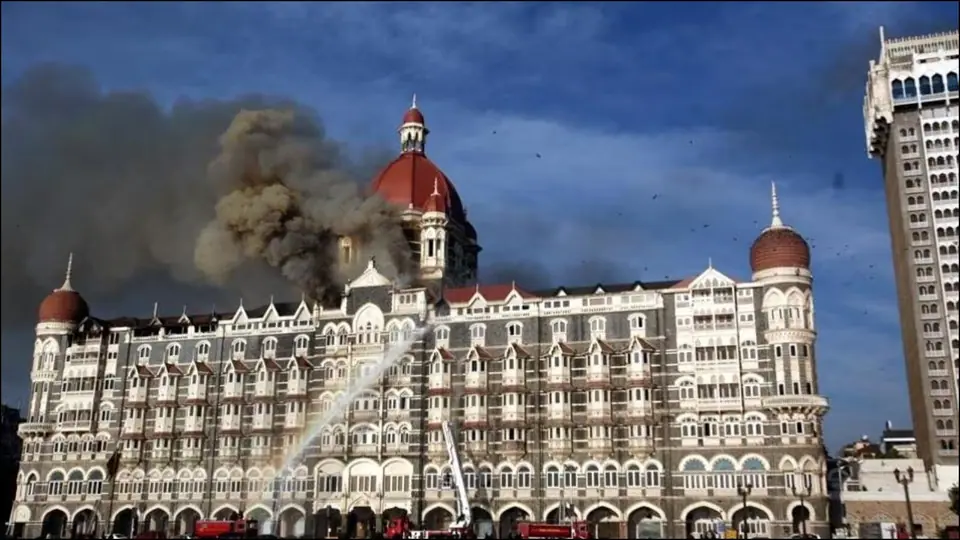
At the Taj Mahal Palace, gunmen entered the building and opened fire on guests and staff. Grenades were also used, while attackers moved through parts of the hotel and held people hostage. The assault turned the historic property into a battlefield.
At around the same time, another group stormed the Oberoi-Trident. Gunmen fired at people inside the complex, used explosives and took hostages. Guests and employees were trapped as security forces attempted to establish control over the building.
The attacks at the two hotels created a prolonged rescue operation. Police and commandos had to distinguish between attackers and civilians, navigate unfamiliar interiors and respond to fires and explosions while trying to prevent further casualties.
The Taj became particularly symbolic of the attack. Its distinctive architecture and central dome were visible in television coverage as flames and smoke rose from the building. Images of the burning hotel were broadcast around the world, bringing the scale of the Mumbai siege into international focus.
Mumbai Police face the first wave of the assault
Mumbai Police were among the first security personnel to respond. Officers rushed towards the affected locations, attempted to evacuate civilians and confronted attackers who were armed with automatic weapons and grenades.
The police response unfolded under extremely difficult conditions. Officers had incomplete information about the number of attackers, their locations and whether the attacks were connected. Multiple incidents were taking place across South Mumbai, making it difficult to deploy personnel effectively.
One of the most consequential encounters involved Kasab and Ismail Khan after they left CST and moved towards Cama and Albless Hospital. Police personnel confronted the attackers, and two officers were killed during the exchange of fire.
The two gunmen later ambushed a police vehicle near the hospital. The attack killed several senior officers, including Mumbai Anti-Terrorism Squad chief Hemant Karkare, Additional Commissioner of Police Ashok Kamte and senior police inspector Vijay Salaskar.
The deaths of these officers were a major loss for the city’s security establishment. Their involvement in the response reflected the danger faced by police personnel who were attempting to stop an attack whose full scale was still emerging.
Ajmal Kasab is captured after a deadly encounter
After the ambush, Kasab and Ismail Khan attempted to escape in a police vehicle. Their movement was intercepted by another police team near Girgaum Chowpatty.
During the encounter, Khan was killed. Police officer Tukaram Omble confronted Kasab at close range and attempted to overpower him despite being under fire. Omble was fatally wounded, but his actions helped other officers capture Kasab alive.
Kasab’s arrest proved crucial to the investigation. Unlike the other attackers, who were killed during security operations, he could be questioned and tried in an Indian court. His testimony and the evidence gathered during the investigation helped establish details of the attack, including the attackers’ training, journey and links to Lashkar-e-Taiba.
Kasab was convicted for his role in the attacks and sentenced to death. After the completion of the legal process, he was executed at Yerwada Central Jail in Pune on November 21, 2012.
Operation Black Tornado: NSG commandos take charge
As the attacks continued, the scale of the crisis made it necessary to bring in specialised counter-terrorism forces. The Indian Navy’s Marine Commandos were among the first specialised units to enter the affected hotel premises.
NSG commandos were flown from Delhi to Mumbai on November 27. Their deployment marked the beginning of the major phase of the counter-terrorism operation, which became known as Operation Black Tornado.
The NSG teams were tasked with clearing the Taj Mahal Palace, Oberoi-Trident and Nariman House, locating the attackers and rescuing hostages. The operation required commandos to move through buildings where civilians remained trapped and where attackers had established firing positions.
The challenge was not simply to eliminate the gunmen. Security forces also had to minimise the danger to hostages, identify explosives and deal with fires and structural damage caused by the attacks.
November 28: Oberoi-Trident and Nariman House are cleared
On November 28, NSG commandos completed operations at the Oberoi-Trident complex, rescuing hostages and killing the attackers inside. The clearance of the hotel ended one of the longest and most dangerous phases of the siege.
Security forces also moved against the attackers at Nariman House. Commandos used a helicopter-assisted operation to reach the building’s rooftop and enter the premises. The operation ended with the attackers killed, but six people held at the Jewish centre had already lost their lives.
November 29: The Taj siege finally ends
The Taj Mahal Palace remained the last major location under attack. Commandos continued searching the building as fires, explosions and gunfire complicated the operation.
On the morning of November 29, security forces announced that the operation at the Taj had been completed. The remaining attackers were killed, bringing the nearly 60-hour siege to an end.
Parts of the historic hotel had been damaged by fire and explosions. Around 36 people were killed in the attack at the Taj, according to the figures cited in the source account. The destruction became a lasting reminder of the violence inflicted on the city.
26/11 death toll: 166 people killed, more than 300 injured
The final human cost of the attacks was devastating. A total of 166 people were killed, while more than 300 others were injured. The victims included Indian citizens, foreign nationals, hotel guests, railway passengers, restaurant visitors and members of the security forces.
Twenty security personnel were among those killed, including police officers who confronted the attackers and personnel involved in the response. The deaths of senior officers and other first responders highlighted the risks faced by those who moved towards danger while civilians tried to escape.
The loss of 26 foreign nationals also gave the attacks an international dimension. Several countries had citizens among the victims, and the targeting of hotels and a Jewish centre raised concerns about the wider implications of the assault.
Behind the national casualty figures were individual families who lost relatives, survivors who suffered physical and psychological trauma, and communities whose sense of security was permanently altered.
How 26/11 changed India’s counter-terrorism system
The attacks exposed serious weaknesses in India’s ability to detect and respond to a coordinated terrorist operation. The attackers’ sea route, the time taken to bring specialised forces to Mumbai and the challenges faced by police highlighted gaps that required institutional attention.
In the aftermath, the government introduced changes to the country’s counter-terrorism framework, intelligence-sharing arrangements and maritime security system. The objective was to improve the ability of central and state agencies to identify threats, coordinate responses and prevent another attack of similar scale.
National Investigation Agency was established
One of the most important institutional changes was the creation of the National Investigation Agency (NIA). Parliament passed the National Investigation Agency Act in December 2008, and the agency was established as India’s central counter-terrorism investigation body.
The NIA was designed to investigate offences related to terrorism and other threats to national security that fall within its statutory mandate. Its creation addressed the need for a specialised central agency capable of investigating serious terror cases with national and international dimensions.
The agency’s establishment also reflected a broader recognition that complex terrorist attacks could not always be investigated effectively through fragmented state-level processes alone.
Coastal security received greater attention
The attackers’ arrival by sea exposed vulnerabilities in coastal surveillance and coordination. In response, India strengthened maritime security arrangements involving the Indian Navy, Coast Guard, marine police and other agencies.
Measures included expanding coastal surveillance, improving coordination between maritime agencies, strengthening monitoring of fishing vessels and developing systems to identify suspicious movements near the coastline.
The attacks also reinforced the importance of maintaining reliable information about vessels operating in coastal waters. India’s coastline is extensive, and monitoring it requires cooperation between central security agencies, state authorities, port officials and fishing communities.
Intelligence coordination and emergency response were strengthened
The attacks highlighted the importance of sharing intelligence quickly between agencies. Information about suspicious activity can lose value if it is not communicated to the authorities responsible for acting on it.
India subsequently strengthened intelligence coordination and established mechanisms intended to improve the flow of information between central and state-level agencies. The Multi Agency Centre also received greater attention as part of efforts to facilitate intelligence sharing.
Specialised counter-terrorism capabilities, police training and emergency preparedness also became important areas of focus. The experience of 26/11 demonstrated that local police forces need appropriate equipment, communication systems and training to respond to heavily armed attackers before specialised units arrive.
How the attacks affected India-Pakistan relations
The 26/11 attacks placed India-Pakistan relations under severe strain. Investigations established that the attackers belonged to Lashkar-e-Taiba, a Pakistan-based terrorist organisation. India presented evidence linking the operation to handlers and planners based in Pakistan and sought action against those responsible.
Pakistan initially faced international pressure over the evidence and the involvement of individuals operating from its territory. The case became a major issue in diplomatic discussions between the two countries and complicated efforts to restore normal relations.
Although Pakistan took some legal steps against individuals accused in connection with the attacks, India repeatedly raised concerns about the pace and effectiveness of prosecutions. The question of accountability for the planners and handlers has remained a central issue in the aftermath of 26/11.
The attacks also demonstrated how terrorism can affect relations between two nuclear-armed neighbours. India faced pressure to respond to the assault while weighing the risks of military escalation and the need to build an internationally recognised evidentiary case.
Why the 26/11 attacks remain relevant today
Nearly two decades after the attacks, 26/11 remains a defining moment in India’s national security history. Its significance lies not only in the number of people killed but also in the methods used by the attackers and the institutional weaknesses the operation exposed.
The attack demonstrated how a small, organised group could exploit multiple vulnerabilities to create a national crisis. It showed the importance of protecting crowded public spaces, monitoring maritime routes, sharing intelligence and ensuring that emergency responders can act quickly when several incidents occur simultaneously.
It also underlined the importance of international cooperation against terrorist networks. The planning, training, financing and execution of a cross-border operation can involve individuals and infrastructure spread across different jurisdictions. Investigating such attacks therefore requires cooperation that extends beyond national borders.
For Mumbai, the memory of 26/11 is preserved through memorials, annual tributes and the stories of those who survived or lost loved ones. The Taj Mahal Palace, CST and other affected locations continue to carry the history of the attacks, while the names of victims and security personnel remain central to remembrance.
26/11: A tragedy that reshaped Mumbai and India
Ten terrorists, nearly 60 hours of violence and 166 deaths made the November 2008 attacks one of the darkest chapters in India’s history. The assault on Mumbai was designed to create fear, disrupt daily life and draw international attention through simultaneous attacks on civilians and prominent landmarks.
But the response also revealed the courage of police officers, commandos, hotel employees, railway staff, medical workers and ordinary citizens who helped people escape or confronted danger. Their actions became an enduring part of the story of 26/11.
The attacks forced India to reassess its security preparedness and build stronger institutions, including the National Investigation Agency, while placing coastal defence and intelligence coordination higher on the national agenda.
The passage of time has not erased the loss suffered by the victims’ families or the survivors. The 26/11 attacks remain a reminder that counter-terrorism is not only about responding after violence begins. It also depends on intelligence, prevention, preparedness and accountability. For Mumbai, November 26 will always be remembered as the night the city was attacked, and the days when its people endured one of the most difficult tests in its history.
For breaking news and live news updates, like us on Facebook or follow us on Twitter and Instagram. Read more on Latest India on thefoxdaily.com.


COMMENTS 0